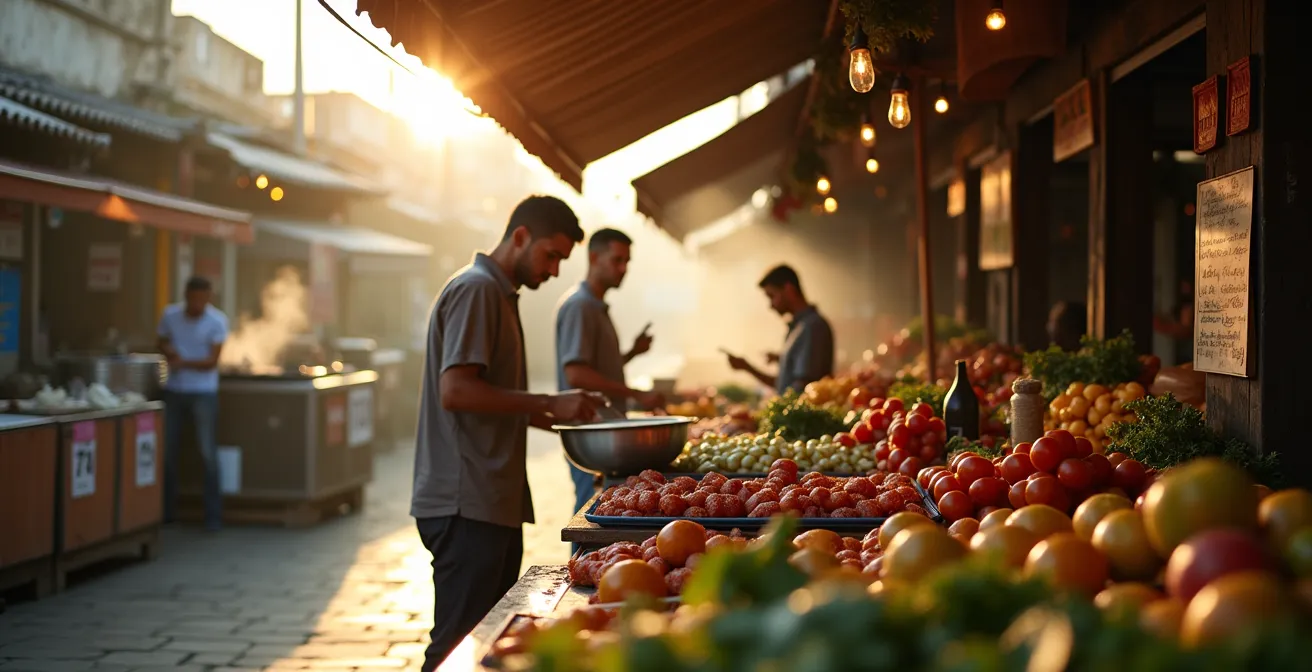
Finding authentic food isn’t about avoiding tourist areas; it’s about learning to read the ‘culinary grammar’ of a dish itself.
- Authenticity is revealed in a dish’s flavor DNA (fat, acid, umami), not just its price or location.
- Human connections—from local guides to market vendors—provide access that no online platform can replicate.
Recommendation: Treat every meal as a field study: analyze its components, understand its economic context, and ask about its history.
Every seasoned traveler knows the feeling: a deep-seated disappointment after a meal that promised authentic local flavor but delivered a bland, generic imitation. You followed the common advice—you avoided the main square, you steered clear of glossy picture menus—and yet, you still feel like you’ve been had. Research shows that over 70% of travelers experience this letdown in heavily touristed areas, a clear sign that our current methods for sniffing out authenticity are failing us.
The conventional wisdom tells us to look for external cues: crowded restaurants, menus in the local language, or high ratings on travel apps. While these can be helpful, they only scratch the surface. They treat the search for authentic food like a scavenger hunt for locations, rather than an exercise in cultural understanding. This approach overlooks the most important piece of evidence available to us: the food itself.
But what if the key wasn’t about finding the right place, but about learning to read the language of the plate? This guide proposes a shift in perspective. Instead of just being a consumer, you will become a culinary anthropologist. We will explore the idea that every dish has a “culinary grammar”—a set of rules, a history, and a structure that tells a story about its people and place. By understanding this grammar, you can learn to distinguish a dish with deep cultural roots from one designed purely for the uninitiated tourist palate.
This journey will equip you with the tools to decode complex flavors, understand the cultural significance of recipes, and see how a region’s economy and history are served on your plate. We will move beyond the superficial to a deeper, more rewarding connection with the places you visit, one bite at a time.
As a culinary anthropologist, I believe understanding a culture also means appreciating its unexpected artifacts and shared humor. The following video is one such classic, a perfect palate cleanser before we dive deep into our main course.
text
To navigate this anthropological journey, this article is structured to build your skills progressively. We will begin by understanding the cultural soul of a recipe, then move to practical sensory analysis, and finally explore the broader ecosystem of a local food scene.
Summary: A Culinary Anthropologist’s Field Guide to Authentic Cuisine
- Why modifying a traditional recipe is considered an insult in some cultures?
- How to identify the flavor notes in complex regional dishes?
- Street Food vs Michelin Star: where lies the true heart of a city’s cuisine?
- The raw food risk that ruins vacations in tropical climates
- When to reserve for high-demand restaurants to guarantee a seat?
- Why a travel agent can get upgrades that Booking.com cannot?
- Artisan vs Mass-produced: spotting the “handmade” marketing lie
- Eco-lodge vs Chain Hotel: which actually supports the local economy?
Why modifying a traditional recipe is considered an insult in some cultures?
To a culinary anthropologist, a traditional recipe is more than a list of ingredients; it’s a historical document, a repository of collective memory passed down through generations. Modifying it isn’t just a culinary choice—it can be seen as rewriting history or disrespecting the identity of a community. This concept of recipe integrity is central to understanding food authenticity. When a dish is altered to cater to foreign palates—often by dulling spice, adding sugar, or substituting key ingredients—it loses its “flavor DNA” and becomes a caricature of itself.
This dilution is often driven by market demand from tourists who expect a familiar version of an “exotic” dish. The result is the creation and proliferation of inauthentic food that ultimately misrepresents a culture’s culinary heritage. The dish no longer tells the story of its origin; it tells the story of tourism’s impact.
Case Study: The “Spaghetti Bolognese” Myth
A prime example comes from Bologna, Italy. Many tourists arrive seeking “Spaghetti Bolognese,” a dish famous worldwide. However, as authentic cooking classes in the region reveal, this dish doesn’t exist in traditional Italian cuisine. The authentic local preparation is Tagliatelle al ragù, made with fresh, wide egg pasta designed to hold a rich, slow-cooked meat sauce. The global popularity of a non-existent spaghetti version demonstrates how tourist expectations can invent and codify an inauthentic dish, erasing the true cultural artifact it claims to represent.
Therefore, seeking authentic food begins with respecting that some recipes are not meant to be changed. They are anchors of cultural identity. Understanding this principle shifts the traveler’s mindset from demanding food that suits their taste to seeking food that teaches them about another’s.
How to identify the flavor notes in complex regional dishes?
Once you appreciate the importance of recipe integrity, the next skill is to learn the language of the plate through sensory forensics. This involves deconstructing a dish not just by taste, but by identifying its foundational components. Every authentic regional cuisine has a distinct “culinary grammar,” a unique combination of fats, acids, and flavor bases that define its character. Learning to spot these elements is like learning the key phonetics of a new language; it allows you to understand the conversation happening in the dish.
Instead of just asking “is it good?”, ask “what is the story here?” Is the foundational fat lard (suggesting a history of agricultural thrift) or clarified butter (pointing to pastoral traditions)? Is the sour note from citrus, vinegar, or fermentation (each telling a different story of preservation and climate)? This analytical approach moves you beyond a passive taster to an active investigator of flavor.
This close examination of ingredients is where the soul of a dish reveals itself. The texture of hand-ground spices, the aroma from a specific cooking wood, or the deep umami from a locally fermented product are details mass-produced food cannot replicate.
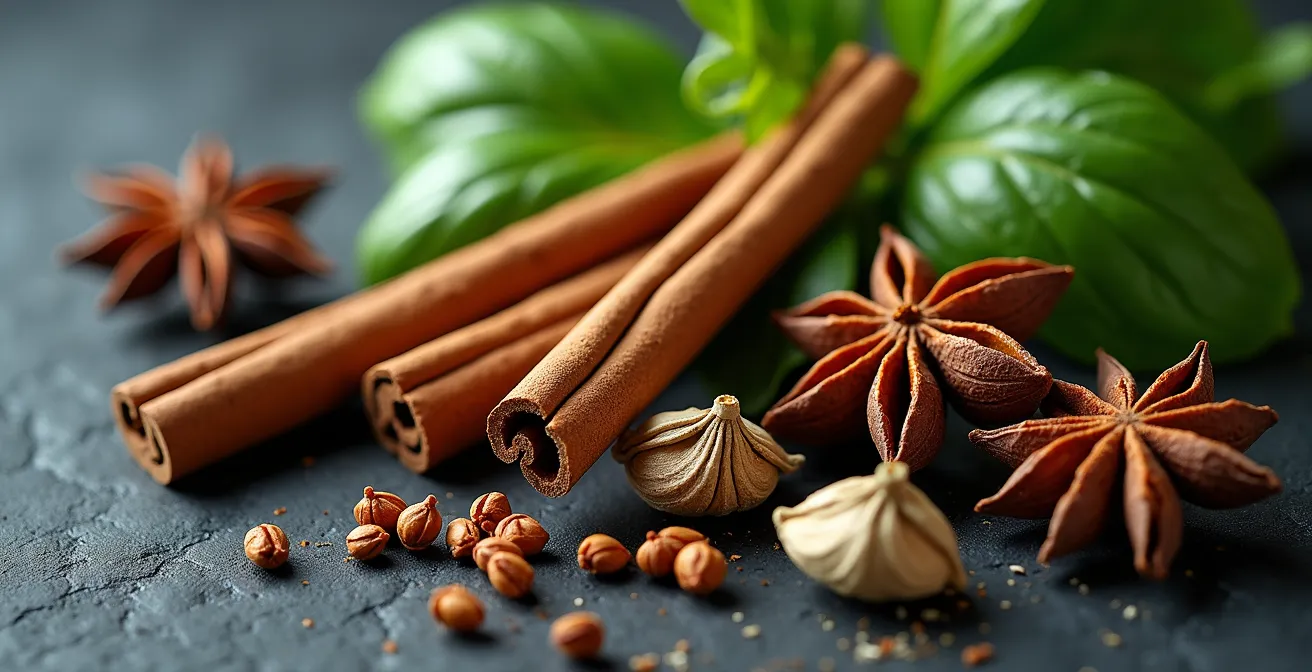
As the image above illustrates, authentic flavor is built from real, tangible components. To systemize this analysis, you can use a simple framework to decode any dish you encounter, turning every meal into a field study.
- Step 1: Identify the primary fat source. Lard, olive oil, ghee, or butter forms the dish’s foundation and speaks to its agricultural roots.
- Step 2: Detect the acidic element. Citrus, vinegar, tamarind, or fermented ingredients provide balance and are often tied to local preservation methods.
- Step 3: Locate the source of umami. Fermented fish sauce, aged cheese, cured meats, or mushrooms provide depth and are hallmarks of regional identity.
- Step 4: Distinguish cooking method impact. The subtle notes of charcoal smoke, the char from a gas flame, or the richness from slow simmering are all part of the flavor profile.
- Step 5: Recognize time as a flavor component. Appreciate the depth from aged ingredients, fermentation, or a long-simmered stock.
Street Food vs Michelin Star: where lies the true heart of a city’s cuisine?
The debate between street stalls and fine dining is often framed as a simple binary: gritty authenticity versus sterile innovation. A culinary anthropologist, however, sees them as two essential dialects of the same city’s food language. The true heart of a cuisine doesn’t lie in one or the other, but in understanding the distinct role each plays in the economic terroir and cultural ecosystem. Street food often represents the daily sustenance of the working class, with recipes unchanged for generations, perfected through repetition and constrained by affordability.
A Michelin-starred restaurant, on the other hand, can act as a culinary ambassador, elevating traditional flavors using modern techniques and premium ingredients. Its authenticity lies not in preservation, but in thoughtful interpretation. The key is to discern intent. As James Beard semifinalist chef Hector Santiago notes, a tourist trap is a place that “makes what they assume a traveler would want… rather than making a delicious version that has their spin on it.”
To me, it’s a place that makes what they assume a traveler would want… rather than making a delicious version that has their spin on it
– Hector Santiago, James Beard semifinalist chef, quoted in HuffPost
An authentic high-end restaurant engages in a dialogue with tradition, while a tourist trap simply mimics it poorly. Both street food and fine dining can be authentic or inauthentic. The deciding factor is their connection to the local supply chain, their patronage by locals (for daily meals or special occasions), and their role in the community’s life.
This table breaks down the signals of authenticity you can look for in both contexts, helping you understand where each fits within a city’s culinary landscape.
| Aspect | Street Food | Michelin Restaurant | Authenticity Signal |
|---|---|---|---|
| Local Patronage | 60-80% locals daily | Mixed tourists/locals for occasions | Daily local presence = higher authenticity |
| Price Point | Accessible to working class | Special occasion pricing | Democratic access preserves tradition |
| Recipe Evolution | Unchanged for generations | Chef interpretation/innovation | Both valid: preservation vs elevation |
| Supply Chain | Local markets, daily fresh | Premium suppliers, often same sources | Shared local suppliers = authenticity |
| Cultural Role | Daily sustenance | Culinary ambassadorship | Both essential to food ecosystem |
The raw food risk that ruins vacations in tropical climates
For many travelers, especially in tropical climates, the fear of foodborne illness creates a barrier to trying authentic local dishes, particularly raw preparations or street food. This fear often drives them toward “safe” but sterile tourist restaurants, sacrificing cultural experience for perceived safety. However, an anthropological perspective reveals a more nuanced reality: traditional cuisines often have sophisticated, time-tested food safety methods built directly into their recipes.
Before the advent of modern refrigeration, cultures developed ingenious ways to control pathogens. These techniques are integral to the dish’s flavor and are a testament to generations of culinary wisdom. Understanding these methods can help a traveler assess risk more accurately and embrace local food with confidence.
Case Study: Traditional Antimicrobial Preservation
Many traditional ‘raw’ foods are safer than they appear due to embedded preservation techniques. For example, Korean kimchi uses fermentation to cultivate protective bacteria that inhibit harmful pathogens. Peruvian ceviche leverages the high acidity of citrus juice (denaturation) to effectively ‘cook’ raw fish, making it safe to eat. Similarly, many Indian dishes employ a powerful arsenal of antimicrobial spices like turmeric, cloves, and cinnamon, which were historically crucial for preserving food in a hot climate.
This doesn’t mean ignoring all risks. Rather, it means shifting from a blanket fear of the unknown to a more informed observation. Instead of avoiding all street food, become a “hygiene detective.” Look for empirical signs of food safety: high customer turnover (indicating fresh ingredients), separation of raw and cooked foods, and vendors who handle money and food with different hands or utensils.
Your Hygiene Detective Checklist: 5 Points to Verify
- Food Separation: Check for clear separation between raw meat and ready-to-eat ingredients on the prep surfaces.
- Handling Practices: Observe if vendors use different utensils or gloves for handling money versus food.
- Cleanliness Cues: Notice the smell. A faint scent of clean bleach or soap indicates active sanitation, while old, stale grease suggests poor hygiene.
- Temperature Control: Look for visible signs of refrigeration for perishable items or ensure that hot food is kept steaming hot on the grill or in the pot.
- Hand Washing: A visible hand-washing station with soap that is actively used by the staff is one of the strongest indicators of good food safety practices.
When to reserve for high-demand restaurants to guarantee a seat?
Part of eating like a local is dining on their schedule, not a tourist’s. In many cultures, dinner starts much later, and popular establishments are booked days or weeks in advance by a discerning local clientele. Relying on walk-ins, especially during peak tourist mealtimes (like 6:30 PM in Spain or Italy), is a surefire way to be funneled into second-rate restaurants that cater to the unprepared. Strategic reservation planning is therefore a crucial tool for accessing authentic culinary experiences, and statistics show that 85% of travelers who adapt to local dining schedules report better overall experiences.
However, not all authentic restaurants operate on the same reservation system. A tiny, 8-seat omakase counter in Tokyo requires a different strategy than a bustling worker’s trattoria in Rome or a legendary street food stall in Bangkok. Understanding the typology of the restaurant is key to securing a seat. The “fully booked” sign is often not the end of the story; it’s a filter that separates those in the know from the casual passerby.
A phone call in the local language, an inquiry about bar seating, or knowing the right time to show up for a second dinner service can often open doors that online platforms show as closed. The right strategy demonstrates respect for the establishment’s rhythm and culture.
The following matrix provides a framework for navigating the reservation landscape, based on restaurant type. It’s a practical guide to moving from hopeful tourist to strategic diner.
| Restaurant Type | Booking Window | Best Strategy | Alternative Access |
|---|---|---|---|
| Omakase Counter | 1-2 months ahead | Online reservation systems | Bar seating for walk-ins |
| Trendy Neo-Bistro | 1-2 weeks ahead | Call directly | Early (5:30pm) or late (9:30pm) slots |
| Local Institution | Day before/morning of | Phone call in local language | Weekday lunch service |
| Worker’s Trattoria | No reservations | Arrive before noon or after 2pm | Take-away option |
| Street Food Legend | Cannot reserve | Arrive 30 min before opening | Off-peak days (Tuesday-Thursday) |
Why a travel agent can get upgrades that Booking.com cannot?
In an age dominated by algorithms and booking platforms, we’ve been conditioned to believe that technology provides the most efficient access to everything. However, when it comes to truly exceptional and authentic experiences, the human network remains an unparalleled asset. This principle, often seen with travel agents securing hotel upgrades through personal relationships, applies even more profoundly to culinary exploration. An online search can find a restaurant; a human connection can get you a seat at the chef’s favorite table.
These human connections are built on trust and reciprocity over years, something a digital platform cannot replicate. A local food guide, a knowledgeable hotel concierge, or even a chatty taxi driver possesses a mental map of the city’s culinary scene that is layered with social context. They know which chef just launched an exciting new menu, which market stall has the best seasonal produce, and which “fully booked” restaurant saves a table for regulars and friends.
Case Study: The Human Network Advantage in Florence
In Florence, local food tour guides demonstrate the power of this human network daily. While tourists armed with apps line up at well-known sandwich shops, a guide like Lorenzo can lead his group to a small, unmarked stall in the Sant’Ambrogio Market. His long-standing relationship with the vendor means his group gets sandwiches made with prized ingredients not offered to the general public, at a local’s price. Later, a simple phone call from him can secure a table at a trattoria that has been turning away walk-ins all evening, all because he is a trusted, familiar face.
The most valuable travel tool, therefore, is often simple curiosity and the willingness to engage with people. As Chelsea Dickenson, founder of Cheap Holiday Expert, advises, building your own human network is key.
I love asking my taxi drivers, the hotel staff, and even people I meet out and about what their favorite place is that they’d visit with friends
– Chelsea Dickenson, Founder of Cheap Holiday Expert
Artisan vs Mass-produced: spotting the “handmade” marketing lie
The term “artisan” or “handmade” has become a powerful marketing buzzword, often used to bestow a false sense of authenticity on mass-produced goods. In any market or bakery, from Provence to Peru, you’ll find products that look the part but lack the soul of true craftsmanship. Spotting this marketing lie requires the traveler to develop an eye for the subtle but telling signs of genuine production versus industrial imitation. True artisan work is defined by its perfect imperfections.
A truly handmade loaf of bread will have an irregular crumb structure, with holes of varying sizes. A batch of hand-pinched dumplings will show slight variations in shape and size. Mass-produced items, by contrast, are defined by their uniformity. They are engineered for consistency, which is the very antithesis of artisanal work. Your senses are your best tool for verification. Look for flour dust on the floor, listen for the sound of a dough mixer, and smell for the scent of yeast and baking, not just reheating.
This verification is crucial because choosing artisan products is not just about taste; it’s an economic act that supports local skills and suppliers. As local surveys indicate that 70% of locals recommend these small, off-path establishments, finding them is key to an authentic experience. The following techniques can help you distinguish the real deal from a convincing fake.
- Examine product consistency: True artisan items always show slight variations, while mass-produced goods are perfectly identical.
- Look for production evidence: An authentic bakery will have flour dust, mixing equipment, and prep areas visible to the discerning eye.
- Check the crumb structure: Artisan bread has irregular, airy holes, whereas industrial bread often has a dense, uniform texture.
- Test the daily variation: A true artisan’s products can vary slightly from day to day depending on humidity, temperature, and ingredient batches.
- Observe the workspace: Authentic producers show signs of active, on-site production, not just baking off pre-made or frozen items.
- Analyze menu stability: A genuine artisan establishment will often change its offerings based on the availability of fresh, seasonal ingredients.
Key takeaways
- Recipe integrity is paramount; authentic dishes tell a cultural story that shouldn’t be altered for tourist palates.
- Learning to decode a dish’s “culinary grammar”—its core fats, acids, and umami—is the key to identifying authenticity.
- Human networks and local relationships provide access to culinary experiences that algorithms and booking platforms cannot find.
Eco-lodge vs Chain Hotel: which actually supports the local economy?
As conscious travelers, many of us choose accommodation like eco-lodges over large chain hotels, believing our money is better directed toward the local economy. However, the term “eco” can be as misleading as “artisan.” The true measure of an establishment’s commitment to its community is not in its marketing materials, but in its supply chain. And nowhere is this more evident than at the breakfast buffet.
The breakfast buffet serves as a perfect litmus test for local economic support. An authentic eco-lodge or a locally-owned hotel proud of its heritage will feature regional breads, cheeses from a nearby dairy, honey from a local apiary, and traditional breakfast dishes made with seasonal ingredients. Their menu is a map of the local food-shed. In contrast, many establishments—even those branding themselves as “green” or “local”—serve a generic international breakfast of croissants, corn flakes, and UHT milk, all sourced from large, multinational distributors. This reveals a clear disconnect between their marketing and their actual economic impact.
Case Study: The Breakfast Buffet Sourcing Test
An analysis of hotel breakfasts reveals everything about their local commitment. A genuine eco-lodge in Costa Rica might serve gallo pinto made with locally grown rice and beans, alongside tropical fruits from a neighboring farm. A chain hotel next door, despite a leafy green logo, may offer the same breakfast assortment you’d find in Chicago or Frankfurt. By observing what is—and isn’t—on the buffet, you can directly see whether the hotel is investing in local farmers and producers or simply funneling revenue back out to global corporations.
This principle extends to every meal and every purchase. As Executive Pastry Chef Claudia Martinez puts it, the choice is a conscious one about where your money goes. It’s about ensuring your travel dollars empower the very culture you’ve come to experience.
I want to make sure my money is being spent on people who work hard to put out their local cuisine — not mass-market corporations or tourist traps that purchase food that’s already made
– Claudia Martinez, Executive Pastry Chef and James Beard Semifinalist
Ultimately, distinguishing authentic cuisine from its tourist-trap imitation is an active, intellectual, and sensory pursuit. It requires you to move beyond being a passive consumer and to become an engaged anthropologist in the field. By learning the grammar of food, valuing human connection, and observing the economic realities behind your plate, you transform your travels from a series of meals into a profound cultural dialogue. Begin today by applying this mindset to your own local market or next travel destination.