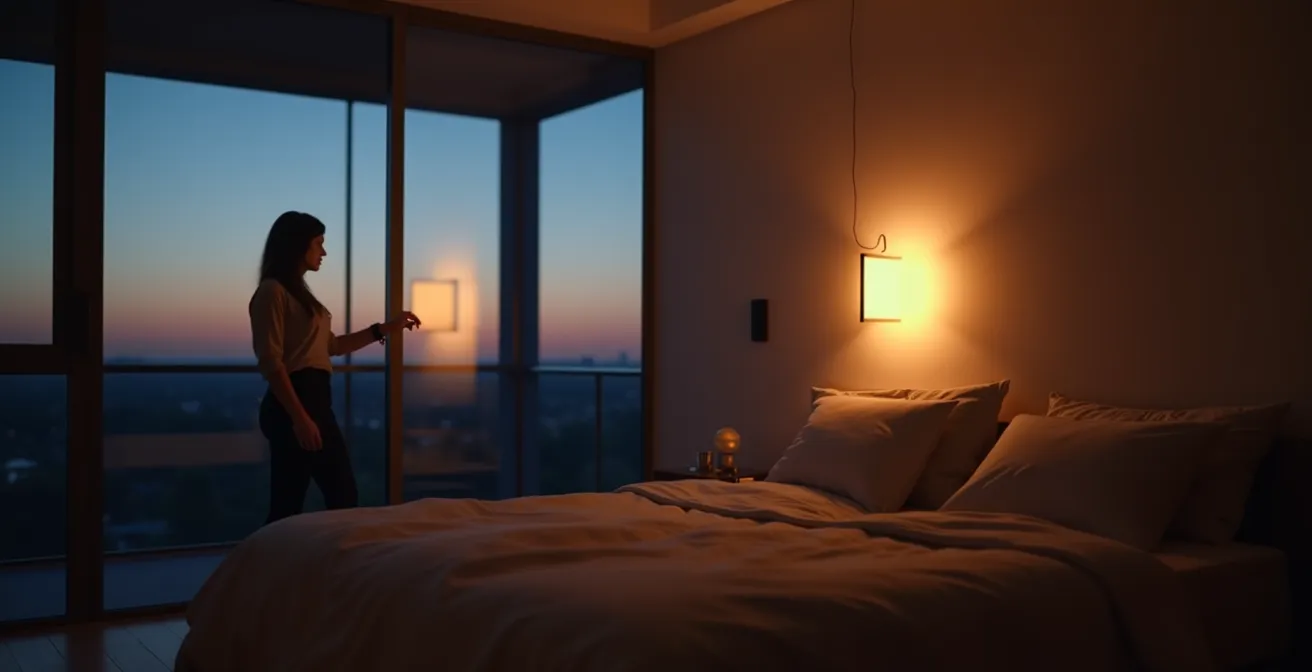
The key to mastering your sleep-wake cycle isn’t just avoiding ‘bad’ light; it’s actively engineering your environment to deliver the right spectral signal at the right time.
- Light acts as a biological signal, with color temperature (Kelvin), intensity (lux), and timing dictating its effect on melatonin and cortisol.
- High-quality, full-spectrum LEDs with a high Color Rendering Index (CRI >95) are critical tools, as cheap “warm” bulbs often hide a disruptive blue light spike.
Recommendation: Begin by auditing your evening light exposure, especially in the bathroom, and implementing a strict natural light protocol in the morning to anchor your internal clock.
For years, the advice for better sleep has been deceptively simple: get morning sun and avoid screens at night. For the health-conscious individual, this feels incomplete. You’ve swapped your bulbs for “warm white” versions and enabled night mode on all your devices, yet you still struggle to achieve consistent, high-quality sleep. This is because we’ve been treating light as a simple on/off switch, a nuisance to be avoided rather than a powerful tool to be precisely controlled.
The common approach focuses on passive avoidance. But what if the true breakthrough lies in active management? The real problem isn’t just the presence of light, but its specific composition—its spectrum, intensity, and timing. The generic advice to use warm light, for example, often overlooks the hidden blue light spikes present in low-quality LEDs, which continue to send a ‘daytime’ signal to your brain. It’s time to move beyond basic sleep hygiene and into the realm of circadian engineering.
This guide reframes the problem. We will not offer vague tips. Instead, we will provide a set of engineering principles and actionable protocols to architect a home lighting environment that gives you direct control over your biology. We’ll treat light as the powerful biological signal it is, with a specific dose, spectrum, and timing. This is about designing a system, not just following a rule.
By understanding and implementing these targeted strategies, you can transform your home from a source of circadian disruption into a finely tuned machine for optimal health, focus, and recovery. This article will walk you through the essential design principles, from deconstructing the damage done by common bathroom lighting to engineering a bedroom for maximum sleep efficiency.
Summary: An Engineer’s Guide to Circadian Lighting: How to Program Your Sleep-Wake Cycle
- Why 6000K light in the bathroom destroys your melatonin production?
- How to eliminate shadows in the kitchen workspace effectively?
- Warm White vs Cool White: where to use each for maximum focus?
- The hidden blue spike in “warm” cheap LEDs that hurts your eyes
- When to trigger the “sunset” mode in your smart home system?
- How to reset your internal clock using natural light protocols?
- When will your solar panels actually break even without subsidies?
- How to engineer your bedroom for maximum REM efficiency?
Why 6000K light in the bathroom destroys your melatonin production?
The bright, sterile light common in modern bathrooms is a primary culprit in circadian disruption. A typical 6000K “cool white” bulb emits a powerful spike in the blue portion of the light spectrum, mimicking the light of midday sun. When your eyes are exposed to this light in the evening, your brain receives a strong “wake up” signal. This directly interferes with the suprachiasmatic nucleus (SCN), your body’s master clock, which in turn signals the pineal gland to halt the production of melatonin, the crucial hormone that initiates sleep.
The effect is not trivial. The intensity and spectrum of this light are potent biological triggers. In fact, Harvard research demonstrates that blue light can suppress melatonin for about three hours, compared to just 90 minutes for green light of comparable brightness. That single late-night trip to a brightly lit bathroom can effectively delay your natural sleep onset by hours, fragmenting your sleep architecture and reducing the restorative quality of your rest. This isn’t just about feeling tired; it’s about actively misaligning your internal biology.
The goal is to eliminate this accidental daytime signal. This requires replacing high-Kelvin bulbs with warm alternatives (around 2700K) for evening use and, more importantly, reducing the overall intensity (lux) of the light. The solution is a dual-lighting system: bright, high-quality light for the morning routine and an ultra-dim, warm, or even red-light source for any use within three hours of bedtime. This is the first and most critical step in engineering a pro-sleep environment.
Action Plan: Your Bathroom Light Audit
- Measure Your Light: Download a free lux meter app on your smartphone to get a baseline reading of your current lighting.
- Test at Eye Level: At night, stand where you normally would and measure the light intensity at eye level. This is the signal your brain is receiving.
- Check Against Threshold: Compare your reading to the scientifically established disruption threshold. Any reading above 8 lux has been shown to affect melatonin production.
- Install Navigational Lighting: For safe nighttime use, install motion-activated red LED strips along the floor or under the vanity. These should provide less than 10 lux and lack the blue spectrum.
- Replace Evening Bulbs: Swap out any bulbs over 3000K with high-quality, dimmable 2700K alternatives for any tasks you must perform in the evening.
How to eliminate shadows in the kitchen workspace effectively?
In the kitchen, the quality of light is not just about mood; it’s about safety and function. A single, central ceiling fixture is a common design flaw that creates significant problems. When you stand at the counter, your own body blocks the light, casting your workspace and sharp implements into shadow. This forces your eyes to strain and increases the risk of accidents. Effective kitchen lighting design is not about one powerful light, but about creating multiple layers of light to eliminate shadows and render colors accurately.
The solution is a three-layer approach: ambient, task, and accent lighting. Ambient light provides the overall, general illumination for the room, often from recessed ceiling lights or a central fixture. Task lighting is the most critical layer for workspaces; it’s directed light focused specifically on countertops, the sink, and the stove. Under-cabinet LED strips are the gold standard for this, as they illuminate the entire work surface from the front, erasing any shadows your body might cast. Finally, accent lighting adds depth and visual interest, perhaps by highlighting a textured backsplash or artwork.
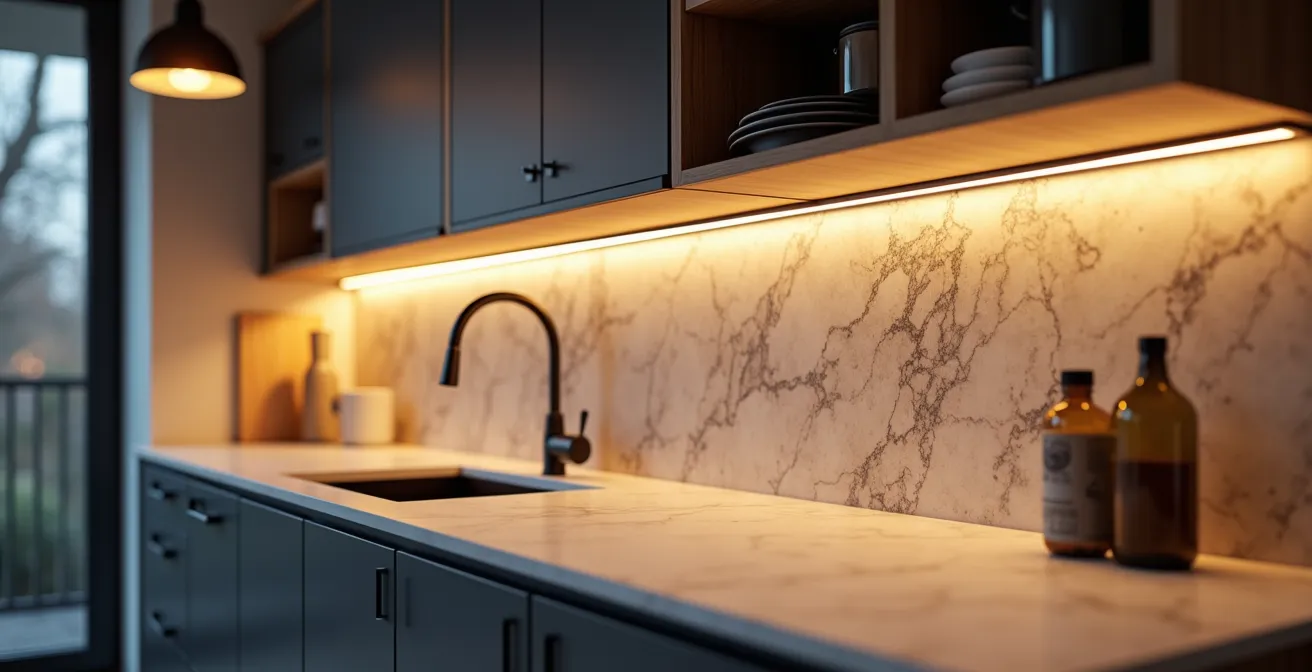
Beyond positioning, the spectral quality of your kitchen light is paramount. This is measured by the Color Rendering Index (CRI), a scale from 0 to 100 that indicates how accurately a light source reveals the true colors of objects. For a space where you assess the freshness of food, a CRI of 90 or higher is non-negotiable. A low-CRI light can make fresh meat look dull or vibrant vegetables appear washed out, leading to poor culinary decisions and increased eye strain as your brain works harder to interpret the distorted color information.
| CRI Range | Visual Quality | Impact on Food Prep | Eye Strain Level |
|---|---|---|---|
| <80 CRI | Poor color accuracy | Cannot assess food freshness accurately | High – colors appear unnatural |
| 80-90 CRI | Acceptable | Basic color distinction possible | Moderate |
| 90-95 CRI | Good | Can detect subtle color variations | Low |
| >95 CRI | Excellent | True color rendering for food safety | Minimal |
Warm White vs Cool White: where to use each for maximum focus?
The debate between warm and cool white light is often oversimplified. It’s not just a matter of preference; it’s a matter of biological function. The color temperature of light, measured in Kelvin (K), sends a direct signal to your brain. Warm light, typically 2700K-3000K, has a higher proportion of red and yellow wavelengths, mimicking sunrise or sunset. This signals relaxation and is ideal for living rooms and bedrooms in the evening. Cool white light, from 4000K to 6000K, is rich in blue wavelengths, replicating the bright, overhead sun of midday. This is a powerful signal for alertness, attention, and cognitive performance.
To engineer an environment for maximum focus, you must deploy cool white light strategically. It is not meant for all-day use, which can lead to eye strain and cognitive fatigue. Instead, it should be used as a tool for specific “deep work” or analytical task sessions. For a home office or study area, dynamic lighting that can change color temperature is the ideal solution. You can begin the day with a neutral 3500K-4000K light and then ramp up to a crisper 5000K for a 90-minute block of intense, focused work.
The intensity of the light is just as important as its color. The goal is to replicate the alerting effects of being outdoors on a bright day. To achieve this, you need a significant amount of light directed at eye level. Recent research indicates peak focus requires a combination of approximately 1000 lux at eye level with a 5000K color temperature. This is far brighter than typical indoor lighting and is why a dedicated, adjustable task lamp is a critical piece of equipment for any serious biohacker. Using this intense, cool light acts as a non-caffeinated stimulant, boosting cortisol and sharpening your cognitive function precisely when you need it.
Therefore, the answer is not “warm” or “cool,” but “when.” Use cool, bright light (4000K-5000K) in task-oriented spaces like offices or workshops during peak focus periods in the morning and early afternoon. Transition to warmer, dimmer light (below 3500K) in the late afternoon and use exclusively warm light (under 3000K) in all spaces during the evening to allow for natural melatonin production. This dynamic approach allows you to program your alertness levels throughout the day.
The hidden blue spike in “warm” cheap LEDs that hurts your eyes
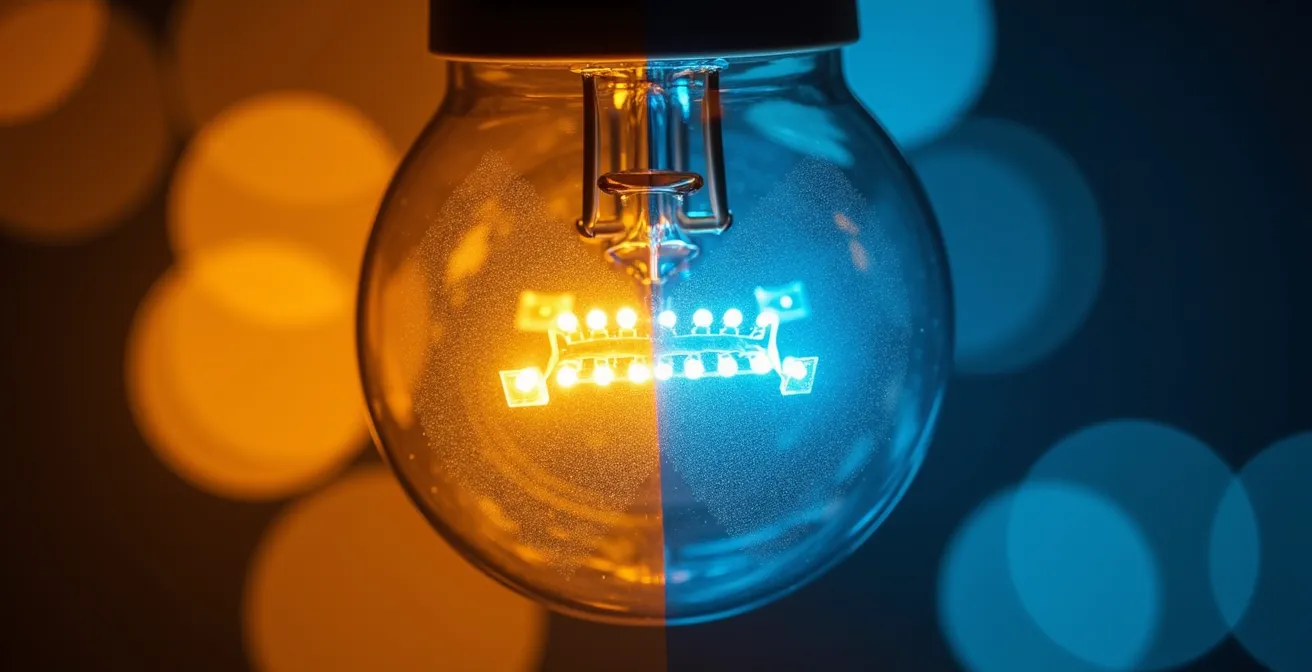
One of the most pervasive myths in modern lighting is that any “warm white” LED bulb is good for your evenings. This is a dangerous oversimplification. Many inexpensive LEDs achieve their warm appearance not by producing inherently warm light, but by starting with a cheap, high-energy blue LED chip and coating it with a yellow phosphor. While the resulting light *appears* warm to the naked eye, it still emits a significant, narrow spike of blue wavelength light that cuts right through the phosphor coating.
This hidden blue spike is a Trojan horse for your circadian rhythm. As you relax in what you believe is calming, sleep-friendly light, your eyes are still being bombarded with a powerful wakefulness signal. Your brain’s photoreceptors are highly sensitive to this specific narrow band of blue light, and they dutifully report “it’s daytime” to your master clock, suppressing melatonin production. This is why you can follow all the rules, buy 2700K bulbs, and still feel “wired” at night. Your lighting technology is betraying your biology.
As the Sleep Foundation’s research team notes, this specific wavelength is particularly potent. In their guide “Light & Sleep,” they explain the underlying science:
Blue light has a short wavelength and is emitted by many LEDs. Studies have found that it has a significantly larger effect on melatonin and circadian rhythm than light with a longer wavelength.
– Sleep Foundation Research Team, Light & Sleep: Effects on Sleep Quality
The solution is to invest in high-quality, full-spectrum LED lighting from reputable brands that specialize in human-centric or low-blue-light technology. These bulbs are engineered differently. They either use a violet chip with a more complex mix of phosphors or multiple LEDs of different colors to create a warm light that has a much more even, natural spectrum, closely mimicking incandescent bulbs but with modern efficiency. When selecting evening lights, look for terms like “full spectrum,” “low blue,” or a high CRI (95+), as these are indicators of superior spectral engineering and a true commitment to biological compatibility.
When to trigger the “sunset” mode in your smart home system?
Owning a smart lighting system is only half the battle; programming it effectively is what unlocks its biological benefits. The “sunset mode” is a key feature, designed to signal to your brain that the day is ending. However, triggering it at the actual local sunset time is often a mistake. The optimal timing is not universal; it must be personalized based on your individual chronotype (whether you’re a morning person or a night owl) and your target bedtime.
The goal of the sunset transition is to create a gradual wind-down period of 3-4 hours before you intend to sleep. During this window, you want to orchestrate two key shifts: a decrease in light intensity (lux) and a shift in color temperature (Kelvin). The process should begin with a gentle dimming across your home. It’s crucial to understand how sensitive our systems are; research shows that even ordinary room light at around 180 lux is more than enough to delay or suppress melatonin. Your automated dimming should bring ambient levels well below this threshold.
The second, more critical phase is the color shift. This should happen about 90 minutes before your target bedtime. During this phase, your lighting system should eliminate virtually all blue and green light, transitioning to a spectrum dominated by amber and red tones (ideally below 2200K). This deep warm light has a minimal impact on melatonin and promotes a state of relaxation. A seamless, slow transition over 30 minutes is far more effective than an abrupt change.
Here is a simple protocol for personalization:
- Calculate Your Anchor Time: Determine your ideal bedtime. All timing is calculated backward from this point.
- Phase 1 (Intensity Shift): Program your lights to begin a slow, gradual dimming process starting 3-4 hours before your bedtime.
- Phase 2 (Color Shift): Program the transition to a deep amber/red spectrum to begin 90 minutes before bed.
- Chronotype Adjustment: If you are an extreme “early bird,” you might align this schedule closer to the natural sunset. If you are a “night owl,” you will likely need to delay this entire sequence by 1-2 hours relative to the sun to match your internal clock.
This systematic, personalized approach transforms your smart lighting from a novelty into a precision medical device for circadian entrainment.
How to reset your internal clock using natural light protocols?
While we can engineer our indoor environment, the most powerful tool for setting and resetting our circadian rhythm remains the sun. Natural light provides a full-spectrum signal of an intensity that artificial sources can rarely match. Leveraging it correctly is the cornerstone of any effective circadian health strategy. The most critical event is morning light exposure, which acts as the “start” button for your daily biological clock, initiating a cascade of hormonal processes, including the timely shutdown of melatonin and a healthy rise in cortisol to promote wakefulness and focus.
As the National Heart, Lung, and Blood Institute states, the signal’s power is unmatched:
Light is the strongest signal in the environment to help reset your sleep-wake cycle. You may need more sunlight during the day and less artificial light at night from TV screens and electronic devices.
– National Heart, Lung, and Blood Institute, Circadian Rhythm Disorders Treatment Guidelines
To do this effectively, you must follow a “Minimum Effective Dose” protocol. This isn’t about aimless sunbathing; it’s a targeted dose of light received by your eye’s photoreceptors within the first 60 minutes of waking.
- On a clear, sunny day: 5-10 minutes of direct sunlight viewing is sufficient. This provides over 10,000 lux.
- On a cloudy day: You need to extend the duration to 15-20 minutes, as cloud cover can still provide 10,000-50,000 lux.
- On a very overcast day: Aim for at least 30 minutes of outdoor exposure.
- Crucial Rule: Do not wear sunglasses or look through a window. Both block specific wavelengths and reduce the intensity, negating the signal’s effectiveness.
In winter months or for those unable to get outside, a 10,000-lux “SAD” lamp can be a viable substitute, used for 30 minutes at eye level.
Case Study: The Wilderness Circadian Reset
To demonstrate this power, researchers from the University of Colorado Boulder conducted a landmark study. They took eight participants camping in a wilderness area, completely removed from artificial light. The subjects lived only by the natural light-dark cycle of the sun. After just one week, lab tests revealed a profound change: their internal melatonin rhythms had completely synchronized with the solar day. Their bodies began producing melatonin at sunset and stopped at sunrise, demonstrating the human body’s innate ability to rapidly entrain to a natural light signal when artificial interference is removed.
When will your solar panels actually break even without subsidies?
When considering a major home investment, we often default to a purely financial Return on Investment (ROI) calculation. For solar panels, the question is simple: “When will my energy savings equal my initial cost?” But this framing is too narrow when applied to our health. We should be asking the same ROI question about investing in a high-quality circadian lighting system. Here, the “solar panels” are our own eyes, and the “energy” they generate is our vitality, focus, and long-term wellness.
If we only calculate the break-even period based on energy savings from switching to LEDs, the timeline might be 3-5 years. However, this ignores the much larger and faster return that comes from improved health outcomes. A proper circadian lighting system is not an energy-saving project; it’s a health-optimization investment. When you factor in the “wellness ROI,” the break-even point arrives dramatically sooner.
Poor lighting and the resulting sleep deprivation have staggering, measurable costs. As a meta-analysis in the National Library of Medicine highlights, the impact is significant, with research indicating that poor lighting environments were linked to decreased sleep efficiency in 50% of reviewed studies. This lost sleep translates directly to lost productivity, increased errors, more sick days, and higher long-term healthcare costs. Conversely, an optimized light environment yields tangible gains. The initial expense of a circadian system is offset within 1-2 years by increased productivity, enhanced cognitive function, and a more resilient immune system.
| Investment Type | Initial Cost | Break-even Period | Hidden Benefits |
|---|---|---|---|
| Standard LED upgrade | $500-1000 | 3-5 years (energy only) | Basic efficiency gains |
| Circadian lighting system | $1500-3000 | 1-2 years (including health benefits) | Better sleep, 15% productivity increase, fewer sick days |
| Solar + smart lighting | $15000-25000 | 5-7 years (holistic calculation) | Energy independence + optimized health outcomes |
Thinking about a high-performance lighting system in the same way we think about solar panels—as a long-term infrastructure investment—is the correct mental model. The difference is that the dividends are paid not just to your utility bill, but directly to your biological bottom line.
Key Takeaways
- Light is a biological signal defined by its Kelvin (color), Lux (intensity), and CRI (quality).
- Morning light (natural or 10,000-lux lamp) is the primary signal to anchor your internal clock.
- Evening light must be dim (<10 lux) and warm (<2700K with no hidden blue spike) to permit melatonin production.
How to engineer your bedroom for maximum REM efficiency?
After spending the day managing light signals, the final and most important project is engineering your bedroom into a sanctuary for sleep. The goal here is absolute, uncompromising darkness. This is not a matter of preference; it is a biological necessity. Your skin contains photoreceptors (like melanopsin), meaning that even low levels of light can signal your brain and disrupt the delicate phases of sleep, particularly REM and deep sleep, which are critical for memory consolidation and physical repair.
The threshold for disruption is shockingly low. Research has shown that effects on sleep can begin at an intensity of just 8 lux—roughly twice the brightness of a standard night light. The tiny blinking LED on your smoke detector, the standby light on your television, or the glow from your phone charger are all potent sources of biological noise that can fragment your sleep without you ever consciously waking up. Achieving maximum sleep efficiency requires a zero-tolerance policy for light pollution in the bedroom.
This requires a systematic approach, what can be called the “Absolute Darkness Cave Protocol.” The objective is to eliminate every single photon of unwanted light.
- Windows: Install high-quality blackout curtains or blinds that block 99.9% of external light. Ensure there are no gaps at the sides, top, or bottom.
- Electronics: Cover every single LED indicator with a piece of black electrical tape or specialized light-dimming stickers. This includes TVs, chargers, air purifiers, and smoke detectors (using approved covers that don’t block the sensor).
- Doorways: Seal the gap under your bedroom door with a draft stopper to block light from hallways.
- Temperature: Maintain a cool room temperature, ideally between 65-68°F (18-20°C), as a drop in core body temperature is another key signal for sleep onset.
This meticulous engineering transforms your bedroom from a simple place of rest into a high-performance recovery chamber, allowing your brain and body to fully engage in the restorative processes that only happen in complete darkness and silence.
By systematically applying these engineering principles—from auditing your bathroom lights to creating an absolute-darkness sleep cave—you move from being a passive victim of your environment to the active architect of your own biology. Start architecting your personalized light environment today to reclaim control over your health and performance.