The true cost isn’t in the handmade object you buy once, but in the mass-produced one you’re forced to replace every few years.
- Genuine craftsmanship is defined by structural honesty—durable techniques like saddle-stitching and traditional joinery—not just a “handmade” label.
- The price of an artisan good reflects a complex value stack: material costs, tiered labor rates, design originality, and a premium for preserving scarce heritage skills.
Recommendation: Shift your mindset from short-term cost to long-term value. Learn to spot the markers of quality and invest in objects built to last a lifetime, not just a season.
We’ve all felt the quiet frustration of a product failing long before its time. A wallet’s glued seams peeling apart after a year, a piece of flat-pack furniture wobbling after a move. The common response is to seek out a replacement, often another inexpensive, mass-produced item destined for the same fate. We’re told to “support small businesses” and that “handmade costs more because it takes time,” but these statements barely scratch the surface of a much deeper truth.
This cycle of consumption creates a hidden “disposability tax”—a recurring cost paid in both money and waste. But what if the antidote wasn’t just buying something different, but understanding value in a new way? The key isn’t simply in the raw materials or the hours logged. The real worth of a handmade object lies in its structural honesty, the preservation of scarce skills, and the transparent story of its creation. It’s an investment in an object that gains character with age rather than heading for a landfill.
This guide moves beyond the simple price tag. We will deconstruct the true value of artisan work, showing you not just what to look for, but why it matters. We’ll explore the tangible durability of traditional techniques, the growing crisis in heritage skills, how to spot marketing lies, and how artisans calculate a price that respects their craft. It’s time to learn the language of objects built with intention.
To navigate this exploration of true value, this article is structured to guide you from understanding physical durability to appreciating the intangible worth of heritage skills. Here is a summary of what we will cover.
Summary: Beyond the Price Tag: How to Truly Value the Skill in Handmade Objects
- Why a hand-stitched wallet lasts 10 years longer than a glued one?
- How to start woodworking in an apartment without noise complaints?
- Artisan vs Mass-produced: spotting the “handmade” marketing lie
- The apprenticeship gap that threatens traditional joinery
- How to calculate an hourly rate that respects the craft?
- Why ‘passive income’ in real estate is a myth for the first 5 years?
- The ‘Farmhouse Chic’ elements that are already making homes look old
- How to test demand for a niche service using only social media?
Why a hand-stitched wallet lasts 10 years longer than a glued one?
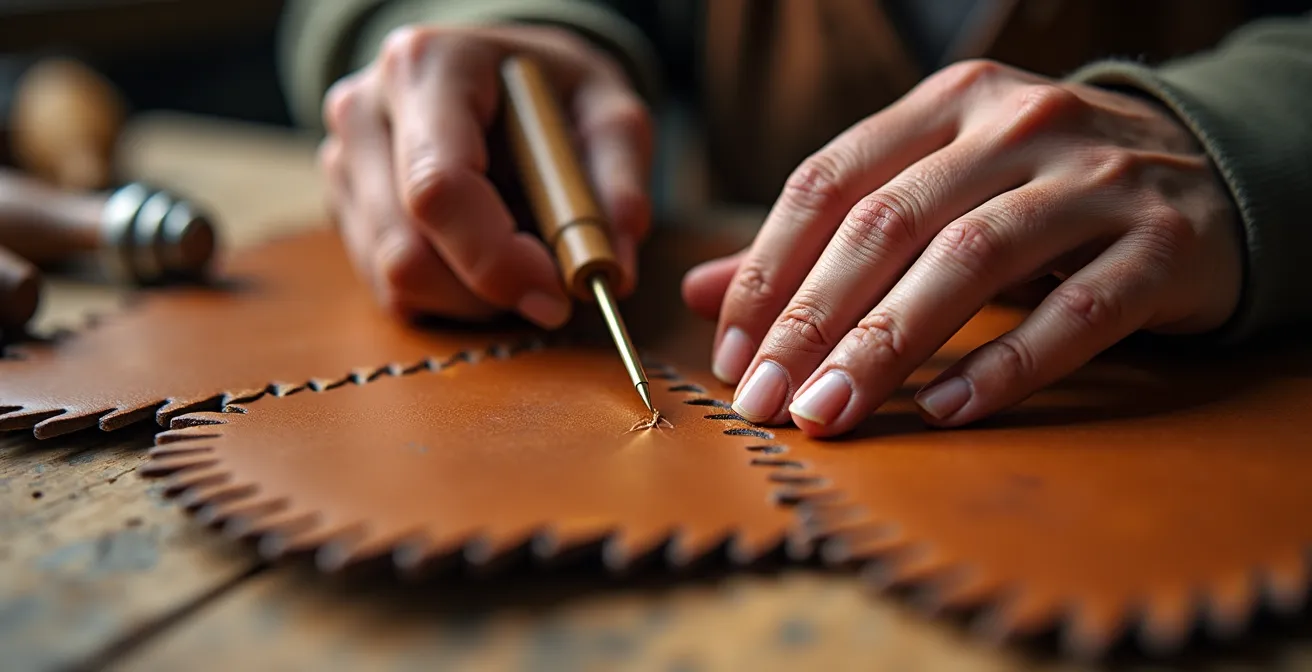
The difference between an object that lasts a decade and one that fails in a year often comes down to a single, crucial element: its structural honesty. Nowhere is this more evident than in leatherwork. A machine-made wallet typically uses a “lockstitch,” where two threads lock together in the middle of the leather. While fast and cheap to produce, its critical flaw is that if a single stitch breaks, the entire seam can unravel like a zipper.
In stark contrast, artisan wallets almost exclusively use the traditional saddle stitch. This painstaking method, performed with a single thread and two needles, creates an overlapping, interwoven pattern. Each stitch independently locks itself in place. If one stitch were to ever wear through, the surrounding stitches would hold fast, preventing the seam from failing. This is not a stylistic choice; it is a fundamental engineering decision prioritizing longevity over production speed.
The materials follow the same philosophy. Full-grain leather, the highest quality grade, isn’t sanded or buffed to remove imperfections. It retains its natural strength and develops a unique patina over time—a visual story of its use. Mass-produced goods often use corrected or synthetic materials that degrade and lose their appeal quickly. The difference in construction and philosophy is not subtle.
| Aspect | Hand-Stitched Wallet | Machine-Made Wallet |
|---|---|---|
| Construction Method | Saddle stitch with two needles | Machine lockstitch |
| Materials | Full-grain or top-grain leather | Lower-cost materials or synthetic |
| Durability | Holds even if single stitch breaks | Entire seam compromised if thread breaks |
| Character Development | Develops unique patina over time | Loses appeal quickly |
| Longevity | 10+ years with proper care | 2-3 years typical lifespan |
How to start woodworking in an apartment without noise complaints?
The pursuit of craft shouldn’t be limited to those with sprawling workshops. The rise of “quiet craftsmanship” demonstrates that even a skill as seemingly disruptive as woodworking can thrive in an urban apartment. The secret lies in turning away from the noise and dust of power tools and embracing the precision and peace of traditional hand tools, many of which have been perfected over centuries.
This approach is not about compromise; it’s about a deeper connection to the material. Instead of the roar of an electric sander, you experience the whisper of a hand plane shaving off a paper-thin curl of wood. Rather than the scream of a power saw, you feel the satisfying pull of a Japanese saw, or *nokogiri*, which cuts on the pull stroke, offering greater control with minimal noise. It transforms a noisy, messy hobby into a meditative practice.
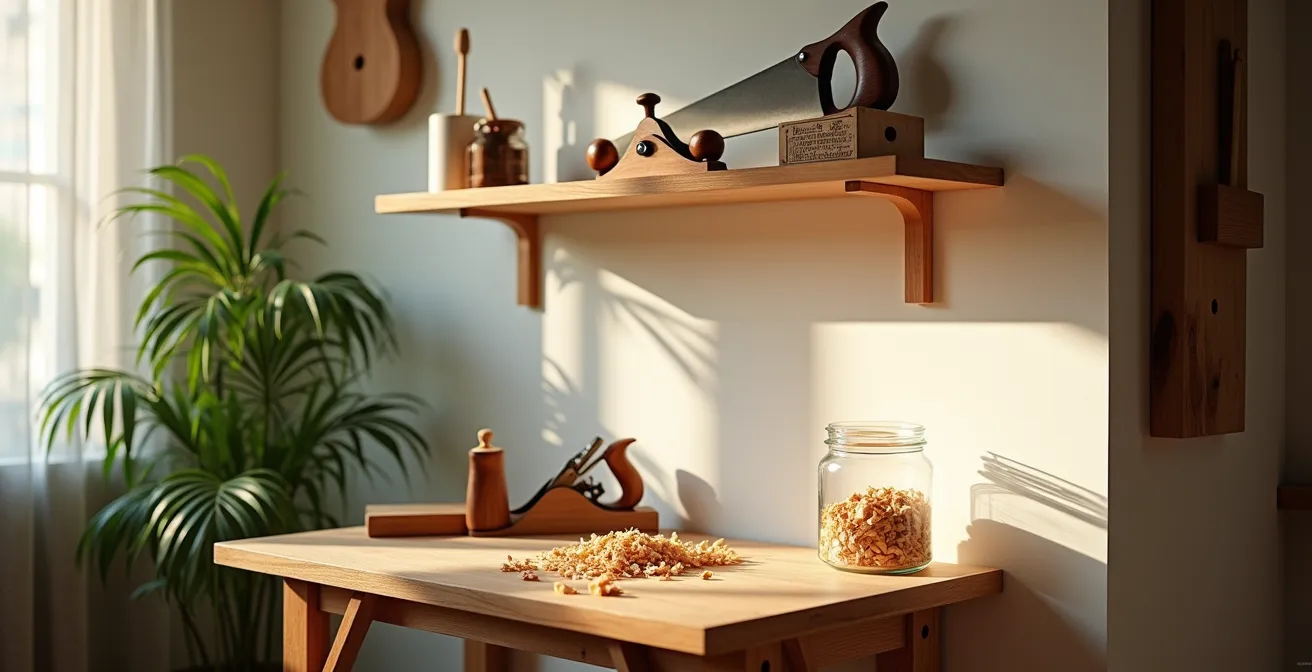
Setting up a silent workshop is surprisingly simple and focuses on a few key tools that do the work of an entire arsenal of power equipment. By mastering these, an apartment dweller can produce work of exceptional quality without disturbing a single neighbor. Here are the essential steps to begin:
- Invest in Japanese pull saws (nokogiri) which cut on the pull stroke, requiring less force and producing minimal noise compared to Western push saws.
- Master the use of hand planes for surface preparation instead of electric sanders—they’re virtually silent and connect you to centuries of woodworking tradition.
- Use card scrapers for finishing work; they produce paper-thin shavings silently while achieving glass-smooth surfaces.
- Set up work during reasonable hours (e.g., 9 AM – 7 PM) and use rubber mats under your workbench to absorb vibrations.
- Join online communities of apartment woodworkers who share techniques for quiet hand tool mastery.
Artisan vs Mass-produced: spotting the ‘handmade’ marketing lie
As consumers grow more interested in authentic goods, the term “handmade” has been co-opted by marketers to imply a level of quality that often doesn’t exist. This “handmade-washing” can make it difficult to distinguish a genuinely crafted item from a mass-produced one with a clever label. However, an educated eye can quickly learn to spot the lies and identify the signatures of true craftsmanship.
The most telling clue is the presence of perfect uniformity. Machines excel at replication; human hands do not. If a seller offers a hundred “unique” items that are mathematically identical, it’s a red flag. True handmade items possess subtle, charming variations—the soul of the piece. As The Luxury Institute’s research points out, genuine craft is a cornerstone of true luxury, not a marketing gimmick.
Topping the list of attributes that define luxury brands were superior quality (73%), craftsmanship (65%) and design (54%).
– The Luxury Institute, Luxury Branding and Marketing: A Global Comparison of Wealthy Consumers
To arm yourself against misleading marketing, you need a forensic mindset. By learning to read the tool marks, analyze the stitching, and apply a dose of reality to the price, you can become a confident judge of authenticity. This checklist provides a framework for looking beyond the sales pitch and seeing the object for what it truly is.
Your Checklist for Identifying Genuine Handmade Goods
- The Perfect Symmetry Test: Examine multiple “identical” items. Genuine handmade pieces will have subtle variations in dimensions, while machine-made items are perfectly uniform.
- The Tool Mark Signature: Look for irregular patterns from hand tools (like slight waviness from a hand plane) versus the uniform marks of machines (like perfectly parallel sander scratches).
- The Stitching Pattern Check: Inspect the stitching. Hand stitching shows slight angle variations and spacing differences; machine stitching is mathematically perfect.
- The Product Line Consistency Test: Assess the seller’s inventory. If a seller has hundreds of “unique handmade” items that look identical, they are likely mass-produced.
- The Price Reality Check: Do a quick mental calculation of material costs and a reasonable hourly wage. If the price seems impossibly low for the time a handmade item would take, it probably isn’t handmade.
The apprenticeship gap that threatens traditional joinery
The value of a handmade object isn’t just in its physical form; it’s also in the invisible library of knowledge required to create it. This knowledge, passed down through generations, is a finite and increasingly fragile resource. Today, many heritage crafts like traditional joinery face a silent crisis: the apprenticeship gap. As master craftspeople retire, there are not enough skilled apprentices to inherit their expertise, leading to a dangerous erosion of our shared cultural skill set.
This isn’t just a nostalgic concern; it’s a systemic problem. New research highlights that many businesses lack any formal training programs, with a survey showing that 40.4% of woodworking operations admit they have no formal training at all. This is compounded by a decline in vocational programs in schools. The result is a growing scarcity of skill. When a technique is known by only a handful of people, it becomes exponentially more valuable.
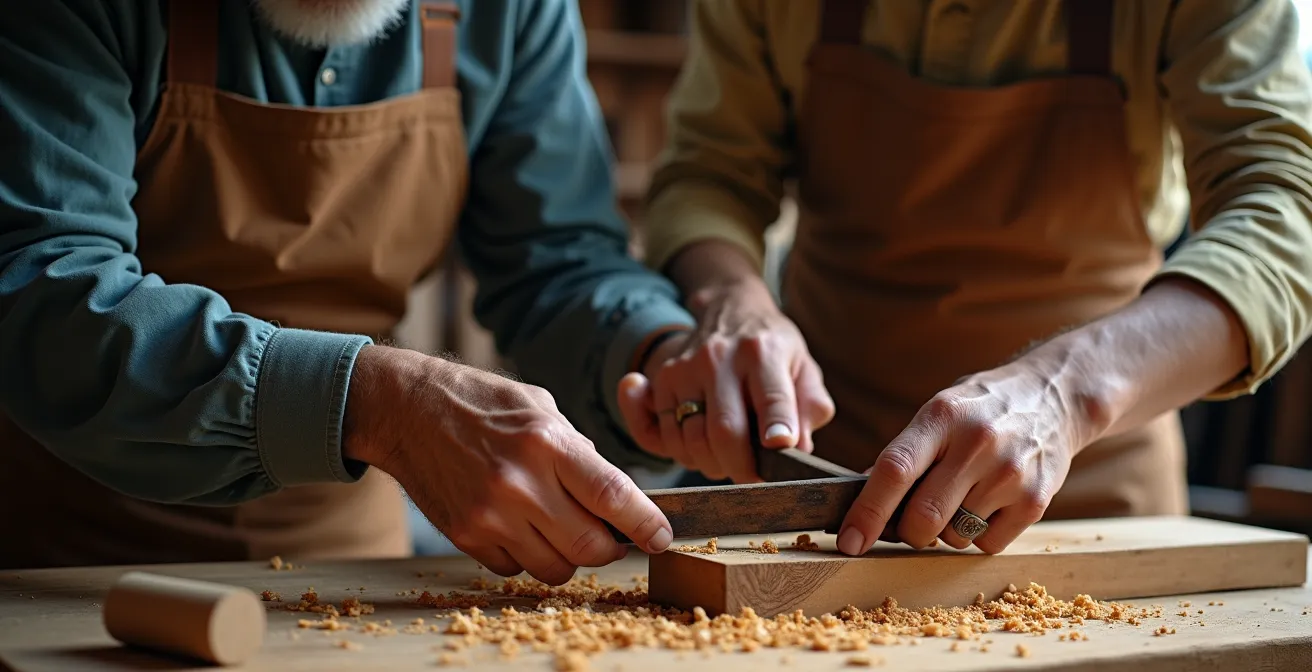
Think of it like this: a dovetail joint, cut by hand, is more than just a way to connect two pieces of wood. It’s a physical manifestation of centuries of trial and error. It represents a solution so elegant and strong that it has remained unchanged for generations. When you buy an object featuring such a joint, you are not just acquiring a piece of furniture; you are becoming a custodian of that knowledge. You are funding the continuation of a legacy and helping to close the apprenticeship gap, ensuring these skills don’t fade into history.
How to calculate an hourly rate that respects the craft?
One of the biggest hurdles for both consumers and makers is understanding the price of a handmade item. For consumers, it can seem high compared to mass-produced alternatives. For artisans, it’s a difficult balance between honoring their skill and remaining accessible. The simplistic formula of “(Materials + Labor) x 2” is a disservice to the craft, as it ignores the most valuable components: expertise, originality, and skill scarcity.
A professional pricing model, what we can call the “Artisan’s Value Stack,” provides a much more honest and comprehensive framework. It builds value in layers, starting with the tangible costs and progressively adding premiums for the intangible assets that truly define craftsmanship. This method respects the years of practice behind a master’s efficiency and the intellectual property of an original design. The market for this value is real; research shows that premium minimalist card wallets (above $100) account for around 28% of the market share, proving that consumers are willing to pay for quality.
This layered approach helps demystify the final price and educates the consumer on what they are truly paying for. Here is a breakdown of the Artisan’s Value Stack:
- Layer 1 – Base Costs: Calculate all materials, tool depreciation, workspace costs, and business overhead. This is the non-negotiable foundation.
- Layer 2 – Tiered Labor Rate: Assign a rate based on skill level and efficiency—e.g., Apprentice ($20-30/hour), Journeyman ($35-50/hour), or Master Craftsman ($60-100+/hour).
- Layer 3 – Design & IP Value: Add a premium of 15-25% for original designs, custom patterns, or unique techniques you’ve developed through your own research and development.
- Layer 4 – Heritage & Scarcity Premium: If you are one of the few practitioners of an endangered craft or technique, add a 20-40% premium to reflect this skill scarcity.
- Layer 5 – Market Positioning: Finally, compare your item to others of similar quality and adjust the price by ±15% based on your brand’s reputation and target customer.
Why ‘passive income’ in real estate is a myth for the first 5 years?
The term “passive income” is often associated with real estate investing, but anyone who owns property knows it’s anything but passive, especially in the beginning. There are constant demands on time and money: tenant issues, unexpected repairs, property management, and taxes. This reality provides a powerful analogy for understanding the value of handmade goods: the hidden costs of ownership.
We can think of the constant need to replace cheap, mass-produced items as a “disposability tax.” You may pay less upfront for a particle board bookshelf, but you’ll pay again and again in time, money, and frustration as you replace it every few years. A single, well-made object, like a solid wood bookshelf built with traditional joinery, eliminates this tax. Its higher initial cost is an investment against future spending and waste. This testimonial from a conscious consumer perfectly captures the sentiment.
I’d much rather pay more up-front, for the value of a skilled craftsperson’s time, and get an item that will last for years, than buy several mass-produced equivalents over time as they keep wearing out. It’s cheaper for me in the long run that way, and puts less flimsy garbage in landfills!
– Sydney M., Artisans Cooperative customer interview
The comparison becomes even clearer when we map out the long-term costs associated with different types of ownership. A handmade object is an asset that requires minimal maintenance, while both real estate and mass-produced goods come with significant, ongoing liabilities.
This comparative analysis, inspired by data on the lifecycle of quality goods, reveals the hidden financial and environmental burden of disposability.
| Cost Factor | Real Estate Investment | Mass-Produced Items | Handmade Objects |
|---|---|---|---|
| Initial Investment | High down payment + closing costs | Low upfront cost | Higher initial price |
| Maintenance | 1-3% property value annually | None (replace when broken) | Minimal (leather conditioner, oil) |
| Replacement Frequency | N/A (renovations every 10-15 years) | Every 2-3 years | Once per decade or lifetime |
| Time Investment | Property management, tenant issues | Frequent shopping/replacing | Initial research only |
| Environmental Cost | Energy consumption | Landfill waste from replacements | Minimal – one item for life |
| Value Over Time | Appreciation potential | Depreciates to zero | Develops patina, becomes heirloom |
The ‘Farmhouse Chic’ elements that are already making homes look old
Trends, by their very nature, have a built-in expiration date. The “Farmhouse Chic” aesthetic, with its artificial distressing and shiplap walls, is a perfect example of a style that is quickly becoming dated. This highlights a fundamental distinction in design and craft: the difference between applied style and structural honesty. Applied style is a surface-level treatment designed to evoke a feeling, while structural honesty means the object’s beauty and integrity come from the way it’s built.
An artisan-made object values timelessness over trends. The focus is on proportions, material quality, and construction techniques that have been proven to last for centuries. For example, instead of chemically “distressing” wood to make it look old, a craftsperson will choose a piece of solid wood that will develop a natural, beautiful patina over decades of use. The value is authentic and earned, not faked. This is what connoisseurs of luxury goods seek: authenticity and longevity that transcend fleeting styles.
Learning to distinguish between these two philosophies is the final key to appreciating handmade value. It’s about training your eye to look past the surface and assess the core of the object. Here are the key indicators of structural honesty to look for:
- Check the edges: Hand-burnished edges on leather or wood are smooth and sealed from careful finishing, not just painted over to hide a rough cut.
- Examine the aging: True craftsmanship shows natural patina development from use, not artificial distressing applied with paint or tools at the factory.
- Test the joints: Traditional joinery like dovetails or mortise-and-tenon joints remains tight and strong after years, while glued particle board or nailed joints loosen and fail.
- Assess the materials: Full-grain leather and solid wood improve with age and develop character, while veneers, laminates, and synthetic materials chip, peel, and deteriorate.
- Look for repair potential: Quality handmade pieces are designed to be restored and repaired for future generations, whereas trend-based items are designed for disposal.
Key Takeaways
- True value lies in long-term durability, not short-term price. Techniques like the saddle stitch are an investment against the hidden “disposability tax.”
- Heritage skills are a scarce resource. Supporting artisans helps close the “apprenticeship gap” and preserves our shared cultural knowledge.
- Authenticity has clear signatures. Learn to identify the markers of structural honesty—like hand-finished edges and traditional joinery—to spot marketing lies.
How to test demand for a niche service using only social media?
For artisans and makers, one of the greatest challenges is communicating the immense value embedded in their work. The answer doesn’t lie in competing on price, but in pulling back the curtain and making the process the proof. Social media is the perfect stage for this, allowing makers to visually demonstrate the time, skill, and intention behind each piece, effectively testing and building demand before a product is even finished.
Major luxury brands have already mastered this. Louis Vuitton and Gucci bring artisans into their stores to hand-stitch goods in front of customers, and they use platforms like YouTube to make these demonstrations global. They don’t just tell you their bags are well-made; they show you the intricate, time-consuming process, creating a powerful narrative of value. This “Process as Proof” strategy is accessible to every artisan with a smartphone.
By documenting the journey from raw material to finished object, you can build a community of followers who understand and appreciate your work on a deeper level. This isn’t about creating slick marketing videos; it’s about authentic storytelling. Sharing a mistake and the skill needed to fix it is often more powerful than showing a flawless final product. Here is a simple, effective content strategy to start building that narrative:
- Week 1: Share a time-lapse of your most complex process, highlighting the hours of focused work involved in creating one small part of a piece.
- Week 2: Post a “failure story” showing a mistake—a cracked piece of wood, a dropped stitch—and explain the skill and extra time required to fix it, demonstrating deep expertise.
- Week 3: Create a video about one of your favorite tools, explaining its specific purpose and perhaps the history or personal story behind it.
- Week 4: Document your process of selecting raw materials, showing how and why you choose high-quality wood, leather, or fiber over cheaper, more convenient alternatives.
- Ongoing: When asked about price, respond with mini-educational posts that break down the investment in time, skill, and materials, referencing your “Process as Proof” content.
By shifting our focus from price to process, and from disposability to durability, we empower ourselves as consumers and honor the artisans keeping heritage skills alive. The next step is to apply this knowledge. Begin by examining an object you own and love, and try to identify the markers of its quality. This small act is the start of a more intentional relationship with the things we choose to bring into our lives.