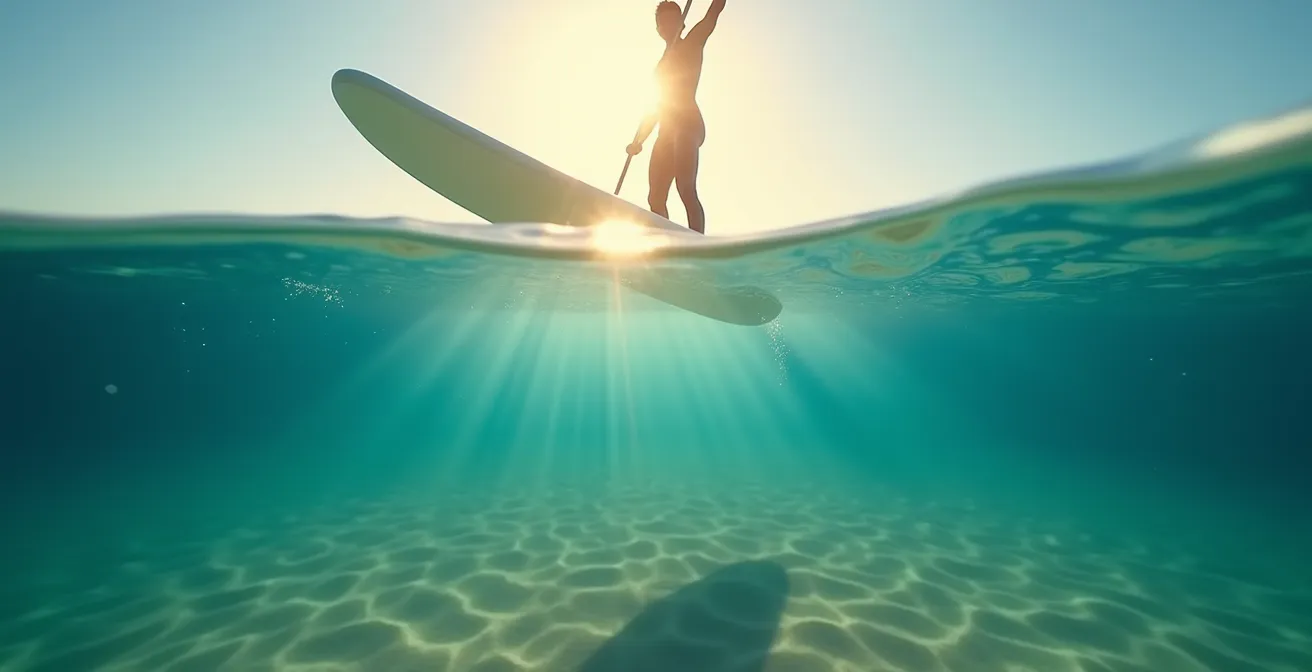
In summary:
- Ocean sports build a functional core by forcing constant stabilization on an unstable surface, engaging deep muscles traditional workouts miss.
- Proper technique, like rotating your torso when paddling, is more critical for core activation and calorie burn than arm strength.
- Understanding environmental factors like tides and wind is not just for safety; it’s essential for optimizing your workout and preventing dangerous situations.
- Choosing the right sport (e.g., paddleboard for disc issues, kayak for facet joint issues) can be tailored to pre-existing back conditions.
For the active traveler, a vacation is an opportunity not just to relax, but to connect with your body in a new environment. Many see the ocean as the ultimate playground, jumping on a paddleboard or surfboard with the simple goal of having fun and maybe getting a bit of a workout. The common advice is to “engage your core,” but this often translates to little more than tensing your abs, a superficial effort that misses the true potential of water sports.
The reality is that these activities offer a far more profound physical benefit than a simple calorie burn. From a sports physiotherapy perspective, the unstable surface of the water acts as a powerful biofeedback system. It constantly challenges your balance, forcing your body to activate a deep network of stabilizer muscles that form your functional core. This goes far beyond the “six-pack” muscles, encompassing the entire trunk, hips, and shoulders working in a coordinated system.
But what if the key wasn’t just *doing* the sport, but understanding how to use the ocean as a diagnostic tool? This guide reframes the approach. We will move beyond generic fitness tips to explore the specific biomechanics of each activity. You will learn how to interpret the water’s feedback to build resilient strength, maximize cardiovascular benefits without high-impact stress, and prevent the common mistakes that can lead to injury or danger. It’s time to turn your time on the water into a truly transformative physical experience.
For those who prefer a visual introduction, the following video provides an overview of how structured training can enhance your ocean sports experience, complementing the detailed advice in this guide.
To help you navigate this comprehensive guide, we’ve broken down the key principles of building ocean-based core strength into distinct sections. The following summary outlines how we will explore each aspect, from the science behind calorie burn to the practical skills needed for a safe and effective session.
Summary: Your Guide to Ocean-Based Core Fitness
- Why paddleboarding burns more calories than you think?
- How to stand up on a surfboard within your first hour?
- Kayak vs Paddleboard: which is safer for bad backs?
- The current mistake that drifts beginners 1km offshore
- When to go out for flat water: reading tide charts for beginners
- How to maximize cardiovascular benefit without running’s impact?
- The hydration mistake that ruins 30% of tropical vacations
- How to experience marine biodiversity safely without scuba gear?
Why paddleboarding burns more calories than you think?
Stand-up paddleboarding (SUP) is often perceived as a leisurely activity, but its metabolic demand is surprisingly high. The reason lies in the principle of proprioception—your body’s ability to sense its position in space. On an unstable surface like water, your brain is in constant communication with hundreds of small stabilizer muscles throughout your core, back, and legs. These muscles fire continuously just to keep you upright, even before you take a single paddle stroke. This constant, low-level activity consumes a significant amount of energy over time.
When you add the dynamic movement of paddling, the energy expenditure skyrockets. A powerful paddle stroke originates not from the arms, but from the core. It involves a rotational movement of the torso, engaging the obliques, latissimus dorsi, and glutes in a coordinated kinetic chain. This full-body engagement transforms paddling from a simple arm exercise into a powerful metabolic workout. Depending on intensity and conditions, research shows that you can burn anywhere from 300 to over 1125 calories per hour. Recreational paddling on calm water sits at the lower end, while SUP surfing or racing pushes you toward the upper limit.
The key to unlocking this calorie-burning potential is proper form. Many beginners make the mistake of using only their arms, which leads to rapid fatigue and minimal core engagement. By learning to paddle from your core, you not only increase your power and efficiency but also turn your session into a highly effective functional workout that builds strength and endurance simultaneously.
How to stand up on a surfboard within your first hour?
The “pop-up” is the foundational movement in surfing and often the biggest hurdle for beginners. Success within the first hour isn’t about brute strength; it’s about muscle memory and efficient movement patterns. From a physiotherapy standpoint, the pop-up is an explosive, full-body motion that requires coordination, flexibility in the hips and spine, and core stability. The most effective way to learn it is by drilling the movement on land before even touching the water.
A common mistake is trying to “push up” like a standard push-up and then awkwardly bringing your feet under you. This is slow and unstable. The correct technique is a fluid, single motion. A proven method is to practice a dry-land protocol that mimics the movement. An effective pre-surf routine focuses on activating the correct muscles and improving hip flexor mobility. For example, a dynamic stretch where you cushion your knee against a wall, keep your back flat by tightening your abs and glutes, and then lift your torso can significantly improve your pop-up success rate.
This pre-habilitation prepares the kinetic chain for the explosive movement required. Once on the board in the water, focus on these steps: hands flat on the board under your chest, push your chest up, and in one fluid motion, swing your legs underneath you, landing with your feet wide and your center of gravity low. The image below breaks down this sequence on the beach, which is the ideal training ground.
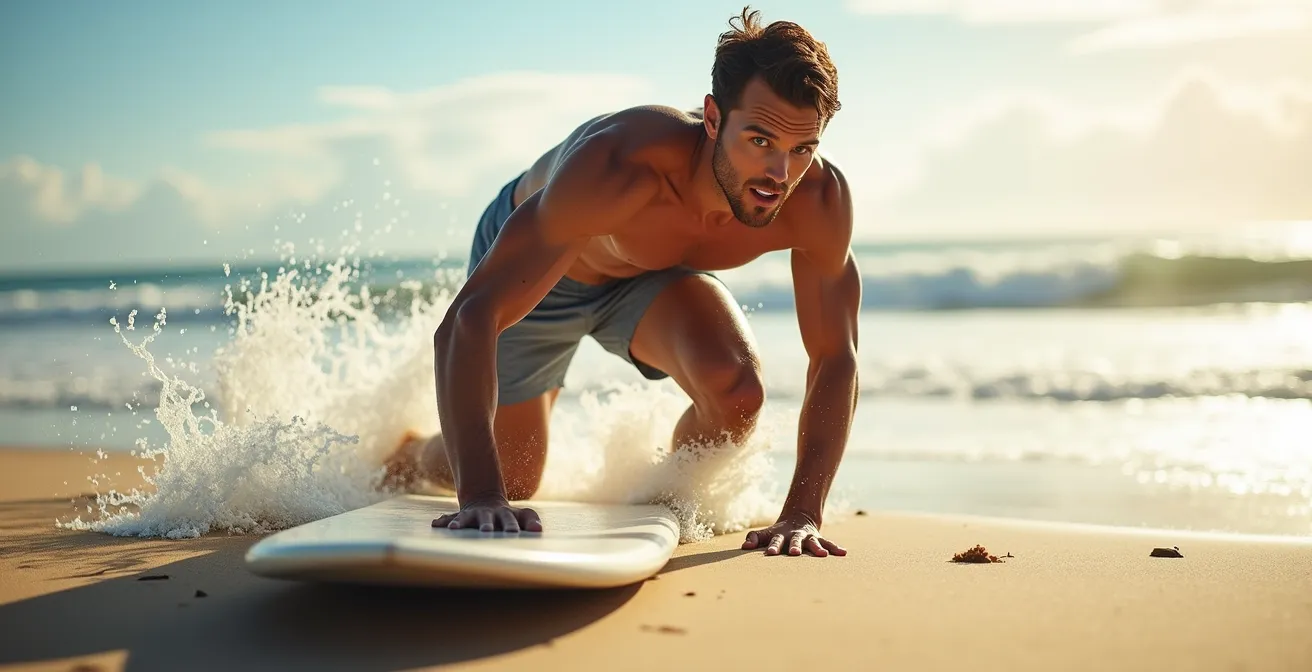
As you can see, the movement is a swift transition, not a series of disjointed steps. By practicing this on the sand 20-30 times, you build the necessary muscle memory. When you get into the water, your body will know what to do, allowing you to focus on balance and catching the wave instead of fumbling with your feet.
Kayak vs Paddleboard: which is safer for bad backs?
As a sports physiotherapist, one of the most common questions I get from active travelers with a history of back pain is which water sport is “better” for them. The answer is nuanced and depends entirely on the nature of your back condition. There is no one-size-fits-all solution; instead, the choice between a kayak and a paddleboard should be guided by whether you have flexion intolerance or extension intolerance.
Standing on a paddleboard requires constant adjustments to your posture and movements, enhancing proprioception (awareness of your body in space)
– The Kayak Centre, Paddle Your Way to Fitness Guide
Flexion intolerance, often associated with disc issues like a herniated or bulging disc, means that pain is aggravated by bending forward or slouching. For these individuals, stand-up paddleboarding (SUP) is generally the superior choice. The upright, neutral spine posture required for SUP helps to decompress the lumbar discs and encourages the activation of deep core stabilizers to maintain balance. The constant micro-adjustments are therapeutic, strengthening the very muscles that protect the spine.
Conversely, extension intolerance, often linked to conditions like facet joint syndrome or spinal stenosis, means pain is worse when arching the back. For this group, kayaking is typically safer. The seated position with a high-backed seat provides lumbar support and prevents excessive backward arching. While kayaking still involves core rotation, the load on the facet joints is minimized compared to the demands of standing and balancing on a paddleboard.
The following table, based on a comparative analysis of biomechanics, breaks down the key differences to help you make an informed choice.
| Factor | Kayak | Paddleboard (SUP) |
|---|---|---|
| Back Position | Supported by seat | Upright stance required |
| Core Engagement | Rotational movement | Constant stabilization |
| Best For | Extension intolerance (facet joint issues) | Flexion intolerance (disc issues) |
| Equipment Solution | High-back seat with lumbar support | Wider, more stable board |
The current mistake that drifts beginners 1km offshore
The most dangerous mistake a beginner can make on a paddleboard or kayak isn’t falling off—it’s underestimating the power of wind and currents. Every year, coast guards are called to rescue paddlers who have been unexpectedly swept far from shore, exhausted and unable to return. This drift is almost always caused by a failure to assess environmental conditions before and during their session. An offshore wind (blowing from land to sea) can feel pleasant on the beach, but once on the water, it acts like a giant, invisible hand pushing you further out.
From a safety standpoint, the numbers are clear: paddling experts recommend beginners stick to days when the wind is under 7 knots (around 8 mph or 13 kph). Above this speed, a paddleboard, with its high profile, becomes extremely difficult to control and acts like a sail. A paddler can be pushed offshore at a speed of 1-2 km/h without even realizing it until the shoreline looks alarmingly small.
The solution is not just to check a weather app before you go, but to maintain constant situational awareness while you are on the water. A simple, professional-grade protocol is to use fixed landmarks on the shore to monitor your position. This turns a subjective feeling (“Am I drifting?”) into an objective measurement. It is the single most effective technique for preventing a leisurely paddle from turning into a dangerous emergency situation. Always paddle into the wind on the way out, so your return journey is assisted by the wind when you are more tired.
Your 5-Point Safety Checklist for Preventing Drift
- Before starting, identify three large, fixed landmarks on the shore (e.g., a specific building, a large rock formation, a water tower).
- Every 15 minutes, stop paddling completely and check your position relative to these three landmarks.
- If you notice you are moving away from shore while not actively paddling, the conditions are too strong for your ability.
- Immediately begin paddling directly toward the shore, using your landmarks to gauge your progress against the wind or current.
- Always plan your route to paddle into the wind first, ensuring the return trip is easier and safer when you have less energy.
When to go out for flat water: reading tide charts for beginners
For beginners, the ideal condition for any water sport is “flat water.” Glassy, calm water makes balancing easier, paddling more efficient, and the overall experience far more enjoyable. While many people associate flat water with a lack of wind, the most influential factor in a coastal environment is often the tide. Understanding basic tide patterns is a skill that separates knowledgeable water-goers from those who are constantly battling choppy conditions.
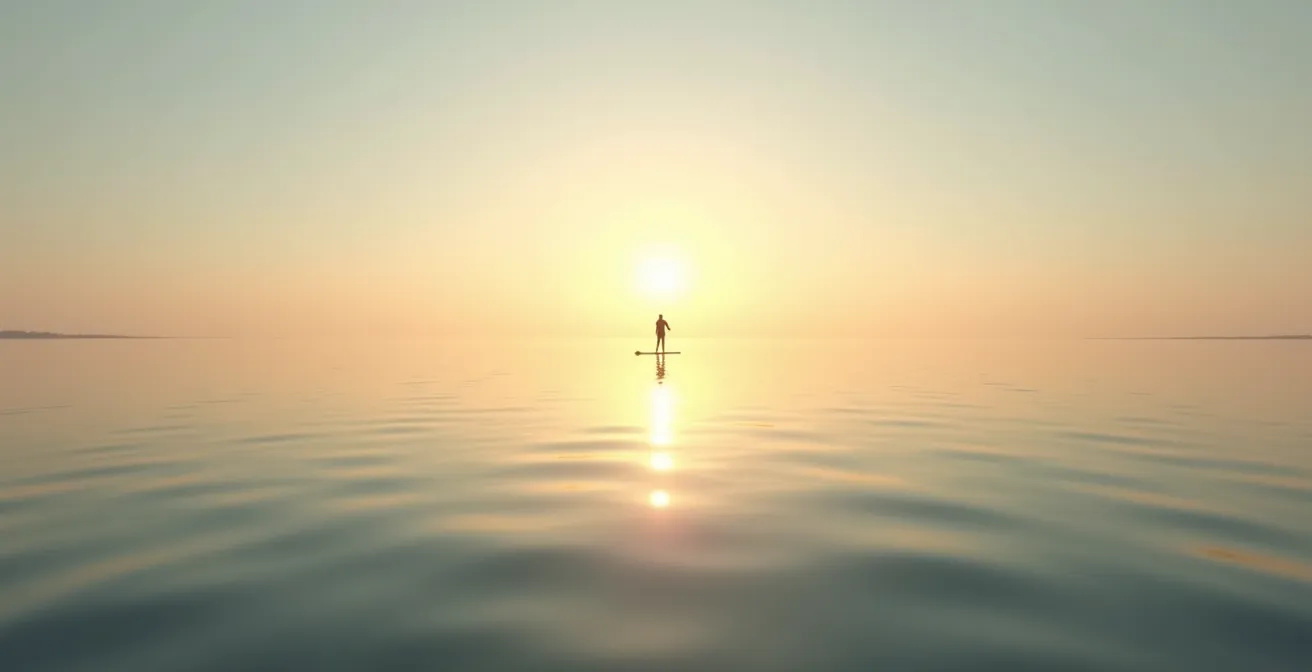
The golden window for beginners is known as slack tide. This is the period, lasting approximately 30 to 60 minutes, when the tide is reversing direction (from incoming to outgoing, or vice versa). During slack tide, the horizontal movement of water, or tidal current, is at its weakest. This brief pause creates the flattest possible water surface, perfect for learning to paddleboard, practicing your pop-up, or enjoying a peaceful kayak trip. Tide charts, available through apps like Windfinder or local marine websites, will tell you the exact times of high and low tide for your location. Slack tide occurs at the peak of high tide and the bottom of low tide.
In addition to slack tide, it’s important to understand the difference between neap tides and spring tides. Neap tides occur during the quarter moon phases and have the smallest difference between high and low water levels, resulting in weaker currents and longer, more forgiving slack tide periods. Spring tides, occurring around the full and new moons, have the largest tidal range and produce the strongest currents, making conditions more challenging and the slack tide window much shorter. For a stress-free experience, aim for a session during slack tide on a neap tide day.
How to maximize cardiovascular benefit without running’s impact?
Many active individuals turn to running for cardiovascular fitness, but the high-impact nature of the sport can be punishing on the joints, particularly the knees and hips. Water sports like paddleboarding and kayaking offer a powerful, low-impact alternative. The key to unlocking their cardio potential lies in shifting from steady-state paddling to High-Intensity Interval Training (HIIT). This method involves short bursts of all-out effort followed by brief recovery periods, a proven strategy for improving cardiovascular health and boosting metabolism.
A water-based HIIT session elevates your heart rate into the optimal training zone without a single jarring step. The resistance of the water provides a smooth, consistent challenge that is easy on the joints. A typical protocol involves a 5-10 minute warm-up of gentle paddling, followed by cycles of 1-minute sprints at 90% effort and 2-minute recovery paddles at 50% effort. Repeating this cycle 6-8 times creates a potent cardiovascular stimulus that can be more effective than a longer, slower paddle.
Furthermore, the core strength developed through these sports enhances cardiovascular efficiency. A strong, stable core acts as a solid platform for movement, allowing for a more powerful and efficient transfer of energy through the kinetic chain with each paddle stroke. This means less wasted energy and a greater ability to sustain high-intensity efforts. A landmark study on elite swimmers by Karpinski et al. (2020) found that a six-week core training program significantly improved their 50m freestyle times, demonstrating the direct link between core strength and performance. This principle applies directly to paddling sports, where a stronger core allows you to generate more power, thus increasing your cardiovascular workload.
The hydration mistake that ruins 30% of tropical vacations
Dehydration is one of the most common—and preventable—issues that sideline travelers in tropical climates. When engaging in water sports, the risk is paradoxically higher due to a dangerous illusion: the cooling effect. On land, you feel the heat, see the sweat, and are prompted to drink water. On the ocean, the combination of wind and water spray creates a constant cooling sensation on your skin. This masks your body’s true core temperature and the rate at which you are sweating. Athletes often report feeling cool and comfortable while their bodies are losing significant amounts of fluid, leading to a gross underestimation of their hydration needs.
This is not just a feeling; it’s a physiological trap. You can be sweating just as much, if not more, than during a land-based activity in the same heat, but you lack the primary sensory cue to rehydrate. By the time you feel thirsty, you are already in a state of dehydration, which can lead to headaches, muscle cramps, extreme fatigue, and even heatstroke. This can effectively ruin a day of your vacation or longer.
The professional approach to hydration for water sports is proactive, not reactive. The goal is to be fully hydrated *before* you even start your activity. As a clinical guideline, you should consume around 500ml of water, preferably with electrolytes, in the hour before you leave for the beach. Electrolytes (sodium, potassium) are crucial as they help your body retain fluid and are lost through sweat. Waiting until you are on the water to start drinking is a failing strategy. Pre-loading your hydration is the only way to counteract the deceptive cooling effect of the ocean and ensure you have the endurance to perform safely.
Key takeaways
- Functional Core Strength: Water sports build a resilient core through constant, multi-directional stabilization, engaging deep muscles that traditional exercises often miss.
- Technique Over Power: True power in paddling comes from core rotation and the kinetic chain, not arm strength. Proper form maximizes fitness benefits and prevents injury.
- Environmental Awareness is Non-Negotiable: Understanding wind, currents, and tides is as crucial as physical conditioning for both safety and performance optimization.
How to experience marine biodiversity safely without scuba gear?
One of the great joys of ocean sports is the opportunity to witness marine life in its natural habitat. A paddleboard or kayak serves as a fantastic, non-invasive platform for exploration, allowing you to access areas that are inaccessible from shore without the need for heavy scuba equipment. This “SUP snorkeling” or “kayak snorkeling” approach combines the fitness of paddling with the wonder of underwater discovery.
The strategy is simple: paddle out to a sheltered cove, a calm reef, or a mangrove forest. These areas are often teeming with life and are far from the crowded beach. Once there, you can deploy a small, folding anchor to secure your craft, preventing it from drifting while you explore. Your board or kayak then becomes your personal “rest and safety platform.” You can snorkel for 15-20 minutes and then easily return to your board to rest, rehydrate, and observe life from above the surface before moving to a new spot.
Even without getting in the water, the elevated vantage point of a paddleboard offers a unique perspective. Wearing a good pair of polarized sunglasses is essential, as they cut through the surface glare and dramatically improve your ability to spot fish, rays, or turtles from your board. For a different kind of exploration, plan your paddle to coincide with low tide. This exposes the intertidal zone along rocky shores or reefs, a rich ecosystem of its own. You can anchor your craft nearby and, wearing reef shoes for protection, carefully walk and explore the tide pools, discovering starfish, crabs, and other resilient creatures.
Apply these principles on your next trip to transform your relationship with fitness and the ocean. By treating the water as your partner in training, you will not only build a stronger, more resilient body but also gain a deeper appreciation for the environment you are exploring.
Frequently Asked Questions about Ocean Fitness
What is slack tide and why is it important for beginners?
Slack tide is the 30-60 minute window when the tide is switching direction and water movement is minimal. This creates the flattest, calmest conditions ideal for beginners.
How do I know if the wind is too strong?
For beginners, winds over 12 knots (14 mph) make paddling challenging and risky. Check apps like Windfinder for current conditions and avoid offshore winds that blow from land to sea.
What’s the difference between neap tide and spring tide?
Neap tides have a small difference between high and low tide, meaning weaker currents and longer beginner-friendly periods. Spring tides have large tidal ranges with strong currents and very short slack tide windows.