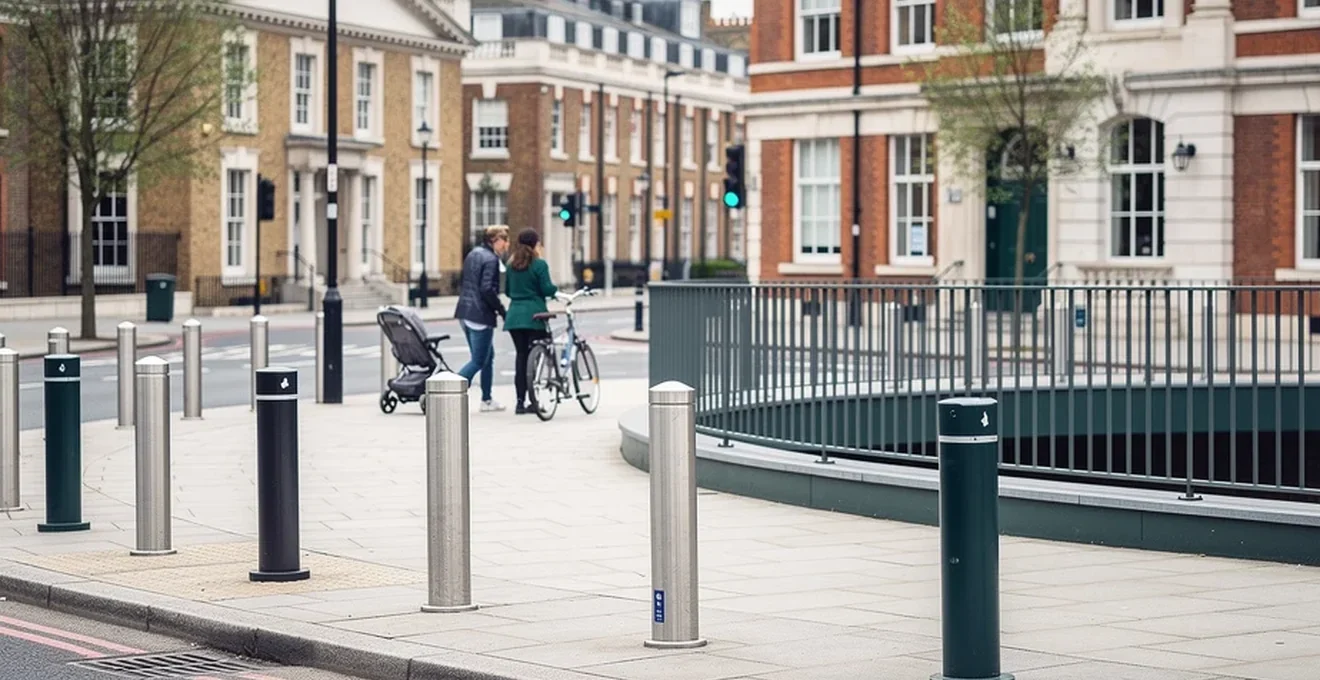
Public spaces work best when movement feels effortless, even though a great deal of planning sits behind the scenes to make that possible. Bollards and railings are two of the most widely used tools for organising these environments, guiding pedestrians, restricting vehicle access, and defining boundaries without turning a street or square into a fortress. Used well, they protect people from vehicle incursions, help those with visual or mobility impairments navigate confidently, and can even complement the character of a heritage streetscape or a modern shared surface scheme. This article looks at how bollards and railings are specified and placed in UK public realm projects, the standards that govern their use, and the material choices that affect how long they last and how much they cost to maintain over time.
Pedestrian segregation and traffic calming through bollard placement
Bollards remain one of the simplest and most effective ways to separate pedestrians from vehicles. Positioned along pavements, at park entrances, outside schools, and at pedestrian crossings, they act as both a physical and visual barrier, discouraging vehicles from mounting kerbs while leaving footways open to walkers, wheelchair users and cyclists. In the UK, government guidance recommends a maximum gap of 1.2 metres between bollards, a spacing that maintains security while allowing pedestrian flow to continue largely unaffected. Studies referenced in UK Traffic Advisory Leaflet guidance suggest that, at this spacing, the impact on pedestrian movement is minor compared with other common street obstructions such as retail kiosks.
Fixed steel bollards versus retractable hydraulic systems
Fixed steel bollards are permanently anchored into the ground, typically by casting them in concrete or bolting them to an existing hard surface. They offer strong impact resistance with minimal moving parts, making them a low-maintenance choice for locations where vehicle access will never be required, such as pedestrianised shopping streets or park boundaries facing busy roads.
Retractable, or telescopic, bollards serve a different purpose. They can be lowered into the ground, either manually or via a hydraulic or electric mechanism, to allow temporary access for emergency vehicles, deliveries or event set-up, then raised again to restore the pedestrian barrier. This flexibility makes them well suited to high streets, market squares and locations that alternate between vehicle and pedestrian use throughout the day. The trade-off is a more complex installation and the need for periodic servicing of the lifting mechanism, sockets and locking systems to keep them operating reliably.
Anti-ram bollard ratings and PAS 68 crash test standards
Where the risk of vehicle-borne attack or ram-raiding is a genuine concern, standard bollards are not sufficient. Anti-ram and anti-terror bollards are engineered and crash-tested to stop or significantly slow a moving vehicle, and their performance is verified against recognised standards such as PAS 68 and ISO 22343, which assess how a bollard performs when struck by a vehicle of a given weight and speed. These bollards are typically found around government buildings, financial institutions, transport hubs and other locations judged to be at higher risk, and they are usually installed as permanent, deeply anchored posts, although telescopic versions rated to the same standards are increasingly available for locations that need occasional vehicle access without compromising on protection.
Decorative cast iron bollards in conservation areas
Not every bollard needs to prioritise raw impact strength. In conservation areas and heritage streetscapes, cast iron bollards are often favoured for their traditional appearance, sometimes incorporating fluted profiles or decorative tops that echo Victorian and Georgian street furniture. Many of today’s cast iron designs even reference a genuinely historic practice: in the nineteenth century, decommissioned naval cannons were embedded muzzle-up into pavements around British ports and cities to act as makeshift bollards, and the rounded « cannonball » bollard shape seen across London’s South Bank today descends directly from that tradition. Cast iron offers a heavy, vandal-resistant presence, though it needs more careful upkeep than modern alternatives, generally requiring repainting to guard against rust and chipping.
Solar-powered bollard lighting for Low-Light visibility
Visibility matters as much as physical strength, particularly in parks and public spaces used into the evening. Bollards can incorporate integrated lighting, and increasingly this is solar-powered, removing the need for a mains electricity connection while still illuminating pathways after dark. Beyond the practical safety benefit of highlighting a barrier that might otherwise be missed in low light, lit bollards also improve the general sense of security in a space and reduce reliance on grid electricity, supporting broader sustainability goals for local authority infrastructure.
Railings as boundary definition tools in urban planning
Where bollards tend to work as discrete, spaced-out markers, railings provide a continuous line, making them the preferred choice where a clear, unbroken boundary is needed, such as along raised walkways, waterfronts, level changes or busy road frontages where pedestrians need to be kept firmly away from traffic. Railings can also carry handrail functions, supporting people on steps, ramps or sloped paths, and they often work alongside bollards rather than instead of them, with railings enclosing a stretch of boundary and bollards marking entry and exit points.
Galvanised mild steel railings for High-Footfall corridors
Galvanised mild steel is a common specification for railings along busy pedestrian corridors, transport interchanges and school boundaries. The galvanising process coats the steel in a protective layer of zinc, substantially improving its resistance to rust and extending its service life, and the galvanised surface can then be powder-coated to add colour and a further layer of durability. This combination gives local authorities a robust, relatively low-maintenance option that can withstand heavy use, knocks from luggage or pushchairs, and repeated exposure to weather.
Powder-coated aluminium railings in coastal environments
Coastal and waterfront settings place particular demands on street furniture, since salt-laden air accelerates corrosion in many metals. Powder-coated aluminium railings offer a lighter-weight alternative to steel while still providing strong resistance to weathering, making them a practical choice for seafront promenades, harbour edges and coastal parks where salt spray is a constant factor. The powder coating adds both a decorative finish and an additional protective barrier, helping to preserve the railing’s appearance and structural integrity over years of exposure.
Heritage-style wrought iron railings in georgian and victorian streetscapes
In towns and cities with a significant stock of Georgian and Victorian architecture, railings are frequently specified to reflect that heritage rather than simply to meet a functional minimum. Wrought iron and cast iron designs, often featuring decorative finials, scrollwork or fluted balusters, allow a boundary treatment to sit comfortably alongside period buildings and conservation area requirements. As with decorative cast iron bollards, these railings do the job of guiding movement and marking boundaries, but their primary value in these settings lies in preserving the character of the streetscape.
Handrail compliance under BS 6180 and building regulations approved document K
Where railings function as handrails or protective barriers on steps, ramps, balconies or changes in level, they must meet specific safety requirements rather than aesthetic preference alone. BS 6180 sets out barrier loading and design requirements for these situations, while Building Regulations Approved Document K covers the protection of people from falling, colliding or being trapped in and around buildings, including guidance on handrail height, baluster spacing and structural loading. Compliance with these frameworks is not optional in most public and commercial contexts, and it should be factored in from the earliest design stage rather than treated as a late-stage adjustment.
Integrating bollards and railings into shared space design
Shared space schemes, where pedestrians, cyclists and vehicles occupy the same surface with minimal separation, rely heavily on careful placement of street furniture to remain safe and legible. Bollards and railings become subtler tools in this context: rather than creating hard segregation, they nudge movement, mark thresholds and protect specific vulnerable points, while leaving the wider space open and flexible.
Woonerf principles and Level-Surface street design
The woonerf concept, originating in the Netherlands, treats streets as shared living spaces rather than traffic corridors, using level surfaces, informal layouts and minimal kerb delineation to encourage drivers to slow down and defer to pedestrians. In this model, bollards and low railings often replace conventional kerbs and barriers as the main way of protecting specific zones, such as seating areas or building frontages, while the rest of the surface remains open to shared use. The approach depends on drivers reading the environment correctly, which is why the placement of bollards at key thresholds matters just as much as their physical strength.
Sightline preservation for cyclists and wheelchair users
Any bollard or railing scheme needs to consider how it affects sightlines for the people using the space, not just vehicles. Bollards placed carelessly at junctions or crossing points can obscure the view between cyclists, wheelchair users and other pedestrians, increasing the risk of collision rather than reducing it. Good practice involves keeping bollard heights and railing designs low enough, or positioned far enough back, that sightlines remain clear at eye level for both standing adults and wheelchair users, particularly around corners and crossing points.
Colour contrast and tactile paving coordination for visually impaired pedestrians
For visually impaired pedestrians, colour contrast and coordination with tactile paving are essential rather than decorative details. Bollards finished in a colour that contrasts strongly with their background, sometimes combined with reflective bands, are far easier to detect, particularly in low light. Where bollards or railings sit near tactile paving, such as at crossing points, their placement needs to align with, rather than interrupt, the tactile guidance system, so that the two features work together instead of sending conflicting signals to someone navigating by cane or by underfoot texture.
Case studies from UK public realm schemes
Several well-known UK public realm projects illustrate how bollards and railings are applied in practice, each responding to a different set of pressures, from shared surface safety to waterfront protection and heritage regeneration.
Exhibition road, london: shared surface bollard strategy
Exhibition Road in South Kensington is one of the UK’s best-known shared surface schemes, removing conventional kerbs in favour of a level, patterned surface used by pedestrians, cyclists and vehicles alike. Bollards play a central role in this design, marking the edges of the carriageway and protecting pedestrian zones without resorting to traditional barriers, relying instead on their visual presence and spacing to guide behaviour across the shared space.
Bristol harbourside railings and waterfront safety barriers
Waterfront regeneration schemes such as Bristol’s Harbourside depend heavily on railings to protect pedestrians from the risk of falling into the water, particularly along busy quaysides used for events, dining and evening leisure. In these settings, railings need to combine reliable safety performance with a design that suits a mixed-use, often historic waterfront setting, frequently drawing on corrosion-resistant materials suited to a damp, exposed environment.
Manchester’s northern quarter pedestrianisation scheme
Pedestrianisation schemes in areas like Manchester’s Northern Quarter typically combine bollards with wider streetscape improvements, restricting vehicle access to protect the pedestrian character of narrow historic streets while still allowing controlled access for deliveries, refuse collection and emergency services. Removable or retractable bollards are particularly useful in this context, since they allow the pedestrian priority of the area to be maintained for most of the day while accommodating the practical needs of businesses that still require occasional vehicle access.
Material selection and lifecycle maintenance considerations
Choosing the right material for bollards and railings is rarely just about upfront cost. Local authorities and property managers need to weigh durability, corrosion resistance and ongoing maintenance demands against the initial price, since a cheaper installation that requires frequent repainting or repair can end up costing more over its lifetime than a higher-specification alternative.
Corrosion resistance in Marine-Grade stainless steel installations
Stainless steel is widely used where a sleek appearance and strong corrosion resistance are both priorities. Grade 304 stainless steel performs well in general applications, but in coastal or heavily salted environments, marine-grade 316 stainless steel is the more appropriate choice, offering superior resistance to the corrosive effects of saltwater and harsh weather. Even so, stainless steel is not entirely immune to corrosion if exposed to harsh chemicals or prolonged moisture without adequate airflow, so cleaning with non-corrosive solutions and ensuring good drainage remain important parts of ongoing care.
Anti-graffiti coatings and powder coating durability
Powder coating is a common finishing choice for both steel and aluminium bollards and railings, offering a wide range of colours alongside genuine protective value. A well-applied powder coat adds a layer of resistance against corrosion and general wear, and many finishes are formulated to resist staining and make graffiti easier to remove without damaging the underlying coating. This combination of aesthetic flexibility and practical durability explains why powder-coated steel appears so frequently across street furniture contracts, from railings on high-footfall corridors to bollards in car parks and public squares.
Whole-life costing for local authority street furniture contracts
When specifying bollards and railings for public contracts, whole-life costing looks beyond the purchase price to account for installation, inspection, maintenance and eventual replacement. Materials such as recycled plastic or polyurethane, for instance, resist rot, rust and corrosion and require minimal upkeep, which can offset a higher initial cost over a long service life. Fixed installations with no moving parts generally demand less ongoing attention than retractable or automatic systems, which need regular checks on lifting mechanisms, locks and drainage to keep functioning correctly, and factoring these differences into a contract from the outset helps avoid unexpected costs later on.
Regulatory frameworks and Counter-Terrorism security guidance
Beyond day-to-day safety and accessibility, bollards and railings in certain locations are shaped by security and highways legislation that governs where and how they can be installed.
National protective security authority hostile vehicle mitigation standards
For sites judged to carry a heightened security risk, such as government buildings, transport hubs and crowded public spaces, hostile vehicle mitigation guidance informs the specification of crash-rated bollards and barriers. This guidance draws on crash-test standards such as PAS 68 and ISO 22343 to ensure that protective measures are proportionate to the assessed threat, balancing the need for robust vehicle mitigation against the equally important goal of keeping public spaces open, welcoming and accessible rather than overtly fortified.
Highways act 1980 provisions for street furniture placement
The placement of bollards and railings on public highways in England and Wales sits within the framework of the Highways Act 1980, which governs how highway land can be used and what obstructions are permissible on it. Any street furniture installed on adopted highway land generally requires the relevant highway authority’s approval, ensuring that new bollards or railings do not obstruct statutory undertakers’ apparatus, drainage, or the rights of way that the Act is designed to protect, and that spacing and positioning remain consistent with the pedestrian accessibility standards expected across the public realm.