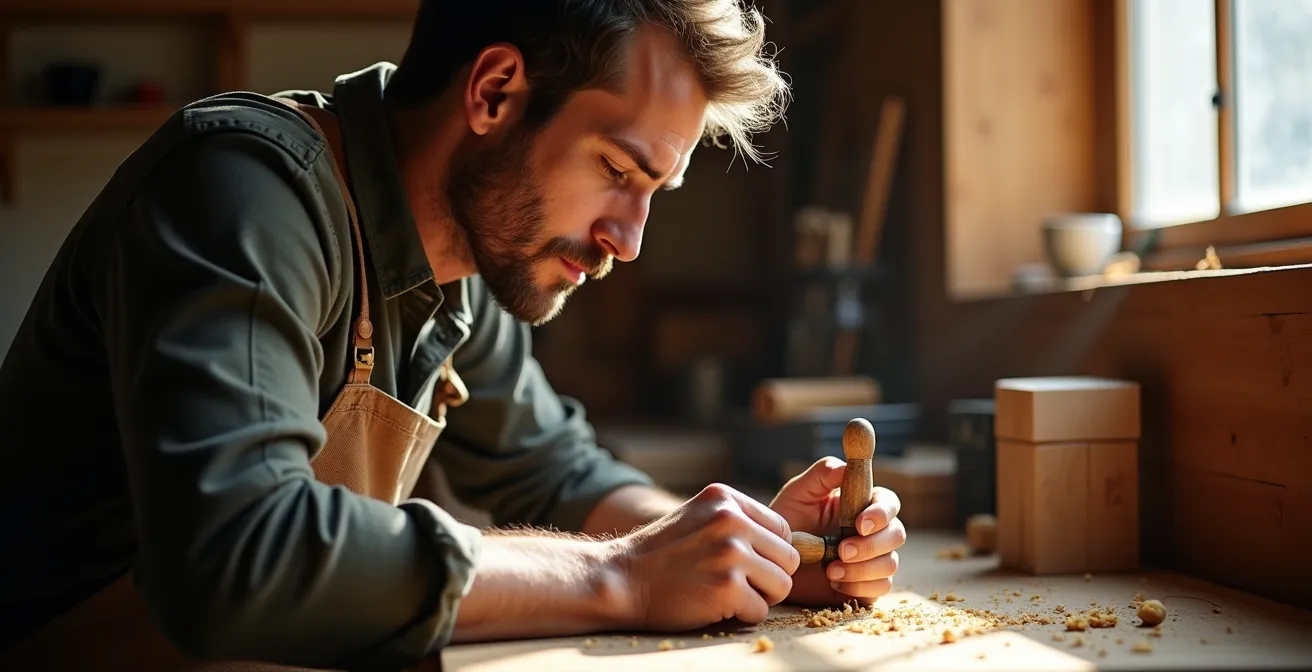
The most effective way to repair a fragmented attention span is not through passive consumption, but by engaging in complex, process-oriented physical creation that synchronizes mind and body.
- Learning complex motor skills physically rebuilds the brain’s focus pathways by increasing myelin.
- Achieving a “flow state,” where challenge meets skill, is the optimal condition for cognitive restoration.
Recommendation: Choose a hands-on hobby, focus on the intrinsic joy of the process rather than the outcome, and schedule it intentionally to create a clear boundary from work.
If you’re a knowledge worker, you likely know the feeling: a persistent “brain fog,” the inability to hold a single thought, and an attention span that feels shattered into a million pieces. Your days are a frantic blur of context-switching between emails, chat notifications, and complex problem-solving. The common advice is to relax by scrolling through social media or binge-watching a series. But this passive consumption often leaves you feeling more drained, not restored. It’s like trying to quench a thirst with salt water.
We’re told to try puzzles or meditation, and while these have their merits, they often fail to address the root of the problem for a brain accustomed to digital overload. The constant partial attention required by our work lives erodes the very neural pathways responsible for deep, sustained focus. To truly repair this damage, we need more than a simple distraction; we need an active, restorative practice.
But what if the most potent antidote to a fragmented digital life is a deeply analogue one? This guide introduces a different perspective, grounded in cognitive psychology: the key to rebuilding your attention isn’t just “focusing harder” but engaging in embodied cognition—a process where your hands and mind work in a synchronized, creative loop. It’s about choosing a hobby not just for enjoyment, but for its power to physically and mentally reconstruct your ability to concentrate.
We will explore the neuroscience behind how motor skills protect the brain, how to find the precise mental “zone” for restoration, and why creating something with your hands is profoundly more restful than consuming content. We will also address the practical pitfalls, such as turning your hobby into another source of stress, and provide concrete strategies to ensure your chosen activity serves its true purpose: to bring clarity back to a scattered mind.
This article provides a structured path to understanding and selecting a hobby for cognitive repair. The following sections will guide you through the science, the strategy, and the practical application of this powerful approach to restoring your focus.
Summary: A Cognitive Psychologist’s Guide to Hobbies That Restore Attention
- Why learning a complex motor skill protects the aging brain?
- How to match challenge level to skill level to enter “the zone”?
- Passive Consumption vs Active Creation: which actually rests the brain?
- The “side hustle” trap that turns your relaxation into work stress
- When to schedule hobbies to separate work day from home life?
- How to start woodworking in an apartment without noise complaints?
- Why slow exhalation physically forces your heart rate down?
- How to value the time and skill inherent in handmade objects?
Why learning a complex motor skill protects the aging brain?
The persistent brain fog many experience isn’t just a feeling; it’s a symptom of neural pathways weakened by constant task-switching. To counteract this, we need activities that don’t just occupy the mind, but actively rebuild it. Learning a complex motor skill—like playing a musical instrument, knitting, or woodworking—is a powerful form of neuro-rehabilitation. This isn’t just about “keeping busy”; it’s a process of targeted myelin plasticity.
Myelin is the fatty sheath that insulates our nerve fibers, much like the rubber coating on a wire. The thicker the myelin, the faster and more efficiently neural signals travel. When you practice a new physical skill, you force your brain to repeatedly fire the same neural circuit. In response, the brain reinforces this pathway by adding layers of myelin. In fact, specific research demonstrates that myelin water fraction increases with motor skill acquisition, physically enhancing the brain’s hardware for that specific task.
This process of myelination is the direct antidote to a fragmented attention span. Instead of jumping between dozens of weak, uninsulated pathways, you are building a robust, high-speed connection dedicated to a single, focused activity. This has profound long-term benefits for cognitive health and resilience against age-related decline.
Case Study: The Complex Wheel and Brain Development
A compelling study on mice illustrates this principle perfectly. When mice were given a standard running wheel, they quickly mastered it. However, when introduced to a “complex wheel” with irregularly spaced rungs, they had to learn a new, more difficult motor skill. This gradual learning process was accompanied by the creation of new myelin-producing cells (oligodendrocytes) in the sensorimotor cortex. Crucially, when researchers blocked the formation of this new myelin, the mice were unable to learn how to run on the complex wheel, proving the physical link between learning a motor skill and building new brain structures.
This isn’t just about long-term protection. The act of learning a motor skill demands a unique form of concentration that quiets the background noise of the mind. It’s a form of embodied cognition, where thinking and doing become one. This is the first step toward repairing your ability to focus.
How to match challenge level to skill level to enter “the zone”?
Simply picking up a tool or an instrument isn’t enough to guarantee cognitive restoration. The magic happens within a specific mental state known as “flow,” or “the zone.” This is a state of complete absorption where you lose track of time, your sense of self dissolves, and the action feels effortless and focused. As a cognitive psychologist, I can tell you this isn’t a mystical concept; it’s a distinct and measurable neurological state. But entering it requires a delicate balance.
The key to accessing this flow channel is to perfectly match the level of challenge to your current skill level. If the task is too easy, you become bored and your mind wanders. If it’s too difficult, you become anxious and frustrated, triggering a stress response that blocks focus. The flow state exists in the narrow, dynamic channel between boredom and anxiety. A hobby that repairs attention is one that allows you to constantly operate within this channel.

This visual of a tightrope walker perfectly captures the concept. To stay on the rope, the walker must make constant, micro-adjustments. Similarly, as your skill in a hobby grows, you must incrementally increase the challenge to remain in the flow channel. If you’ve mastered a simple pottery form, the next step is a more complex one. If you can play a simple chord progression, you add a new chord or a more intricate rhythm.
This state is neurologically different from both regular focus and the “hyperfocus” sometimes associated with ADHD. The following table breaks down these distinctions based on brainwave activity.
| Brain State | Wave Type | Characteristics | Mental State |
|---|---|---|---|
| Flow State | Alpha (8-12 Hz) & Theta (4-8 Hz) | Calm alertness, focused attention, creative insight | Complete absorption, effortless focus |
| Regular Focus | Beta (12-30 Hz) | Active concentration, problem-solving | Effortful attention, conscious processing |
| Hyperfocus (ADHD) | Mixed patterns | Complete absorption to the point of ignoring everything else | Dream-like, outside world ceases to exist |
| Distracted | Gamma spikes, irregular Beta | Fragmented attention, rapid switching | Scattered thoughts, difficulty concentrating |
As the table shows, an analysis of brainwave patterns reveals that flow is characterized by a surge in Alpha and Theta waves, indicating a state of relaxed, creative focus. This is the brain’s ultimate “rest and repair” mode, where attentional residue from the workday is cleansed, and deep concentration pathways are reinforced.
Passive Consumption vs Active Creation: which actually rests the brain?
After a day of intense mental work, the instinct is to collapse onto the sofa and engage in passive consumption: scrolling through feeds, watching TV, or browsing the internet. We call this “relaxing,” but it often fails to restore our cognitive resources. This is because these activities, while low-effort, still engage the brain’s novelty-seeking circuits in a way that perpetuates distraction. The brain continues its pattern of rapid, shallow information processing, doing little to repair a fractured attention span.
The problem is stark: research shows attention spans have dropped from 12 seconds in 2000 to about 8 seconds in recent years, a duration shorter than that of a goldfish. This decline is largely driven by our digital environment, which rewards constant switching. Passive consumption feeds this cycle. Active creation, on the other hand, breaks it. Activities like painting, gardening, cooking, or coding a small project require a fundamentally different mode of engagement. They demand sustained, single-task focus and provide a sensory feedback loop that is deeply grounding.
As HobbyHelp.com notes, “Creative hobbies help to focus your mind by getting you into a state of flow. This can get you out of your head and away from any problems or difficult thoughts that you might have.” This isn’t just about distraction; it’s about re-training the brain. When you are actively creating, your mind is not passively receiving stimuli; it is directing action, solving micro-problems, and integrating sensory information—from the feel of clay to the smell of wood—into a cohesive whole.
Consider the simple act of gardening. A long-term study found that it’s linked to improved cognitive function in later life. It’s not just the physical activity; it’s the combination of mental stimulation and sensory experience that keeps the brain alert. You are planning, observing, and physically interacting with a system, which builds focus in a way that passively watching a gardening show never could. This is the essence of active creation: it pulls you out of the abstract world of information and into the concrete world of action, forcing your brain to practice the very skill it’s losing: deep, unwavering focus on one thing.
The “side hustle” trap that turns your relaxation into work stress
You’ve chosen a hobby. You’re excited. You start creating, and it feels good. But then a dangerous thought creeps in: “I could sell this.” Suddenly, your restorative practice is burdened with the pressures of productivity, monetization, and social validation. This is the “side hustle” trap, and it is the fastest way to turn your sanctuary into another source of stress, completely negating the cognitive benefits.
The moment a hobby becomes about an outcome—a finished product to be sold, a perfect photo for Instagram, or a productivity metric to be met—it ceases to be a tool for attention repair. The focus shifts from the restorative journey to a destination. This re-engages the same performance-driven, anxiety-inducing neural pathways you’re trying to escape from your workday. Your brain is no longer in the calm, creative flow state; it’s back in the high-beta wave state of effortful problem-solving and self-criticism.
To protect your hobby’s restorative power, you must consciously adopt a mindset of process-oriented restoration. The goal is not the finished birdhouse; the goal is the hour of flow you experienced while sanding the wood. The value is not in the “likes” the woven tapestry receives, but in the meditative rhythm of the loom. This requires a deliberate and often difficult shift in perspective, especially for ambitious knowledge workers accustomed to measuring success by external metrics.
The following checklist provides a framework for protecting your hobby from the pressures of productivity and ensuring it remains a true source of cognitive renewal.
Action Plan: The Process Over Outcome Framework
- Define success by time spent in flow, not by the finished product.
- Set clear intentions that the hobby is for mental restoration, not productivity.
- Avoid social media metrics and external validation for at least the first year.
- Practice ‘deliberate imperfection’ to combat perfectionism anxiety.
- Create a written ‘Hobby Manifesto’ stating your commitment to process over outcome.
By internalizing this framework, you create a psychological buffer that protects your leisure time. You give yourself permission for the activity to be “unproductive” in a commercial sense, which is precisely what makes it so productive for your mental well-being and attentional health.
When to schedule hobbies to separate work day from home life?
In the age of remote and hybrid work, the lines between our professional and personal lives have blurred into a single, continuous stream of “on.” This lack of clear boundaries is a major contributor to brain fog and attentional fatigue. A restorative hobby, therefore, is most effective when it is scheduled and ritualized to create a hard stop—a psychological “circuit breaker”—between your work day and your personal time.
The key is to use your hobby as a transitional ritual. This isn’t just about finding a spare hour; it’s about creating a deliberate routine that signals to your brain that one mode of being is ending and another is beginning. A consistent routine helps you enter the flow state more reliably. Establishing a series of small actions—like changing clothes, making a specific cup of tea, or lighting a candle with a particular scent—before you begin your hobby can act as a powerful cue. Over time, your brain learns to associate this ritual with the shift into a focused, restorative state.
There are two primary strategies for scheduling this ritual:
- The Evening Decompression: This is the most common approach. Scheduling your hobby for the end of the workday (e.g., from 6 PM to 7 PM) serves as a definitive barrier. It forces you to shut down your work brain and engage your creative, hands-on brain. This helps cleanse the “attentional residue” from the day and prevents work-related thoughts from bleeding into your evening.
- The Morning Primer: For some, a short session in the morning can be equally powerful. Engaging in 30 minutes of a creative hobby before looking at a single email or notification can prime the brain for a more focused day. It starts your day from a place of calm control, rather than reactive chaos.
The goal of this scheduling is not to “be more productive.” While it’s true that working in the flow state can increase productivity by up to 500%, applying that metric to your hobby falls into the side-hustle trap. Here, the “productivity” we seek is in the production of mental clarity and cognitive rest, which is a powerful byproduct of achieving flow, not the goal itself.
Whether you choose a morning primer or an evening decompression, the consistency of the schedule is what matters. It carves out a protected space in your day that belongs only to you and your restorative practice, teaching your brain to respect the boundary between work and life.
How to start woodworking in an apartment without noise complaints?
The idea of a hands-on hobby like woodworking can seem impossible for those living in small, urban spaces. Visions of loud power tools and clouds of sawdust are enough to deter any apartment dweller. However, this perception is based on an industrial model of woodworking. The tradition of quiet, small-scale craft using hand tools is not only viable in an apartment but is, in many ways, more conducive to achieving a restorative flow state.
The key is to shift your focus from power and speed to precision and process. Hand-tool woodworking is a fundamentally different experience. It’s a conversation with the wood, not a battle against it. The sound is not the roar of a motor but the gentle “shhh” of a hand plane shaving a curl of wood, or the quiet scratch of a Japanese pull saw. This sensory-rich, low-noise environment is ideal for deep concentration.
Setting up a “minimum viable workshop” is surprisingly straightforward. It doesn’t require a dedicated room, but rather a dedicated corner and a commitment to organization. A sturdy, small workbench (or even a kitchen table protected by a mat) can serve as your primary station. The focus should be on acquiring a few high-quality hand tools rather than a collection of noisy, space-consuming machines.

As you can see, a peaceful and productive workspace is entirely achievable. The right tools are essential for maintaining a quiet environment. This table compares common tool types suitable for apartment living.
| Tool Type | Noise Level | Space Required | Best For |
|---|---|---|---|
| Hand saws | Very Low | Minimal | Cutting without power tool noise |
| Chisels & planes | Low | Minimal | Shaping, smoothing, detail work |
| Card scrapers | Silent | Minimal | Finishing without sandpaper dust |
| Compact drill | Moderate | Minimal | Essential holes and screws |
| Japanese pull saws | Very Low | Minimal | Precise cuts in small spaces |
By focusing on tools like Japanese pull saws and card scrapers, you can perform most essential woodworking tasks with minimal noise and dust. This approach not only respects your neighbors but also deepens your connection to the craft, turning a potential obstacle into a core part of the restorative practice.
Why slow exhalation physically forces your heart rate down?
In the pursuit of a restorative hobby, we often focus on the activity itself—the hands, the tools, the materials. But there is a silent, powerful partner in this process: your breath. The synchronization of breath and movement is a core component of entering a flow state, and understanding its mechanism reveals a direct, physical lever for controlling your mental state. The key lies in the vagus nerve and the simple act of slow exhalation.
Your nervous system has two main branches: the sympathetic (“fight or flight”) and the parasympathetic (“rest and digest”). When you are stressed and distracted, your sympathetic system is dominant. A slow, controlled exhalation is one of the fastest ways to activate the parasympathetic system. This is because the vagus nerve, a primary controller of this system, is directly linked to your diaphragm and vocal cords. When you exhale slowly, you stimulate the vagus nerve, which in turn sends a signal to your brain and heart to slow down.
This is not a psychological trick; it’s a physiological command. This is why activities that naturally encourage a rhythm of controlled breathing, like yoga, are so effective for focus. Research has shown that after only 20 minutes of yoga, students could focus and process information better. This benefit is largely attributable to the regulation of the nervous system through breathwork. When engaged in a hands-on hobby, you can consciously apply this principle. By paying attention to your breath—inhaling as you prepare a cut, exhaling slowly as you guide the saw—you are physically anchoring your mind and calming your nervous system.
This mind-body connection is central to the flow state. When you’re absorbed in a hobby like knitting or pottery, your conscious, chattering mind quiets down, and your brain shifts into the Alpha and Theta wave states characteristic of relaxed focus. Your breath naturally deepens and slows, reinforcing this calm state in a positive feedback loop. By consciously using slow exhalation as a tool, you can initiate this process deliberately, guiding yourself more quickly and reliably into a state of cognitive restoration.
Key Takeaways
- True cognitive rest comes from active creation, not passive consumption.
- Learning complex motor skills physically rebuilds focus pathways in the brain through myelination.
- The goal is “process-oriented restoration”—valuing the time in flow over the finished product to avoid stress.
How to value the time and skill inherent in handmade objects?
In a world optimized for speed and efficiency, the idea of spending hours crafting something by hand can seem inefficient or even pointless. We have been trained to measure value in terms of cost and time-to-production. To truly embrace a restorative hobby, a final, crucial mental shift is required: we must learn to reframe the value of what we are doing. The worth of a handmade object is not in its market price, but in the cognitive capital invested in its creation.
This capital is the focused attention, the problem-solving, the mistakes overcome, and the skills acquired. A hand-carved spoon is not just a spoon; it is a physical trophy representing hours of victory over distraction. Each tool mark tells a story of a moment of deep concentration. Each smooth curve is evidence of a newly myelinated neural pathway. As the founder of The Apartment Woodworker beautifully puts it:
It’s the meditative process of making. The weight of the tools in my hands. The smell of the workshop. The empty space on the rack where the material used to be, in potentia.
– The Apartment Woodworker, Hand tool Woodworking for the Urban Apartment Dweller
This perspective transforms the activity. You are not “wasting time”; you are investing it in your mental health. To cultivate this view, begin to document your process not as a project plan, but as a cognitive journal. Note the breakthroughs, the frustrations, and the moments of pure flow. Allow your own idiosyncratic style to emerge, not as a flaw, but as evidence of deep, personal skill acquisition. The value is in the development of an individual practice, a unique dialogue between you and the material.
By valuing the time and skill inherent in the making, you give yourself permission to slow down. You reject the tyranny of productivity and embrace a more human-centered measure of worth. The finished object becomes a powerful, tangible reminder of your capacity for deep focus, a testament to the time you reclaimed from the digital ether and dedicated to the quiet, restorative work of your own two hands.
Start small. Choose an activity that calls to you, acquire one or two simple tools, and dedicate thirty minutes to it today. Do not worry about the outcome. Focus only on the feeling of your hands at work, the rhythm of your breath, and the quiet satisfaction of bringing something new into the world. This is the first step to reclaiming your focus and repairing your mind.