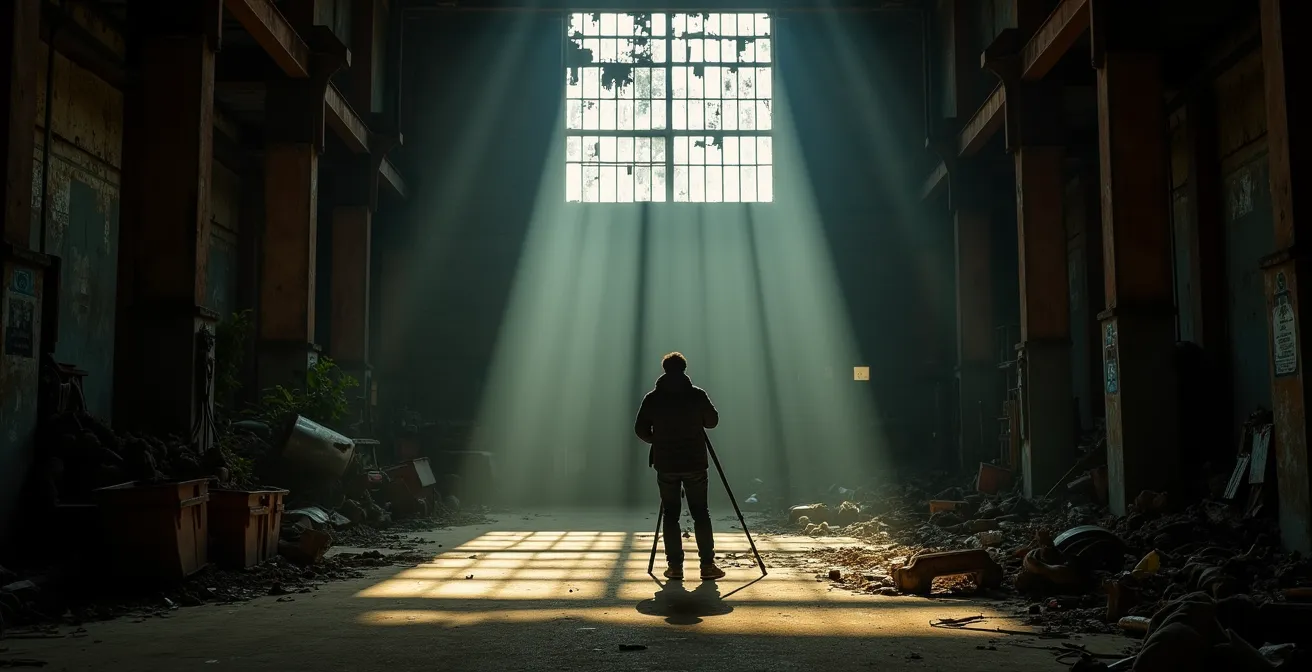
Simply “leaving no footprints” is not enough to protect you or the heritage you document from legal and physical risks.
- Legal liability hinges on the fine line between civil trespass and criminal intent, which is determined by your actions on-site.
- Ethical documentation actively preserves history, but damaging a structure or its historical patina in the process negates its value entirely.
Recommendation: Shift from a mindset of “not getting caught” to one of “professional due diligence” before ever stepping on-site.
The allure of abandoned places is undeniable for photographers and history buffs. These structures, frozen in time, offer a tangible connection to the past. The “Urbex” creed, “take nothing but pictures, leave nothing but footprints,” has long served as the guiding principle for this community. It’s a noble sentiment, born from a desire to preserve these fragile environments. However, from a legal and conservationist standpoint, this maxim is dangerously incomplete. It addresses the symptom—vandalism—but fails to address the complex web of property law, structural liability, and preservation ethics that underpins any exploration.
Merely avoiding theft or graffiti does not absolve an explorer of all responsibility. Every entry onto a property without permission is, at its core, an act of trespass. The true distinction between a documentarian and a criminal is not found in what is left behind, but in a rigorous understanding of the law and a methodological approach to preservation. This guide moves beyond the common platitudes. Instead of simply telling you to be careful, we will analyze how to identify specific structural hazards. Rather than just saying “don’t get caught,” we will dissect the legal nuances that separate a civil infraction from a criminal charge.
This is not a checklist for adventurers; it is a consultation on risk mitigation and ethical conduct. By reframing exploration through the lens of property law and heritage conservation, you can transform a personal hobby into a valuable act of historical documentation, executed with the professionalism and respect these sites deserve. We will explore the physical integrity of these sites, the legal boundaries you must navigate, and the advanced techniques that allow for true, non-invasive preservation.
To navigate this complex field, this article provides a structured overview of the key considerations, from on-site safety assessments to the legal frameworks that govern your actions.
Summary: A Guide to Ethical and Legal Exploration
- Why “take nothing but photos” is crucial for structural integrity?
- How to identify structural instability in abandoned factories?
- Ruins vs Renovation: should every historic site be saved?
- The trespassing law nuance that separates civil from criminal liability
- How to light a pitch-black basement for photography without flash?
- The cleaning technique that accidentally destroyed century-old patina
- How to estimate rehab costs without opening up the walls first?
- How to capture a 360-degree tour with consumer gear?
Why “take nothing but photos” is crucial for structural integrity?
The well-known mantra of urban explorers is more than just an ethical guideline; it is a fundamental principle of structural preservation. Every object within an abandoned site, from a discarded tool to a loose brick, contributes to a delicate state of equilibrium. Removing an item, no matter how insignificant it may seem, can have unforeseen consequences. This act disrupts the archaeological record of the site, erasing a piece of its story. More critically, it can initiate a cascade of minor structural failures. A brick pulled from a wall for a souvenir might compromise the mortar around it, allowing water to penetrate deeper and accelerate decay through freeze-thaw cycles.
This principle of non-interference extends beyond simply not taking souvenirs. It means you are a passive observer, there to document, not to “improve” the scene for a photograph. Moving furniture, opening closed doors, or clearing debris can alter stress loads on fragile floors and supports. The goal of ethical documentation is to capture the site exactly as it is, preserving its current state digitally because its physical form is ephemeral. This approach ensures that future researchers, or even the explorers who follow you, can experience and study the same context.
Case Study: The Proper People’s Approach to Preservation Through Documentation
The popular YouTube channel “The Proper People” exemplifies this ethos. Co-creator Bryan has emphasized that documenting historic structures is critically important as more are demolished each year. Their videos act as a digital archive, allowing the public to see inside magnificent buildings that may soon be lost forever. Their commitment extends to protecting sites from vandals by avoiding sensationalized titles and intentionally keeping the locations of their most vulnerable finds private, proving that true documentation prioritizes the preservation of the site over online clout.
The cumulative effect of many visitors, each making a “small” change, is what ultimately leads to the collapse and loss of these structures. A close-up view of a deteriorating wall often reveals the story of this slow destruction.
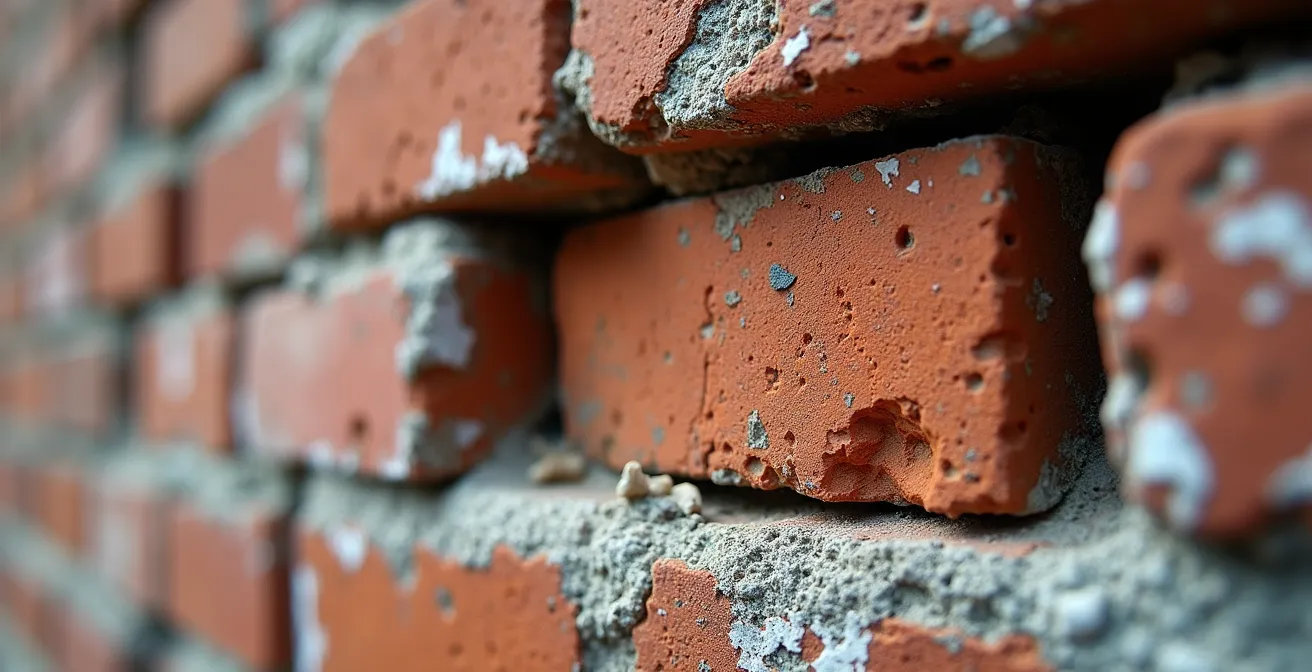
As seen in the texture of decaying brickwork, every disturbance removes a piece of historical data and can weaken the whole. True preservation through photography demands a commitment to absolute passivity. You are there to create a record, not to become a part of its decay.
How to identify structural instability in abandoned factories?
Entering an abandoned structure is, by definition, accepting a certain level of risk. These buildings are not maintained, and what appears solid can be treacherous. While the hobby sees relatively few catastrophic incidents, a study of urban exploration accidents notes that about half a dozen people die or are heavily injured each year, often from falls or structural collapses. Mitigating this risk requires moving beyond a general sense of caution to a systematic process of identifying specific indicators of instability. This is not about being paranoid; it is about conducting the due diligence required to make informed decisions about your safety.
Your senses are your primary tools. Before even entering a room, look up. Are there signs of a collapsed roof or upper floor? Listen for the building’s “voice”—creaking, groaning, or popping sounds are clear warnings of a structure under stress. Never trust a floor without testing it. Industrial sites are particularly hazardous, as floors may be riddled with holes or weakened by chemical spills and water damage. Differentiate between minor settling cracks in masonry and large, diagonal shear cracks, which indicate severe foundation or wall failure. Finally, be aware of environmental hazards. The presence of black mold, common in damp, dark areas, poses a significant respiratory risk and necessitates wearing an FFP3 mask.
Your Multi-Sensory Checklist for Assessing Structural Dangers
- Visual Check: Before entering a room, look up to check for overhead hazards. If the roof or upper floor has collapsed, avoid the area or find a safe path around the debris.
- Sound Assessment: Pause and listen quietly. Creaking, groaning, or shifting sounds are indicators of structural stress and potential imminent collapse. Treat these as immediate warnings.
- Floor Testing: Recognize that floors in decayed buildings are not up to code. Be vigilant for holes and probe uncertain surfaces before committing your full weight. A fall is one of the most common and serious risks.
- Material Inspection: Look for key failure signs like spalling concrete with rust streaks (rebar corrosion), sagging steel trusses, and significant cracks in brickwork.
- Water & Air Tracking: In damp, below-ground spaces, look for black mold, which can be dangerous when inhaled. Always wear appropriate respiratory protection like an FFP3 mask in such environments.
This methodical assessment is not a one-time check at the entrance but a continuous process. Every new room and every new level requires a fresh evaluation. The goal is not to eliminate all risk—that’s impossible—but to understand it, manage it, and know when the only safe decision is to turn back.
Ruins vs Renovation: should every historic site be saved?
The impulse to save every decaying historical site is a noble one, but it collides with harsh economic and philosophical realities. Full restoration is an incredibly expensive and labor-intensive process. For many structures, the funds simply do not exist. Data from heritage organizations paints a stark picture; a recent study revealed that 40% of institutions have no preservation funds, with the vast majority allocating minimal budgets to the task. This financial reality means that choices must be made, and not every building can be returned to its former glory. This is where the work of the ethical documentarian becomes so vital: providing a lasting record of places that are destined to disappear.
This situation also forces a philosophical question: is full renovation always the most respectful outcome? Sometimes, preserving a structure as a “managed ruin” can honor its history more authentically than a pristine, modern reconstruction. This approach, a third way between total abandonment and complete restoration, involves making the site safe for visitors while leaving the marks of time and decay intact. It acknowledges that the process of decay is itself a part of the building’s story. This philosophy validates the aesthetic and historical value of the ruin, framing it not as a failure of preservation but as a deliberate conservation choice.
Case Study: Germany’s Duisburg-Nord Landscape Park – A Managed Decay Success Story
A prime example of this philosophy in action is Germany’s Duisburg-Nord Landscape Park. Instead of demolishing or fully renovating a massive former industrial complex, planners chose to preserve it as a curated ruin. The site was made structurally safe, and key areas were adapted for public use, but the overall aesthetic of industrial decay was intentionally maintained. This approach honors the site’s industrial heritage and the passage of time, demonstrating that preservation can take many forms beyond traditional restoration.
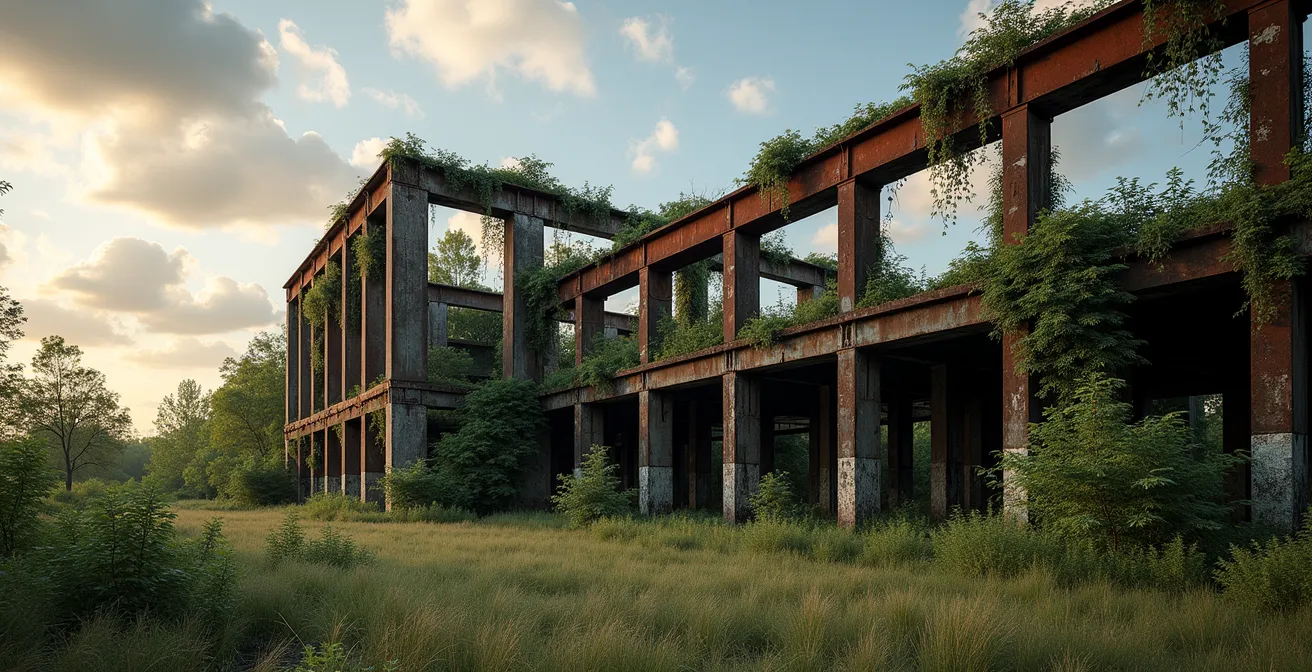
By capturing these sites, whether they are awaiting demolition or being managed as ruins, photographers contribute to a broader cultural appreciation of architectural lifecycles. They document the beauty in decay and the story of nature reclaiming industrial landscapes, offering a perspective that a fully renovated building could never provide.
The trespassing law nuance that separates civil from criminal liability
From a legal standpoint, the most significant risk in urban exploration is not structural failure, but trespassing charges. It is a common misconception that entering a building that “looks abandoned” is legally permissible. Unless a property is explicitly open to the public, it has an owner—be it an individual, a corporation, or a government entity. Entering without permission constitutes trespassing. However, the critical distinction that every explorer must understand is the difference between civil trespass and criminal trespass. This nuance is what separates a minor infraction from a serious offense with lasting consequences.
In most jurisdictions, simple trespass is a civil matter (a tort). This means the landowner could sue you for damages, but it is not typically a police matter. However, the situation escalates to criminal trespass under specific “aggravating factors.” These include: ignoring clearly posted “No Trespassing” signs, refusing to leave when asked by an owner or agent (like a security guard), or breaking and entering (damaging a lock, smashing a window, or forcing a door). Furthermore, entering a site with the intent to commit another crime—such as theft or vandalism—can elevate the charge to burglary, a felony. Your intent and your actions on the property are what define your legal liability.
Case Study: Legal Escalation from Civil Trespass to Criminal Charges
Consider a scenario where an explorer is on a property and is confronted by the landowner. If the explorer immediately apologizes and leaves, the matter will almost certainly remain a civil issue of trespass. However, if the explorer refuses to leave, the act can become “aggravated trespass.” At this point, the police can be called, and criminal charges can be filed. This demonstrates how an explorer’s response to authority is a key determinant in how the law will treat their actions.
Understanding these boundaries is not about learning how to “get away with it.” It is about making a professional risk assessment. A true documentarian respects property rights and knows that causing damage or defying a direct order to leave crosses a bright legal line, jeopardizing not only their own freedom but also the reputation of the entire exploration community.
Action Plan: Navigating Legal Boundaries
- Know the Difference: Understand that entering an abandoned building without permission is, at a minimum, trespassing. If you enter with the intent to steal or vandalize, you could face the far more serious charge of burglary.
- Understand Ownership: Assume every property has an owner. Just because a building is in disrepair does not mean it’s legally abandoned. In urban areas, land is valuable, and ownership is almost always maintained.
- Recognize Aggravating Factors: Be aware that ignoring “No Trespassing” signs, forcing entry, causing any damage, or entering designated critical infrastructure immediately escalates a minor infraction to a serious offense.
- Research Permissions: The only way to be 100% legal is to get permission. Do your homework to find the property owner and ask. Alternatively, seek out abandoned places that are legally open to the public for documentation.
- Document from Public Land: When permission is not feasible, stay on public property. Use zoom lenses from sidewalks or adjacent public areas to document buildings without crossing property lines and incurring liability.
This legal framework is the most important piece of “gear” an explorer can have. It dictates where you can go, what you can do, and how you should behave to ensure your passion for documentation doesn’t result in a criminal record.
How to light a pitch-black basement for photography without flash?
Once you’ve navigated the legal and safety challenges of entering a site, the artistic challenge begins: capturing its atmosphere. In the pitch-black interiors of many abandoned buildings, especially basements, the temptation is to use a powerful on-camera flash. This is often a mistake. A direct flash flattens the scene, destroys shadows, and eradicates the very sense of mystery and decay you are there to capture. The key to powerful low-light photography is to work *with* the darkness, using subtle and controlled light sources to reveal texture and create depth.
One of the most effective techniques is light painting. Using a continuous light source like an LED wand or a powerful flashlight during a long exposure (on a tripod, of course), you can selectively “paint” light onto the parts of the scene you want to emphasize. This method gives you incredible creative control, allowing you to sculpt the light like a brush, creating drama that a single burst of flash could never achieve. Another approach is to embrace the ambient light, however faint. A single beam of light cutting through a broken window can be far more dramatic than a perfectly lit room. Position your subject within that “pocket of light” and let the rest of the scene fall into shadow.
Finally, modern cameras offer another tool: high ISO performance. Don’t be afraid to push your ISO higher than you normally would. The resulting digital noise, or grain, often complements the gritty, textured aesthetic of urban exploration photography. A little noise is far preferable to a blurry image from a slow shutter speed or a flat, uninspired image from a harsh flash. Remember to always carry reliable lighting equipment, including a bright primary flashlight and a headlamp for hands-free navigation, along with extra batteries. Your lighting kit is as crucial as your camera.
Here are some advanced techniques to master for lighting dark spaces:
- Light Painting Method: During a long exposure on a tripod, use a continuous light source to selectively illuminate key areas. Move the light smoothly to “paint” surfaces and avoid creating harsh hotspots.
- Low-Level Ambient Technique: Find and utilize any existing light, no matter how small. A subject lit by a sliver of light from a cracked door will have more impact than one in a room evenly lit by flash.
- High ISO Acceptance: Modern cameras handle high ISO well. A sharp image with some digital grain is often more aesthetically pleasing for this genre than a sterile, noise-free image that lacks atmosphere.
- Exposure Stacking: For ultimate control, take multiple identical shots from a tripod. In each shot, light a different part of the scene perfectly. Later, combine these perfectly lit sections in post-production software.
Mastering light in the darkness is what separates a snapshot from a compelling photograph. By abandoning the flash and embracing these more nuanced techniques, you can capture the true soul of an abandoned place.
The cleaning technique that accidentally destroyed century-old patina
The core of conservation ethics can be summarized in one directive: “do no harm.” For a documentarian, this extends beyond the structure itself to its very surface. One of the most common and damaging mistakes made by well-intentioned explorers is the failure to distinguish between dirt and patina. Dirt is a foreign substance deposited on an object (mud, graffiti, bird droppings) that obscures its surface. Patina, however, is a historical layer formed *by* the object over time through its interaction with the environment—think rust patterns, age-related discoloration on metal, or the weathering of stone. Patina is not contamination; it is a part of the object’s history.
The impulse to “clean” an object for a clearer photograph is a catastrophic violation of conservation principles. There are documented cases where photographers, attempting to make a rusty manufacturer’s nameplate more legible, have scrubbed it with a wire brush. In doing so, they have permanently removed the very historical layer they came to document, destroying irreplaceable information about the object’s age and environmental exposure. The ultimate goal of conservation is not to preserve material for its own sake, but to maintain the values and history embodied by the heritage. Removing patina is akin to tearing a page out of a history book to make the remaining text easier to read.
Case Study: Conservation Ethics Violations in Amateur Documentation
An object’s significance is derived from the values we attach to it, which transforms it into “heritage.” Conservation aims to protect these values. A classic ethical dilemma arises when a photographer encounters a feature obscured by age. For instance, using a wire brush to ‘clean’ a rusty nameplate for a better photo is a fundamental error. This act confuses ‘dirt’ (a foreign substance) with ‘patina’ (a historical layer). By removing the patina, the photographer destroys the very evidence of age and history they intended to capture, violating the core conservation principle of preserving an object’s historical integrity.
Understanding this distinction is paramount. The ethical documentarian knows that their job is to record the object as it is, patina and all. Any cleaning should only be undertaken by trained conservators using the gentlest methods possible. The following table clarifies the critical differences.
| Characteristic | Dirt (Can Remove) | Patina (Must Preserve) |
|---|---|---|
| Origin | Foreign substance deposited recently | Historical layer formed over time |
| Relationship to Object | External contamination | Part of object’s history |
| Examples | Bird droppings, recent mud, modern graffiti | Rust patterns, age discoloration, weathering |
| Conservation Approach | Use gentlest method possible | Do no harm |
| Documentation Value | Obscures historical information | Contains historical information |
By internalizing this chart, sourced from principles outlined in resources like the National Park Service’s preservation guides, an explorer can avoid causing irreversible damage. Your camera is a tool for recording history, not for erasing it.
How to estimate rehab costs without opening up the walls first?
While most urban explorers are focused on artistic or historical documentation, their skills can be applied to a highly practical purpose: preliminary rehabilitation assessment. For potential investors, preservationists, or municipalities, understanding the potential cost of saving a building is the first step. A skilled documentarian can create a visual “preservation feasibility report” from the exterior and accessible interiors, providing crucial clues about underlying structural issues without the need for destructive investigation.
This process involves “reading” the building for signs of distress that point to expensive repairs. A bowed roofline is not just a picturesque feature of decay; it indicates failing rafters or trusses, a major structural repair. Large, diagonal cracks extending from the corners of windows often signal foundation settlement, one of the most costly problems to fix. Patches of white, powdery efflorescence on brick or concrete walls are a clear sign of chronic water infiltration, suggesting hidden mold and rot within the walls. By systematically photographing and noting these indicators, one can build a strong inferential case about the building’s condition.
This documentation becomes even more critical given the widespread lack of formal planning for preservation. Research shows that a staggering 71% of institutions have no digital preservation plans, and many lack the funds for physical assessment. An explorer’s photographic survey can serve as a vital, low-cost first step, helping to prioritize which buildings might be viable candidates for salvation and which are likely too far gone. This approach elevates documentation from a hobby to a valuable civic service, providing the data needed to begin a conversation about a building’s future.
A photographer can use a variety of remote techniques to build this assessment:
- External Sign Reading: Systematically identify and photograph bowed rooflines, diagonal cracks from windows, and brick efflorescence to document likely rafter, foundation, and water damage issues.
- Historical Imagery Analysis: Use tools like Google Earth’s timeline feature to track the progression of decay, such as a roof collapse over several years, to document the rate of deterioration.
- Public Records Research: Cross-reference findings with public tax records or old real estate listings to find information on when key systems (roof, HVAC) were last updated.
- Narrative Development: Assemble the visual evidence into a coherent report that documents not just the problems but also the potential for restoration, creating a full picture for stakeholders.
Key Takeaways
- Legal entry is paramount: Trespassing liability shifts from civil to criminal based on aggravating factors like ignoring signs or causing damage.
- Structural assessment is non-negotiable: Actively look for specific signs of instability like shear cracks and listen for structural stress sounds.
- Ethical documentation is non-invasive: The goal is to preserve the scene as-is, which means never altering surfaces or removing patina.
How to capture a 360-degree tour with consumer gear?
The ultimate goal of documentation is to preserve and share the experience of a place. While traditional photography captures beautiful fragments, 360-degree virtual tours offer an immersive way to archive an entire environment. With modern consumer-grade 360 cameras and software, any explorer can create an interactive “virtual museum” of an abandoned site, allowing people all over the world to walk its halls long after it’s gone. This is perhaps the most complete form of “taking nothing but pictures.”
Creating a compelling tour is more than just taking a series of 360-degree photos. It requires narrative planning. A good tour guides the user through the space logically, perhaps following the original workflow of a factory or the daily path of a hospital’s inhabitants. This storytelling transforms a collection of images into a coherent experience. Technology can also help overcome physical and legal barriers. By mounting a 360 camera on a tall monopod or painter’s pole, you can capture views from inside a fenced-off area or through a high, broken window, documenting inaccessible spaces while remaining on legally permissible ground.

The true power of these tours is unlocked with interactive software like Kuula or Pano2VR. These platforms allow you to embed “hotspots” within the scene. A user could click on a piece of machinery to see a close-up detail shot, read text explaining its function, or even see an archival photo of it in operation. This layering of context creates a rich, educational experience that goes far beyond simple exploration. It is the culmination of the documentarian’s mission: to not only preserve the image of a place but also to capture and share its story. This form of digital preservation is a powerful, accessible way to give these forgotten buildings a new life online, safe from both vandals and the wrecking ball.
Even with advanced gear, be aware that many sites have surprisingly modern security. Basic motion sensors or door contacts can trigger silent alarms that alert owners or police, leading to a swift response. Your advanced documentation efforts should not lead to a false sense of security regarding on-site risks.
By adhering to these legal, ethical, and technical guidelines, you can ensure your explorations are not only safe and lawful but also contribute meaningfully to the preservation of our shared architectural heritage. Your next step is to apply this framework of due diligence to your own practice.