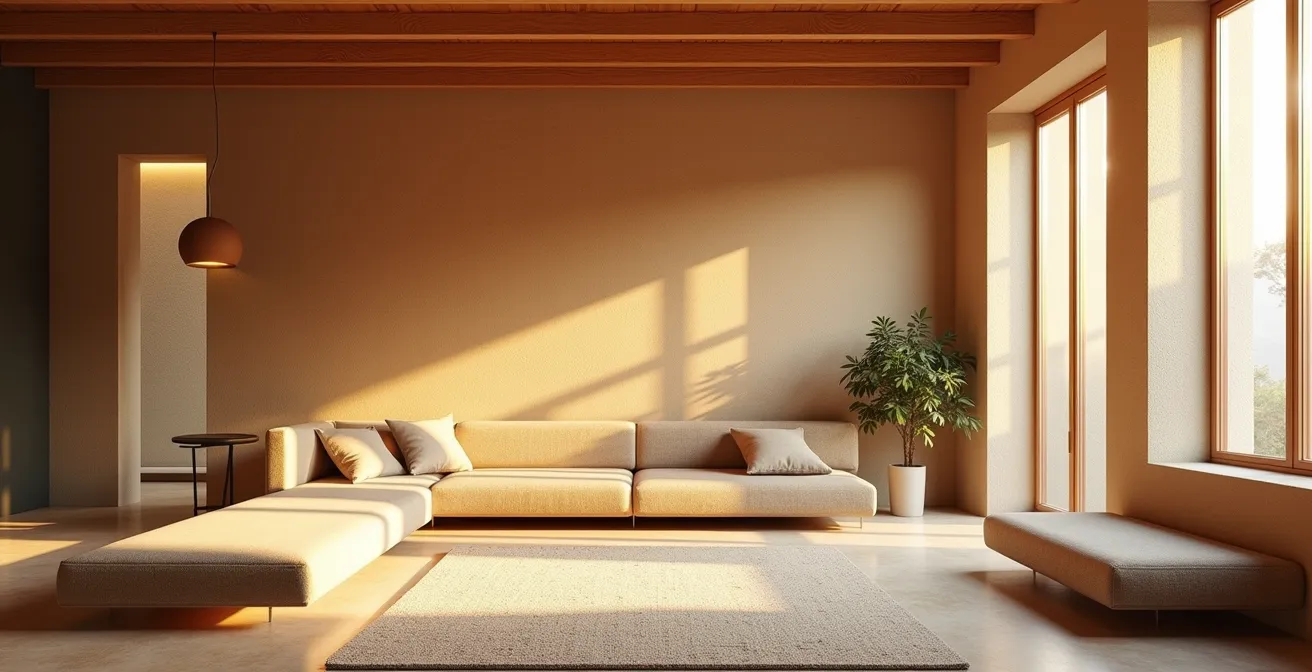
A truly healthy home is less about individual “eco-friendly” products and more about the integrity of the whole-building system designed to manage air, moisture, and light.
- Improperly combined natural materials can create severe health hazards like mold, negating their benefits.
- The long-term value, durability, and health resilience of superior materials often justify their initial premium cost.
Recommendation: Focus on designing integrated systems for moisture management, using materials with proven longevity, and selecting lighting that supports your natural circadian rhythm, rather than just chasing “non-toxic” labels.
As a building biologist, I often meet homeowners who have meticulously researched low-VOC paints and formaldehyde-free cabinets. They are trying to do the right thing for their family’s health, yet they still struggle with persistent allergies, poor sleep, and a general sense of unease in their own homes. This happens because the conventional approach to a “healthy home” is fundamentally flawed. We’ve been taught to focus on individual products, creating a checklist of “good” and “bad” items.
The common advice—ventilate more, choose natural fibers, avoid specific chemicals—only scratches the surface. It treats the house as a static collection of objects. But what if the real key to a healthy living environment isn’t in the products themselves, but in how they interact as a dynamic, living system? A house breathes. It manages moisture. It interacts with light. Viewing your home as an ecosystem, rather than a container, changes everything. It shifts the focus from simply avoiding toxins to actively creating an environment that supports biological well-being.
This guide will walk you through that systemic approach. We won’t just list materials. We will deconstruct the hidden interactions within your walls, floors, and even your lighting, to show you how to build a home that doesn’t just shelter you, but actively contributes to your long-term health. We’ll explore the unseen impact of common materials, the critical importance of moisture management, how to justify better materials financially, and why even your light bulbs are a key part of a healthy building strategy.
To navigate this holistic approach, this article breaks down the essential systems and material choices you need to consider. The following sections will guide you from the foundational elements of your home’s structure to the finer details that impact your daily well-being.
Summary: A Systemic Guide to Building a Healthy Home
- Why standard drywall off-gassing affects your sleep quality?
- How to find structural timber within 100 miles of your site?
- Bamboo vs Reclaimed Wood: which withstands humidity better?
- The insulation mistake with natural materials that causes mold in walls
- How to justify the 20% premium of eco-materials through longevity?
- Bio-based plastics vs Recycled paper: which has the lower carbon footprint?
- How to cut your heating bill by 60% without rebuilding from scratch?
- Why 6000K light in the bathroom destroys your melatonin production?
Why standard drywall off-gassing affects your sleep quality?
The air inside our homes is often far more polluted than the air outside. In fact, research from the EPA reveals that indoor concentrations of some Volatile Organic Compounds (VOCs) are consistently up to 10 times higher than outdoors. A primary, and often overlooked, contributor to this problem is standard drywall. While seemingly inert, the gypsum core, paper facing, and joint compounds can off-gas a cocktail of chemicals, including formaldehyde, acetaldehyde, and benzene, for months or even years after installation.
This low-level chemical exposure has a direct, tangible impact on our most vital restorative process: sleep. During the night, our bodies are supposed to be focused on cellular repair and detoxification. However, when we inhale these airborne compounds, the body’s detoxification systems (the liver and kidneys) are forced to work overtime. This metabolic stress can prevent us from reaching the deepest, most restorative stages of sleep, leading to grogginess, a weakened immune system, and long-term health issues. You may not smell anything, but the microscopic off-gassing is a constant stressor on your biology, particularly in the bedroom where you spend a third of your life.

The porous nature of drywall, as seen in the texture of its surface, is the very landscape where this off-gassing occurs. Choosing alternatives like magnesium oxide (MgO) board, certain plaster finishes, or even specialty drywall products that actively absorb VOCs can make a significant difference. It’s not just about avoiding a toxin; it’s about removing a fundamental obstacle to your body’s nightly recovery and improving your sleep quality at its source.
How to find structural timber within 100 miles of your site?
Sourcing wood locally is a cornerstone of healthy and sustainable building. It reduces the embodied carbon from transportation and connects your home to its regional landscape. More importantly, it gives you direct control over the wood’s history, allowing you to avoid the chemical treatments often applied to mass-market lumber. Finding quality, untreated structural timber within a 100-mile radius is more achievable than many think if you know where to look.
The process begins by bypassing the big-box stores and connecting directly with the source. Your state’s forestry commission and local university agricultural extension programs are invaluable resources. They often maintain lists of certified sustainable logging operations and smaller, family-owned sawmills that are invisible to mainstream supply chains. These small-scale operators are more likely to use traditional air-drying or kiln-drying methods without resorting to chemical fungicides or anti-stain agents. A great resource to also consider are local Amish and Mennonite communities, which are often hubs for traditional lumber practices and can provide beautifully milled, untreated wood.
When you connect with a supplier, your role as a building biologist is to ask the right questions. Insist on documentation for kiln-drying temperatures and specifically inquire about any treatments used, requesting heat-treated (HT) wood over chemically treated alternatives. Finally, embed these requirements into your contracts. Specifying “locally milled, untreated timber from within a 100-mile radius with verification documentation” in your agreements with your architect and builder makes your commitment official and legally binding.
As long as we manage our forest resources for the greater good, wood is the best there is.
– Kyle Freres, Vice President of Operations at Freres Engineered Wood
By taking these proactive steps, you transform a simple building material into a story of local craftsmanship and a pillar of your home’s healthy foundation, ensuring the very bones of your house are clean and non-toxic.
Bamboo vs Reclaimed Wood: which withstands humidity better?
In humid environments like bathrooms and basements, material choice is critical. Bamboo and reclaimed wood are often promoted as “green” flooring options, but their performance in high-moisture areas is complex and fraught with hidden risks. Understanding their unique properties is key to avoiding costly failures and potential health issues. Reclaimed wood, for instance, has a variable resistance to humidity that depends entirely on its species and, more importantly, its past life. Wood reclaimed from old barns may be incredibly resilient, but wood from industrial settings could have been treated with creosote or arsenic, which can be released in humid conditions.
Case Study: Cork as a Superior Alternative for Humid Environments
While bamboo and reclaimed wood present challenges, cork emerges as a clear winner for humid spaces. According to building science resources, cork flooring is naturally hypoallergenic, antimicrobial, and resistant to both moisture and pests due to its inherent suberin content. This waxy substance makes each cell impervious to water, preventing the rot, mold, and adhesive failures common with other materials. This makes cork an ideal and often overlooked alternative for bathrooms, kitchens, and basements where moisture is a concern.
The following table breaks down the nuances of these materials and introduces cork as a high-performance, healthy alternative. The primary failure point for engineered bamboo is often not the material itself but the adhesives used in its construction, which can swell, delaminate, and off-gas when exposed to persistent moisture. Solid bamboo is better, but requires careful acclimatization. A detailed comparison from a healthy materials supplier, faswall.com, highlights these critical distinctions.
| Material | Humidity Resistance | Key Considerations | Hidden Risks |
|---|---|---|---|
| Solid Bamboo | High (natural resistance) | Requires 1-2 week acclimatization | No adhesive-related failures |
| Engineered Bamboo | Low-Medium | Adhesives are failure point | Off-gassing in humid conditions |
| Reclaimed Wood | Variable | Depends on previous treatments | Lead paint, creosote, arsenic release |
| Cork (Alternative) | Excellent | Natural suberin content | Anti-microbial properties |
Ultimately, for high-humidity areas, choosing a material with inherent, natural resistance to moisture like cork is a far safer and more durable strategy than relying on topical sealers or hoping that an engineered product’s adhesives will hold up over time.
The insulation mistake with natural materials that causes mold in walls
Choosing natural insulation like sheep’s wool, cellulose, or cork is an excellent step towards a healthy home. These materials are non-toxic, have great thermal properties, and are often made from renewable resources. However, there is a catastrophic mistake that can turn this healthy choice into a hidden mold factory: creating a vapor profile mismatch within your wall assembly. A wall is not just insulation; it’s a layered system designed to manage heat, air, and moisture. When these layers don’t work together, condensation can form inside the wall cavity, leading to rot and mold that you can’t see until it’s a major health and structural problem.
This happens when a vapor-permeable (breathable) insulation like wool is paired with a vapor-impermeable (non-breathable) barrier on the wrong side of the wall. For example, installing vinyl siding (which doesn’t breathe) on the exterior of a wall filled with wool insulation can trap moisture that is trying to escape from the inside of the house. The moisture hits the cold back of the vinyl, condenses into water, and saturates the insulation, creating the perfect breeding ground for mold. The key is to design a wall assembly that can dry out, either to the inside or the outside.

As a building biologist, the goal is to create a wall system where the permeability of each layer is carefully considered. This involves calculating the dew point to ensure it doesn’t fall within the insulation itself and using “smart” vapor retarders that can change their permeability based on the season and humidity levels. Proper design and testing are non-negotiable when using natural materials to ensure your healthy insulation doesn’t become a source of illness.
Action Plan: Preventing Mold in Natural Insulation Assemblies
- Analyze the Assembly: Calculate the dew point location within your proposed wall assembly (exterior cladding, sheathing, insulation, vapor barrier, interior finish) before construction begins.
- Check Compatibility: Never combine vapor-permeable insulation (like wool or cellulose) with a vapor-impermeable barrier (like polyethylene sheeting or vinyl siding) on the “cold” side of the wall where it can trap moisture.
- Specify Smart Barriers: In complex climates, install smart vapor retarders (e.g., Intello, MemBrain) that adjust their permeability, allowing the wall to dry out in either direction depending on the season.
- Ensure Exterior Breathability: Verify that your exterior cladding choice allows the wall assembly to dry to the outside. Avoid impermeable claddings if your primary drying path is outward.
- Mandate Post-Installation Testing: Commission a blower door test after insulation is installed to identify and seal any air leaks that could transport moisture-laden air into the wall cavity, ensuring proper air sealing without trapping moisture.
How to justify the 20% premium of eco-materials through longevity?
One of the biggest hurdles for homeowners is the upfront cost of high-performance, non-toxic materials, which can sometimes carry a 20% premium over conventional options. The key to justifying this investment is to shift the financial perspective from initial purchase price to total 50-year lifecycle cost. Conventional materials like vinyl flooring and laminate are cheap to buy but expensive to own. They have a short lifespan, requiring multiple replacements over the decades you live in your home. Each replacement cycle involves not just the cost of new material, but also labor for removal and installation, and the disposal of the old product.
In contrast, durable materials like solid hardwood, cork, or high-quality tile have a much higher initial cost but a vastly longer lifespan. Solid hardwood can last over 100 years, requiring only occasional refinishing. Cork flooring can last 40 years or more. When you factor in the avoided replacement costs, the seemingly “expensive” material often becomes the more economical choice over the long term. This is a powerful argument to present to your budget-conscious self or a skeptical builder.
The table below, based on data for various flooring types, illustrates this principle. As shown in an analysis from a supplier of non-toxic materials, the total cost of ownership for cheap laminate flooring can quickly surpass that of premium solid wood.
| Material Type | Initial Cost | Lifespan | Replacements (50 yrs) | Total 50-Year Cost |
|---|---|---|---|---|
| Vinyl Flooring | $3/sq ft | 10-15 years | 3-4 times | $12-15/sq ft |
| Solid Hardwood | $8/sq ft | 100+ years | 0 (refinish only) | $10/sq ft |
| Laminate | $2/sq ft | 10 years | 5 times | $12/sq ft |
| Cork | $5/sq ft | 40+ years | 1 time | $10/sq ft |
This financial analysis doesn’t even account for the unquantifiable health benefits: better indoor air quality, fewer allergens, and the peace of mind that comes from living in a non-toxic environment. When you invest in longevity, you are also investing in resilience and a stable, healthy home for your family for generations.
Bio-based plastics vs Recycled paper: which has the lower carbon footprint?
When evaluating the environmental impact of building materials, the conversation often centers on recycled content. However, a more sophisticated analysis is required to determine a material’s true carbon footprint. This involves looking beyond recycling to concepts like embodied carbon, operational carbon, and carbon sequestration. While using recycled paper insulation, for example, avoids new emissions associated with manufacturing virgin material, it does not actively remove carbon from the atmosphere.
Bio-based materials, derived from plant sources like wood fiber, cork, or hemp, operate on a different principle. As these plants grow, they absorb CO2 from the atmosphere through photosynthesis. When they are harvested and turned into a durable building material, that carbon is effectively locked away—or sequestered—for the entire lifespan of the building. This means that bio-based materials can go beyond being “carbon neutral” and actually become carbon negative, acting as a carbon sink within your home. This is a crucial distinction: recycled materials avoid new pollution, while bio-based materials can reverse existing pollution.
To make an informed choice, you must evaluate the material’s entire lifecycle:
- Embodied Carbon: Emissions from extraction, manufacturing, and transportation.
- Operational Carbon: The material’s impact on the building’s energy performance over its life. For example, an insulation that settles over time loses R-value, increasing heating and cooling costs and thus, operational carbon.
- Carbon Sequestration: The amount of CO2 the material stores.
- End-of-Life: The potential for the material to be composted, recycled, or reused, versus being sent to a landfill.
Therefore, while recycled paper is a good choice, a bio-based material like wood fiber or cork insulation often has a superior net carbon footprint because of its ability to actively sequester carbon for decades, turning your home’s structure into a part of the climate solution.
How to cut your heating bill by 60% without rebuilding from scratch?
For homeowners in existing houses, achieving significant energy savings doesn’t have to mean a full gut renovation. By applying the 80/20 principle and focusing on the highest-impact areas, you can dramatically reduce your heating costs and improve your home’s comfort. The biggest culprits for heat loss are almost always air leakage and poor insulation in the attic and basement, not necessarily the walls or windows.
Start by becoming a detective. You can perform a DIY blower door test by sealing the house, placing a powerful box fan in a doorway blowing outwards, and then walking around with an incense stick. The smoke trail will be visibly sucked towards cracks in window frames, electrical outlets, and especially around the attic hatch and the rim joists in the basement. Sealing these major air leaks is your first, most cost-effective step. Next, focus on high-impact insulation. Bringing your attic insulation up to modern standards (R-38 to R-60) with a material like blown-in cellulose provides the single biggest return on investment for reducing heat loss.
Water heating is another major energy drain. Upgrading to an on-demand water heater eliminates the standby losses of a conventional tank, which can account for 20% of your water heating costs. A less expensive but still effective upgrade is a drain-water heat recovery system. This simple device uses warm outgoing water from your shower to pre-heat the cold water coming in, capturing up to 40-60% of the heat energy that would literally go down the drain. These strategic upgrades target the biggest sources of energy waste for a fraction of the cost of a full rebuild.
- Identify Air Leaks: Use a DIY blower door test (box fan and incense) to find the biggest leaks in your attic, basement, and around windows.
- Insulate High-Impact Zones: Add blown-in cellulose to the attic to achieve an R-value of R-38 to R-60 and seal the rim joists in your basement with rigid foam board.
- Improve Window Performance: Apply climate-specific Low-E window films. These are inexpensive coatings that reflect heat, keeping it in during winter and out during summer.
- Recover Water Heat: Install a drain-water heat recovery system to capture energy from your shower’s waste water.
- Eliminate Standby Losses: Upgrade to an on-demand (tankless) water heater to stop paying to keep a large tank of water hot 24/7.
Key Takeaways
- A healthy home is a holistic system; the interaction between materials is more important than any single “non-toxic” product.
- Moisture management is paramount. A breathable wall assembly that can dry out is essential to prevent hidden mold, especially when using natural insulation.
- The higher upfront cost of superior, durable materials is often offset by their longer lifespan and the avoidance of multiple replacement costs over the decades.
Why 6000K light in the bathroom destroys your melatonin production?
A truly healthy home extends beyond physical materials to the invisible environmental signals that govern our biology, and light is one of the most powerful. Specifically, the color temperature of the light we are exposed to in the evening has a profound impact on our sleep-wake cycle, or circadian rhythm. Research from the National Institutes of Health confirms that exposure to light with a high color temperature, like the cool, blue-white light of a 6000K bulb, aggressively suppresses the production of melatonin, the hormone that signals our body it’s time to sleep.
Many modern bathrooms are outfitted with bright, daylight-replicating fixtures (5000K-6500K) to help with morning routines like applying makeup. While beneficial in the morning, using this same light in the evening before bed is like telling your brain it’s noon. This sends a powerful, disruptive biological signal that delays the onset of sleep and reduces its quality. This effect is not confined to the bathroom; the intense light often spills into adjacent hallways and bedrooms, disrupting the entire household’s pre-sleep environment. The problem is not the light itself, but the mismatch between the light’s signal and the time of day.
The solution is to design a circadian-friendly lighting system that provides the right light at the right time. This can be achieved through several strategic layers of light:
- Tunable White LEDs: Install primary fixtures that can be adjusted from a bright, energizing 5000K for the morning to a warm, calming 2200K (similar to candlelight) for the evening.
- Dimmer Controls: All lighting should be on dimmers to reduce the overall intensity of light after sunset.
- Night-time Circuit: Add a separate, secondary lighting circuit with a dedicated red light (around 660nm wavelength). Red light has been shown to have a minimal impact on melatonin production, making it ideal for nighttime bathroom visits without jolting you awake.
- Strategic Placement: Position lights to minimize glare and prevent light from spilling into other rooms, protecting the dark environment needed for sleep.
By treating light as a biological nutrient, you can design a bathroom that supports your energy in the morning and protects your rest at night, completing the vision of a truly holistic, healthy home.
Now that you understand the principles of a systemic approach—from material sourcing and moisture management to lifecycle cost and circadian lighting—you have the power to create a home that is more than just a shelter. You can build a resilient, supportive environment that actively contributes to your family’s health and well-being for years to come. Start applying these concepts to your own project, whether it’s a new build or a renovation, by questioning every material and every combination to ensure they work in harmony.