
In summary:
- Embrace voluntary downsizing not just to save money, but as a direct path to financial freedom.
- Hack the housing system by exploring alternative models like tiny homes and co-living to bypass the traditional rental market.
- Master spatial arbitrage by making every square foot functional, from micro-kitchens to under-stair pantries.
- Identify and neutralize hidden cost structures, such as inflated utility fees, that make “affordable” housing expensive.
- Leverage market inefficiencies, like converting vacant commercial space, to create unique and affordable living opportunities.
For most young professionals, the dream of city living is crushed by a single, brutal reality: rent. The old advice to spend no more than 30% of your income on housing feels like a cruel joke when the average one-bedroom in a major metropolis easily consumes 50% or more. The conventional solutions—getting roommates or moving to a distant suburb—are compromises that chip away at the very lifestyle you moved to the city for. This approach is fundamentally flawed because it operates within a broken system.
The real path to affordable urban living isn’t about finding a slightly cheaper apartment. It’s about a radical paradigm shift. It requires you to stop playing the game and start hacking the system. This means rethinking the very concept of “home” and strategically exploiting the inefficiencies of the real estate market. It involves a conscious choice to trade underutilized space for financial freedom, a concept known as voluntary downsizing. It’s not about deprivation; it’s about precision and purpose.
This guide will not tell you how to negotiate a few dollars off your lease. Instead, it will provide a playbook for housing system hacking. We will explore how to leverage micro-spaces for massive financial gains, navigate zoning loopholes to place unconventional homes, dissect the true costs of “all-inclusive” living, and master the art of spatial arbitrage. Forget the 30% rule; we’re aiming for a housing cost so low it accelerates your financial independence.
To navigate this new approach, this article breaks down the essential strategies into a clear roadmap. The following sections detail the core hacks, from the financial philosophy behind micro-living to the practical steps for cutting costs and maximizing space in any urban environment.
Summary: How to Live in a City Without Spending 50% of Your Income on Rent
- Why a 300 sq ft apartment creates more financial freedom than a house?
- How to legally park a Tiny House on a city lot without eviction?
- Co-living vs Traditional Renting: is the community worth the premium?
- The utility fee trap in ‘affordable’ housing complexes
- How to design a functional kitchen in a kitchenette footprint?
- Commercial vs Residential: which sector recovers faster after a crash?
- How to turn dead space under stairs into a functional pantry?
- How to cut your heating bill by 60% without rebuilding from scratch?
Why a 300 sq ft apartment creates more financial freedom than a house?
The conventional wisdom equates a larger home with greater success. But this thinking ignores the crushing weight of a mortgage, property taxes, maintenance, and high utility bills. A small apartment, especially one under 300 square feet, flips this script entirely. It’s not a step down; it’s a strategic move toward financial liberation. By drastically cutting your single largest expense, you unlock the ability to save and invest at a rate that is impossible for the average homeowner.
This is the core principle of the Financial Independence, Retire Early (FIRE) movement, where adherents aggressively reduce expenses to achieve hyper-savings. Proponents often aim for savings rates of 50% or more of their income, a goal made attainable primarily by minimizing housing costs. Choosing a micro-apartment isn’t about compromise; it’s a calculated decision to buy back your time and future. The money saved monthly can be channeled directly into index funds, REITs, or other investments that build wealth instead of just maintaining a lifestyle.
The benefits extend beyond pure finance. Take the case of Alaina Randazzo, who lived in a tiny 80-square-foot apartment in NYC for just $650 a month. While extreme, her experience highlights a profound truth: freedom from high rent gave her the ability to travel and live life on her own terms. As she noted, “People need a lot less than what they think they need.” This mindset of voluntary downsizing frees up not only capital but also mental energy. Less space means less to clean, less to maintain, and less to worry about, creating a surplus of time and money to invest in what truly matters.
How to legally park a Tiny House on a city lot without eviction?
The Tiny House movement offers a compelling solution to high housing costs, but for urban dwellers, the primary obstacle isn’t building the house—it’s finding a legal place to put it. Most city zoning codes weren’t written with 200-square-foot homes on wheels in mind. However, navigating this legal grey area is the essence of housing system hacking. Success depends on deep research and creative agreements, not just hoping you won’t get caught.
The key is to understand how your city classifies structures. A tiny house on wheels might be considered a recreational vehicle (RV), while one on a foundation could fall under regulations for Accessory Dwelling Units (ADUs). Some cities are slowly adopting specific ordinances for tiny homes, but loopholes often exist in current codes. For example, some mixed-use or commercial zones surprisingly allow for a residential presence, especially if it’s tied to a business or a caretaker role on the property.
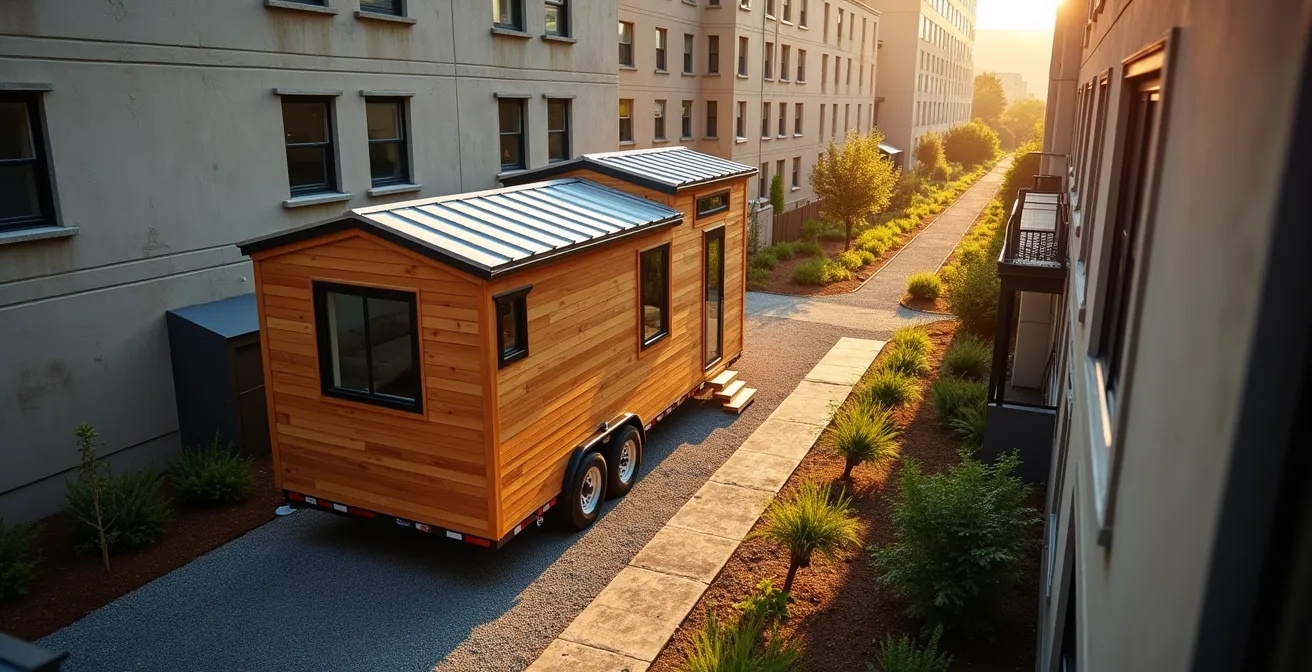
This visual perfectly illustrates the end goal: a legally and beautifully integrated urban tiny home. Achieving this requires proactive legal footwork. Instead of renting a lot, consider drafting a “caretaker agreement” with a property owner. This frames your presence as a service (providing security or garden maintenance) rather than a tenancy, which can often bypass certain residential zoning restrictions. Connecting with local tiny house alliances or advocacy groups is also critical, as they often maintain private lists of friendly landowners and placement opportunities.
Action Plan: Securing a Legal Spot for Your Urban Tiny House
- Research Local Codes: Deep-dive into municipal zoning codes, specifically looking for regulations on Recreational Vehicles (RVs) and Accessory Dwelling Units (ADUs), as these are the most common classifications for tiny homes.
- Identify Favorable Zones: Pinpoint mixed-use or even light commercial zones that may have provisions for a residential unit, caretaker’s quarters, or security lodging.
- Draft a Caretaker Agreement: Create a template for an agreement where you offer services (e.g., property security, landscape maintenance) in exchange for parking, which can circumvent traditional landlord-tenant laws.
- Connect with the Community: Join local and national tiny house community groups online and offline to access private knowledge bases and lists of placement opportunities shared among members.
- Document Everything: Maintain a comprehensive file documenting your home’s compliance with any applicable building standards (like RVIA certification for homes on wheels) and local safety codes to present to officials if questioned.
Co-living vs Traditional Renting: is the community worth the premium?
Co-living spaces have emerged as a popular alternative to traditional renting, promising a built-in community, flexible leases, and all-inclusive amenities. They position themselves as the seamless solution for transient young professionals. However, this convenience often comes at a premium. The central question is whether the “community” and perks justify a higher monthly cost compared to a standard apartment, especially when the goal is aggressive saving.
There’s common space — think sharing economy, extra space when you need it. There’s a roof deck, a dining area that can be reserved, lounge with TV and Wi-Fi. This is where Julie Williams brings dates – not to her studio.
– NPR Report, Living Small In The City
As the NPR report highlights, the value proposition is clear: you get access to a lifestyle and amenities that would be unaffordable in a private apartment. For someone new to a city, the curated social events and shared spaces can be invaluable, reducing social isolation and providing networking opportunities. The all-inclusive billing also simplifies budgeting by bundling rent, utilities, internet, and even cleaning services into one predictable payment. But a critical analysis is needed to see if you are truly saving money.
The following table breaks down the cost-benefit analysis. While the sticker price for co-living is often higher, the bundled value of utilities, a gym membership, and cleaning services can sometimes close the gap. The decision ultimately hinges on your personal valuation of convenience and community versus the raw financial benefit of a cheaper, no-frills traditional rental.
This comparative analysis breaks down the financial and lifestyle trade-offs between the two housing models, helping you determine where the true value lies for your specific needs.
| Factor | Traditional Rental | Co-living Space |
|---|---|---|
| Average Monthly Cost | $1,500-2,000 | $1,800-2,500 |
| Utilities Included | No | Yes |
| Cleaning Service | $0 (self) | Included |
| Gym Access | $50-100/month | Included |
| Community Events | None | Weekly |
| Flexible Lease Terms | 12 months minimum | 3-6 months available |
The utility fee trap in ‘affordable’ housing complexes
You’ve found it: an apartment with a surprisingly low base rent in a desirable neighborhood. But before you sign the lease, you must investigate the “hidden cost structures” designed to extract more money from tenants, with utility billing being the primary culprit. Many large apartment complexes employ a practice called Ratio Utility Billing System (RUBS), and it can turn an affordable unit into a financial drain.
Under RUBS, instead of being billed for your actual electricity, water, or gas usage, the building’s total utility bill is divided among tenants based on a formula. This formula might use factors like apartment square footage, number of occupants, or other arbitrary metrics. The problem is a total lack of transparency and incentive. If your neighbor takes 45-minute showers, you help pay for it. The landlord has no incentive to invest in water-saving fixtures or energy-efficient windows because they simply pass the entire cost on to you. This is not just inconvenient; it’s a system that penalizes a conservative user.
For many tenants, these bundled fees can be a significant financial burden. It’s not uncommon for renters making $120,000 or less to spend around 5% of their monthly net income on utilities alone, a figure that can be inflated by these opaque billing systems. To protect yourself, you must become a forensic accountant for your lease. Before signing, demand to see several months of past utility statements for the specific unit. Ask directly if the building uses RUBS or sub-metering. If they use RUBS, ask for the exact formula used. This scrutiny alone can sometimes signal to a landlord that you are a tenant who won’t be easily overcharged.
How to design a functional kitchen in a kitchenette footprint?
In a micro-apartment, the kitchen is often the first casualty, shrinking to a “kitchenette” that seems barely functional. However, a small footprint does not have to mean a compromised cooking experience. The key is aggressive optimization and mastering vertical spatial arbitrage. Every design choice must serve multiple purposes, and every surface is a potential storage area. A well-designed micro-kitchen can be more efficient than a sprawling suburban one where everything is a ten-step journey away.
The foundation of a functional micro-kitchen is a smart layout and multi-use tools. Forget the traditional “work triangle”; in a kitchenette, a linear layout along a single wall is most effective. This keeps everything within arm’s reach. From there, the focus shifts to maximizing every inch of space with clever storage solutions that go beyond simple cabinets.

As seen here, vertical space is your greatest asset. Walls are not just for pictures; they are for storage. To achieve this level of efficiency, consider these strategies:
- Go Vertical: Install ceiling-mounted pot racks and magnetic knife strips to get bulky items off the counter. A French cleat system allows for modular, adjustable shelving and hanging bins.
- Choose Smart Tools: Invest in stackable, nesting cookware and collapsible tools like colanders and measuring cups. Every item should earn its place.
- Create Convertible Surfaces: Mount a fold-down cutting board over the sink or a stovetop cover to instantly create more prep space when needed.
- Think Magnetically: Use magnetic spice containers that can live on your refrigerator door or a wall-mounted steel sheet, freeing up an entire cabinet.
Commercial vs Residential: which sector recovers faster after a crash?
For the truly savvy housing hacker, affordability isn’t just about finding a cheap apartment today; it’s about anticipating future opportunities. Understanding the different recovery cycles of commercial and residential real estate can unlock unique and deeply discounted housing options in the wake of an economic downturn. History provides a clear lesson: the two sectors do not move in lockstep.
In most market corrections, residential real estate tends to be more resilient and bounce back quicker than commercial. Homeownership is tied to fundamental needs, and while prices may dip, demand remains relatively stable. Commercial real estate, on the other hand, is directly tied to the health of businesses, which are far more volatile during a recession. Post-recession, companies shed office space and retailers close, leading to a glut of vacant commercial properties. For instance, historical data shows that after the 2008 crash, residential properties recovered a full 2-3 years faster than their commercial counterparts.
This lag in recovery creates a powerful opportunity. As cities grapple with high commercial vacancy rates and a simultaneous housing shortage, they become more open to creative zoning changes. This is where the housing hacker can thrive. The post-pandemic era, for example, has seen a surge in projects converting empty office buildings and retail storefronts into live-work lofts and affordable apartments. Cities are fast-tracking these conversions to revitalize downtown cores. By monitoring commercial vacancy rates and local zoning board meetings, you can position yourself to acquire or rent a unique space—like a former warehouse loft or a small office converted into a studio—for a fraction of the cost of a traditional residential unit in the same area.
How to turn dead space under stairs into a functional pantry?
In the quest for spatial efficiency, no area is too small or awkward to be optimized. The triangular void under a staircase is a prime example of “dead space” that is often ignored but holds immense potential. With some clever planning and a bit of DIY spirit, this area can be transformed from a dusty closet into a highly organized and functional pantry, adding significant value to a small home or apartment.
The most effective solution is to build a system of custom-fit, full-extension rolling drawers. This approach avoids the problem of a deep, dark closet where items in the back are lost forever. By having the storage roll out to you, every inch of the triangular space becomes accessible. The key is to use heavy-duty drawer slides rated for the weight of canned goods and other pantry staples. This isn’t a place to cut corners on hardware.
To elevate the project from a simple storage unit to a high-functioning system, consider integrating modern organizational hacks. These small additions can make a huge difference in daily use:
- Install Motion-Activated LEDs: Place thin LED strips along the undersides of the drawers or the interior of the cabinet. They will illuminate the contents automatically when you pull a drawer out, making it easy to find what you need.
- Create a Temperature-Stable Zone: The space under the stairs can be prone to temperature fluctuations. Adding some basic foam board insulation can help create a more stable environment, ideal for storing root vegetables or wine.
- Implement a QR Code Inventory: For the truly organized, place a small QR code on the front of each drawer. Link this code to a simple shared spreadsheet listing the contents. A quick scan with your phone tells you what’s inside without having to open it, making grocery lists a breeze.
Key Takeaways
- Financial Freedom is the Goal: The primary driver for alternative housing isn’t just saving money, but strategically reallocating capital to build wealth and buy back your time.
- Hack the System, Don’t Just Play It: True affordability comes from exploiting legal loopholes (zoning for tiny homes) and market inefficiencies (commercial conversions), not just finding a cheaper listing.
- Every Square Inch Counts: Master spatial arbitrage by using vertical storage, multi-functional furniture, and converting dead zones like under-stair spaces into functional areas.
- Beware of Hidden Costs: A low base rent can be deceptive. Always audit utility billing systems (like RUBS) and other bundled fees that can inflate your monthly expenses.
How to cut your heating bill by 60% without rebuilding from scratch?
For many renters and homeowners in small spaces, utility costs—especially heating and cooling—can be a major budget-buster. While a full gut renovation is out of the question, a series of targeted, low-cost interventions can dramatically reduce your energy consumption. A 60% reduction in heating costs is an ambitious but achievable goal, and it relies on a two-pronged attack: first, sealing the building envelope, and second, optimizing your heating system with smart technology.
Before you touch your thermostat, you must stop heat from escaping. Your home is likely riddled with tiny air leaks around windows, doors, outlets, and plumbing penetrations. A simple DIY audit using an incense stick on a windy day can help you find them; watch where the smoke is blown to detect drafts. Sealing these leaks with weatherstripping, caulk, and expanding foam is the single most cost-effective action you can take. For windows, applying a clear plastic insulation film on the interior creates an insulating air gap, acting like a budget double-pane window and significantly improving its R-value.
Once your home is better sealed, you can focus on smarter heating. A programmable or smart thermostat is a non-negotiable tool in this fight. It allows you to create heating zones and schedules based on your actual occupancy patterns, so you’re not paying to heat an empty room. According to some studies, smart thermostats alone can achieve an average 23% reduction in heating costs. By combining a tightly sealed envelope with intelligent, zone-based heating, you can stop wasting energy and make a significant dent in your monthly utility bills.
Ultimately, escaping the rent trap is an active pursuit, not a passive hope. It requires a shift in mindset from consumer to strategist—one who views the urban housing market as a system to be understood and leveraged. By embracing these hacks, you are not just finding a place to live; you are designing a life of greater financial freedom and personal autonomy. Start today by analyzing your single biggest expense and identifying one strategy from this guide to challenge it.