
You don’t have to sacrifice cardiovascular gains or bone density when you give up high-impact running.
- Mastering walking mechanics—from glute activation to proper posture—unlocks benefits that rival high-impact exercise.
- Targeting Zone 2 heart rate turns your walk into a precise tool for fat oxidation and metabolic health.
Recommendation: Shift your focus from simply moving to moving skillfully to build a durable, high-performance body for life.
For years, running has been held as the gold standard for cardiovascular fitness. But for many, especially as we age or recover from injury, the relentless impact on our joints becomes a non-negotiable price we’re no longer willing to pay. The common advice is to switch to “low-impact” alternatives like swimming or cycling. While these are excellent exercises, this advice often comes with an unspoken fear: are we sacrificing real, tangible benefits like bone density and high-level conditioning?
This leads to a frustrating trade-off between joint health and peak fitness. We dutifully switch to the pool or the elliptical, but wonder if we’re truly doing enough to maintain a strong heart, resilient bones, and a lean physique. We miss the feeling of a challenging workout and the clear metrics of progress that running provided. The conversation often stops at just “finding an alternative,” without exploring how to make that alternative truly powerful.
But what if the key isn’t just switching activities, but mastering the one we do every day? The true solution lies in transforming walking from a casual activity into a technical, high-performance skill. This guide moves beyond the generic advice. We will deconstruct the biomechanics of walking to show you how to replicate running’s most sought-after benefits—from stimulating bone growth to optimizing fat burn—all without the punishing impact. We will explore how to engage the right muscles, choose the right gear, and use data to turn every walk into a potent tool for longevity and peak physical health.
This article will provide a clear roadmap, breaking down the science and practical steps to elevate your walking routine. From building a powerful stride to interpreting your body’s recovery signals, you’ll gain the knowledge to train smarter, not just harder.
Summary: How to Maximize Cardiovascular Benefits Without the Impact of Running
- Why impact walking prevents osteoporosis better than swimming?
- How to engage glutes while walking to prevent lower back pain?
- Walking Shoes vs Running Shoes: the heel drop difference explained
- The forward head lean that reduces your lung capacity while walking
- When to increase pace to hit Zone 2 for fat oxidation?
- Folding bike vs Electric scooter: which fits better on a crowded train?
- Why paddleboarding burns more calories than you think?
- How to interpret Heart Rate Variability (HRV) to predict illness?
Why impact walking prevents osteoporosis better than swimming?
When transitioning from running, many people turn to swimming, believing it’s the ultimate joint-friendly exercise. While it’s fantastic for cardiovascular health and muscle endurance, it lacks a critical component for long-term skeletal resilience: weight-bearing impact. Your bones are living tissue that responds to stress. Much like muscles grow stronger when challenged, bones reinforce themselves when subjected to the forces of gravity and impact. This process is known as Wolff’s Law, and it’s your primary defense against age-related bone density loss and osteoporosis.
This is where walking holds a distinct advantage. Each step you take sends a small, productive stress signal through your legs, hips, and spine, prompting bone-building cells (osteoblasts) into action. Swimming, by its very nature, unloads the skeleton, which is why it feels so good on the joints but does little to promote bone density. A large-scale prospective study confirmed that a significant association between longer duration of daily outdoor walking and reduced osteoporosis risk was found among older adults. The mechanism is clear: walking helps reduce bone turnover and resorption, preserving your skeletal framework for the long haul.
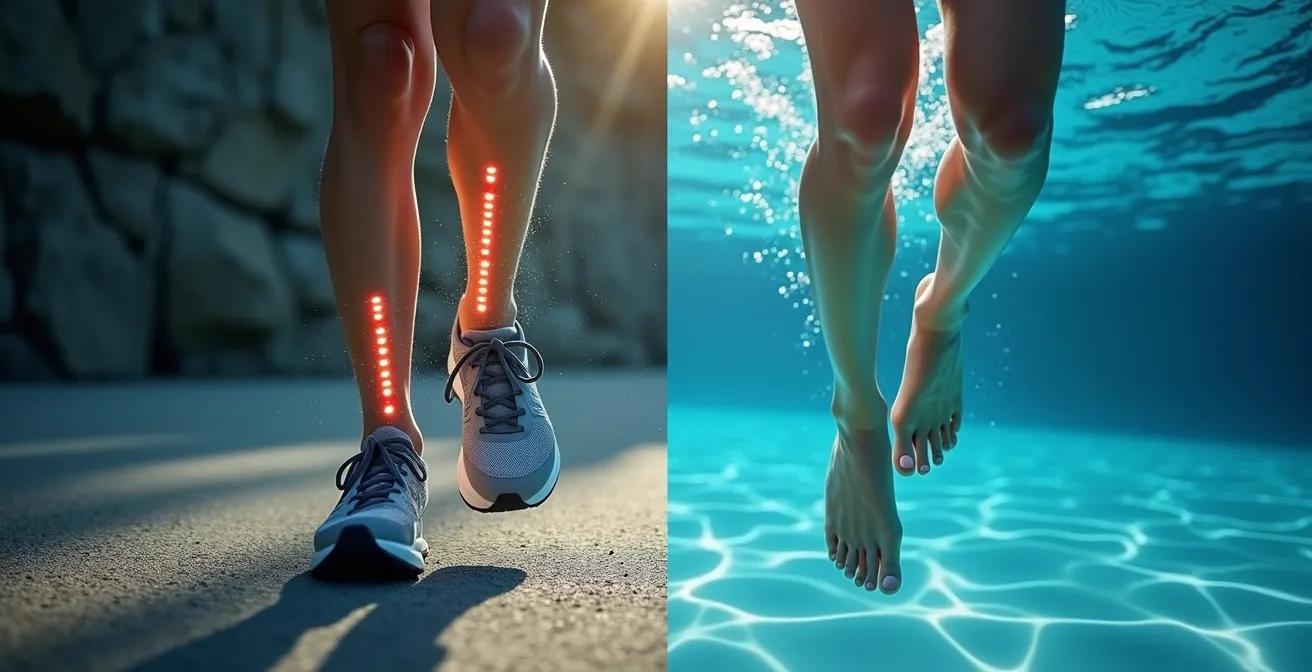
As the visual demonstrates, the ground reaction forces in walking are essential. This doesn’t mean you need the high impact of running, which can be destructive. Instead, walking provides the optimal dose of constructive stress—enough to stimulate growth without overwhelming the joints. It’s the sweet spot for building a robust skeleton that can support an active life for decades to come, a benefit you simply can’t get in the water.
How to engage glutes while walking to prevent lower back pain?
One of the most common complaints among both active and sedentary individuals is lower back pain. Often, the hidden culprit is not the back itself, but weak or inactive gluteal muscles. Your glutes are the powerhouse of your lower body, designed to extend your hips and propel you forward. When they don’t fire properly—a condition often called “gluteal amnesia”—smaller, less capable muscles like the lower back erectors and hamstrings are forced to compensate. This overuse leads to strain, fatigue, and chronic pain. In fact, a systematic review of 24 studies found that individuals with chronic low back pain consistently show reduced gluteal muscle strength and more trigger points.
Transforming your walk into a therapeutic, glute-strengthening exercise requires conscious effort and proper technique. It’s not about walking faster, but walking smarter. The goal is to re-establish the neuromuscular connection between your brain and your glutes, teaching them to be the prime movers in your stride. This starts with focusing on pushing off from your trailing leg with force, consciously squeezing the glute of that leg as you propel yourself forward. This single cue shifts the workload from your quads and lower back to your powerful posterior chain.
To systematically build this habit, you need a clear plan of action. The following audit provides a structured approach to awaken your glutes and integrate them into every step, turning your daily walk into a powerful tool for preventing and alleviating lower back pain.
Your Action Plan: Auditing Your Glute Activation for a Pain-Free Walk
- Points of contact: During your stride, consciously focus on pushing through your heels rather than the balls of your feet. This is the primary contact point that initiates the gluteal drive.
- Collecte: Before you walk, perform a set of 10-15 glute bridges. Inventory the sensation: can you feel the muscles contracting strongly, or is the effort felt more in your hamstrings or back?
- Cohérence: While walking, integrate the “squeeze at push-off” cue. Check if this aligns with maintaining a neutral spine. A good mental image is to imagine balancing a cup of water on your lower back to prevent overarching.
- Mémorabilité/émotion: Turn your walk into a mindful practice. Focus on the feeling of power and propulsion coming from your hips, contrasting it with any sensation of strain in your lower back.
- Plan d’intégration: To make this pattern automatic, schedule 3-4 dedicated glute activation sessions (like bridges, clamshells, and bird-dogs) into your week, separate from your walks.
Core stabilization training based on gluteal muscle-strengthening exercises is believed to enhance the stability in the spine and pelvis, leading to reduced back pain and improved function.
– Research team from MDPI study, Effects of Gluteal Muscle Strengthening Exercise-Based Core Stabilization Training
Walking Shoes vs Running Shoes: the heel drop difference explained
Choosing the right footwear seems simple, but it’s a critical component of biomechanical efficiency and injury prevention. Many people assume that a good running shoe is automatically a good walking shoe, but this overlooks a key design difference: the heel-to-toe drop. This measurement refers to the height difference between the heel and the forefoot of the shoe, typically measured in millimeters. It directly influences your foot-strike pattern and how forces are distributed through your lower limbs.
Running involves different gaits—some runners are heel-strikers, others midfoot or forefoot strikers. Running shoe designs cater to this variety, with drops ranging from 0mm to over 12mm. Walking, however, has a much more consistent pattern: an initial heel strike followed by a smooth roll through the midfoot to a toe-off. A shoe with a higher drop (8-12mm) facilitates this natural rolling motion, reducing strain on the shins and Achilles tendon. Using a low-drop running shoe for walking can feel unnatural and may force an inefficient gait. A biomechanical analysis confirmed that heel-to-toe drop is a key factor influencing the running pattern and loading of lower extremity joints, and the same principles of load management apply to walking.
Understanding which drop is appropriate for your activity is essential for both performance and longevity. A higher drop in a walking shoe supports your natural mechanics, while a recovery shoe might use an even higher drop to temporarily unload a sore calf or Achilles. The following table breaks down these differences to help you make an informed choice.
| Activity | Recommended Drop | Key Benefits | Considerations |
|---|---|---|---|
| Walking | 8-12mm | Facilitates heel-to-toe rolling, reduces shin strain | Matches natural heel-strike pattern of walking |
| Running | 4-10mm | Varies by strike pattern and preference | Lower for forefoot strikers, higher for heel strikers |
| Recovery/Injury | 10-14mm | Reduces Achilles and calf stress | Can shift load to knees if excessive |
The forward head lean that reduces your lung capacity while walking
In our modern, screen-focused world, a subtle but damaging postural habit has become epidemic: the forward head lean. When walking, your head should be balanced directly over your shoulders, allowing the spine to maintain its natural, efficient curves. However, many of us walk with our head pushed forward, as if peering at an invisible phone. This seemingly minor misalignment has significant consequences. For every inch your head moves forward from its neutral position, it effectively adds an extra 10 pounds of pressure on your cervical spine.
This added strain is not just a recipe for neck and shoulder pain; it directly sabotages your cardiovascular workout by compromising your breathing. A forward head posture causes the chest to collapse and the shoulders to round forward, physically restricting the movement of your rib cage. This compression limits the ability of your diaphragm—your primary breathing muscle—to contract fully. As a result, your breaths become shallower and less efficient. You take in less oxygen with each inhale, forcing your heart to work harder to oxygenate your muscles and reducing your overall aerobic capacity.
Correcting this posture is one of the most impactful changes you can make to improve the quality of your walk. It requires shifting from a passive slouch to an active, upright stance. This not only alleviates spinal stress but also opens up your thoracic cavity, allowing for deep, diaphragmatic breaths that fuel your body efficiently. The following techniques will help you cultivate this powerful, upright posture.
- Visualize a helium balloon tied to the crown of your head, gently pulling you upward.
- Strive to align your ears directly over your shoulders while walking.
- Keep your chest open and your shoulders relaxed, but drawn slightly back and down.
- Practice periodic “wall checks” before your walks: stand with your back against a wall, ensuring your head, shoulders, and glutes are in contact with it.
- Focus on deep diaphragmatic breathing, feeling your belly expand as you inhale, rather than just your chest.
When to increase pace to hit Zone 2 for fat oxidation?
To truly maximize the cardiovascular benefits of walking, you must learn to manipulate intensity. Not all walking is created equal. A leisurely stroll is great for mental health and light activity, but to trigger significant physiological adaptations—like improving metabolic health and burning fat—you need to operate within a specific intensity range known as Zone 2. This is the heart rate zone where your body becomes exceptionally efficient at using fat as its primary fuel source. For longevity and endurance, training in Zone 2 is paramount.
So, how do you know if you’re in Zone 2? While a heart rate monitor is the most precise tool (typically 60-70% of your max heart rate), a simpler, no-tech method is the “talk test.” As Healthline’s medical review team notes, moderate-intensity exercise, which aligns with Zone 2, is an activity that allows you to hold a conversation, but is too taxing to allow you to sing. If you can easily belt out your favorite tune, you need to pick up the pace. If you’re too breathless to speak in short sentences, you’re likely in a higher zone and should slow down.
For a more concrete target, experts suggest a minimum pace. For example, UCLA Health experts confirm that walking briskly at 2.5+ miles per hour is typically sufficient to enter this beneficial zone for most adults. The key is to find the pace that elevates your heart rate enough to challenge your system without pushing into an anaerobic, sugar-burning state. This metabolic calibration turns your walk from a simple stroll into a targeted fat-oxidation session.
This image captures the essence of mindful, Zone 2 walking: paying attention to your body’s signals of exertion to stay in that perfect metabolic sweet spot. It’s not about speed for speed’s sake, but about sustained, purposeful intensity.
Folding bike vs Electric scooter: which fits better on a crowded train?
While mastering walking is a foundational skill for low-impact fitness, a comprehensive longevity strategy often involves a variety of activities. For those with a daily commute, integrating low-impact cardio can be a challenge. “Last-mile” solutions like folding bikes and electric scooters offer a way to replace passive transport (like a car or bus) with something more active and efficient. Both can be combined with public transport like trains, but they present different trade-offs in terms of practicality and fitness benefits.
A folding bike directly contributes to your cardiovascular health. Every pedal stroke is an active effort, engaging your leg muscles and elevating your heart rate. It’s a workout integrated seamlessly into your commute. However, even when folded, bikes can be cumbersome. Their larger wheel diameter and often awkward weight distribution can make them difficult to navigate through crowded train cars or up and down station stairs.
An electric scooter, on the other hand, is primarily a passive form of transport. It won’t give you a cardio workout, but its value lies in time efficiency, allowing you to create space for intentional exercise. For example, using a scooter for the longest leg of your commute might free up 20 minutes for a dedicated brisk walk to or from the station. Scooters are generally more compact and easier to carry, though their long, flat shape when folded can be an obstacle. The choice depends on your primary goal: integrating the workout directly, or creating time for a more focused session.
| Factor | Folding Bike | Electric Scooter |
|---|---|---|
| Cardiovascular Benefit | Active cardio integrated | Passive transport |
| Folded Footprint | Larger wheel diameter | Long deck when folded |
| Weight Distribution | Awkward for stairs | More compact to carry |
| Maintenance Issues | Chain grease concern | Wheel grime on clothes |
A hybrid approach is often best. You can alternate between a bike and scooter based on your schedule, or use a scooter to ensure you always have time for a 15-20 minute Zone 2 walk as part of your commute. This “hybrid commute” strategy ensures you meet your daily activity goals consistently.
Why paddleboarding burns more calories than you think?
When seeking variety in your low-impact cardio routine, it’s easy to overlook stand-up paddleboarding (SUP). Often perceived as a leisurely pastime, it is, in fact, a surprisingly potent full-body workout. The secret to its effectiveness lies in the element of instability. Balancing on an unstable surface like a paddleboard forces your body to constantly make micro-adjustments, engaging hundreds of small and large stabilizer muscles throughout your core, back, legs, and feet.
This constant, often involuntary, muscle engagement creates a significant metabolic demand. While you are consciously paddling, your body is also performing a continuous, low-level isometric workout just to stay upright. This is why even a casual session of paddleboarding can burn upwards of 300 calories per hour, a rate comparable to a brisk walk or light jog, but without any of the joint impact. It’s a perfect example of how challenging your body’s systems in novel ways can lead to impressive fitness gains.
Beyond the calorie burn, paddleboarding offers a unique benefit for longevity: it’s a powerful tool for training proprioception. This is your body’s awareness of its position in space, a sense that naturally declines with age and is a key factor in fall prevention. The continuous balance challenge on a paddleboard hones this sense, making you more stable and coordinated in all your daily activities.
Case Study: Proprioception Training and Fall Prevention
The constant micro-adjustments required for balance on an unstable surface like a paddleboard engage hundreds of stabilizer muscles throughout the core, back, legs, and feet. This involuntary isometric contraction provides a full-body workout while improving proprioception—the body’s awareness of position in space. According to health experts at the Cleveland Clinic, this directly translates to better balance and a reduced risk of falls in daily life activities, which is especially beneficial for aging populations seeking to maintain independence and mobility.
Key Takeaways
- True low-impact success lies in mastering the mechanics of walking, not just switching activities.
- Activating your glutes is the non-negotiable foundation for a powerful stride and a pain-free back.
- Calibrating your pace to hit Zone 2 transforms a simple walk into a targeted, fat-burning workout.
How to interpret Heart Rate Variability (HRV) to predict illness?
As you become more attuned to your body and your training, you can begin to use more advanced metrics to guide your efforts. One of the most powerful of these is Heart Rate Variability (HRV). Unlike heart rate, which measures the number of beats per minute, HRV measures the tiny, millisecond variations in time *between* each heartbeat. A highly variable, inconsistent rhythm is actually a sign of a healthy, adaptable, and well-rested nervous system.
Your HRV provides a window into the state of your Autonomic Nervous System (ANS), which has two main branches. The sympathetic system is your “fight or flight” response, which gets you ready for stress. The parasympathetic system is your “rest and recover” mode. A high HRV indicates that your parasympathetic system is dominant, meaning your body is recovered and ready to handle stress—be it a tough workout or a demanding day at work. A consistently low HRV, however, signals that your sympathetic system is in overdrive. Your body is under stress and is not recovering properly. This can be an early warning sign of overtraining, mental burnout, or even an impending illness before you feel any symptoms.
By tracking your HRV daily (typically first thing in the morning with a chest strap or wearable), you can make smarter training decisions. If your HRV is high, it’s a green light to push yourself. If your HRV is low or has been trending downward, it’s a clear signal from your body to prioritize recovery. A light walk, stretching, or a complete rest day would be more beneficial than a hard workout, helping you stave off injury and illness.
A high HRV means your ‘rest and recover’ parasympathetic system is in charge, signaling you’re ready for stress. A low HRV means your ‘fight or flight’ sympathetic system is dominant, signaling you need recovery, not more stress.
– Heart Rate Variability Research Team, 2024 Guidelines for Exercise Prescription Based on HRV
Embracing these principles allows you to build a sophisticated and sustainable fitness practice. By moving with intention, listening to your body’s data, and focusing on quality over quantity, you can achieve a high level of cardiovascular fitness and resilience that will serve you for a lifetime. Start today by incorporating one of these techniques into your next walk.