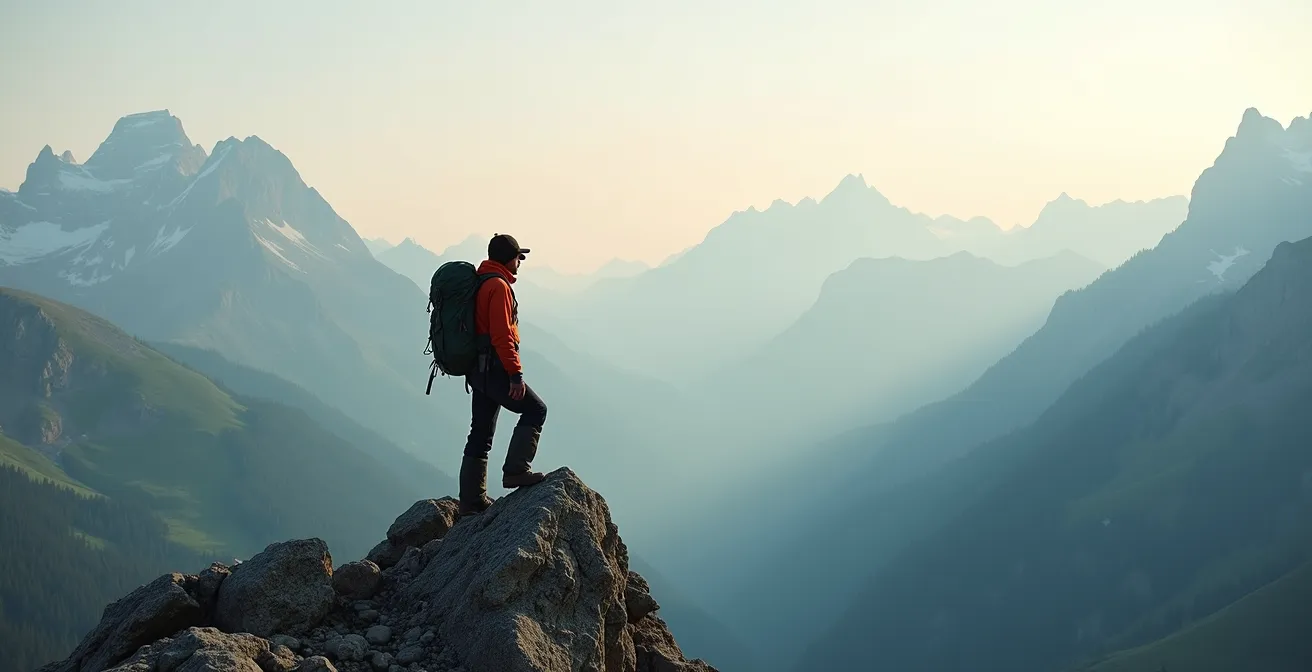
You’ve booked the trip. The flights to Kilimanjaro or Lukla are confirmed. Now, the real question looms for you, a resident of the flatlands: how do you prepare your body for the oxygen-starved environment of 5000 meters? Most guides offer the same platitudes: get fit, drink water, and go slow. While not incorrect, this advice is dangerously incomplete. Many trekkers who are marathon-fit at sea level find themselves struggling, while others with more modest fitness succeed. Why? Because they misunderstand the fundamental challenge.
The common approach is to focus on cardiovascular training, assuming that a strong heart and lungs are the key. But high-altitude success is less about raw power and more about a delicate balancing act. It’s about managing a finite resource: your body’s capacity to handle stress. Hypoxia—the lower partial pressure of oxygen in each breath—is the primary stressor, but it’s compounded by cold, exertion, dehydration, and poor sleep. Think of it as a “physiological stress container.” Every mistake, no matter how small, adds more to the container until it overflows, resulting in Acute Mountain Sickness (AMS) or worse.
This guide will not rehash the basics. Instead, as your high-altitude coach, I will give you the system. The secret isn’t a magic training plan you can do at sea level. The secret is mastering a series of proactive micro-decisions on the mountain that keep your stress container from filling up. We will deconstruct the common errors in acclimatization strategy, gear choices, and recovery, replacing them with an operational framework that will empower you to adapt effectively and stand on that summit.
This article provides a complete system for high-altitude preparation, breaking down everything from interpreting initial symptoms to advanced recovery techniques. The following sections will guide you through each critical component of this physiological management strategy.
Summary: Your System for High Altitude Preparation
- Why ignoring a mild headache at 3000m can be fatal?
- How to structure a climb-high sleep-low itinerary?
- Stiff Boots vs Trail Runners: which prevents fatigue on rocky terrain?
- The layering error that leaves you freezing despite a down jacket
- How to reduce pack weight by 2kg without sacrificing safety gear?
- Walking Shoes vs Running Shoes: the heel drop difference explained
- The cortisol spike that cancels out your recovery efforts
- How to read mountain weather patterns to avoid getting stranded?
Why ignoring a mild headache at 3000m can be fatal?
A mild, throbbing headache is the most common—and most commonly ignored—first sign that your body is struggling with hypoxia. Trekkers often dismiss it as dehydration, fatigue, or sun exposure. This is your first critical error. At altitude, any new headache that develops hours after ascending is guilty of being Acute Mountain Sickness (AMS) until proven innocent. Ignoring it is like ignoring the engine warning light on your car. It’s your body’s primary signal that your physiological stress container is getting full.
The danger lies in progression. An untreated mild headache can evolve into moderate or severe AMS. As the condition worsens, your brain’s ability to make sound judgments—your cognitive function—deteriorates. You might become stubborn, irrational, or lethargic, refusing to acknowledge the severity of your symptoms. This is where things become fatal. A persistent, severe headache, especially when combined with confusion or a loss of coordination (ataxia), can be a sign of High Altitude Cerebral Edema (HACE), a life-threatening swelling of the brain. The only cure for HACE is immediate and rapid descent.
Your first proactive micro-decision on the mountain is to treat that initial headache with respect. You must have a clear, non-negotiable protocol. Stop ascending, communicate your symptom to your guide and teammates, hydrate, and use a simple diagnostic test. This isn’t a sign of weakness; it’s a sign of a smart, self-aware mountaineer who is actively managing their acclimatization. Acting early, when the symptom is minor and your brain is still clear, is the single most important step in preventing a life-threatening emergency. The decision tree below provides a simple, actionable framework.
Your Action Plan: High-Altitude Headache Protocol
- Assess Onset: Did the headache develop within 6-24 hours of ascending above 2500m? This is the classic presentation of an altitude-related headache.
- Check for Friends: Is the headache accompanied by other symptoms like nausea, unusual fatigue, or dizziness? The presence of these friends confirms AMS.
- Run the Ibuprofen Test: Take 600mg of ibuprofen with at least 1 liter of water. Stop ascending and rest for one hour. Do not continue climbing during this time.
- Evaluate the Response: If the headache is gone and you feel good, you can consider continuing a slow ascent. If the headache persists or has only slightly improved, descent is mandatory. Do not climb higher.
- Monitor Progression: Any worsening of symptoms, or the new appearance of confusion, persistent coughing, or loss of coordination (ataxia) requires immediate, urgent descent and medical attention.
How to structure a climb-high sleep-low itinerary?
The mantra “climb high, sleep low” is the cornerstone of successful acclimatization. However, few trekkers understand how to apply it systematically. It’s not just about taking a short walk up a hill from camp; it’s a strategic principle that should govern your entire itinerary. The goal is to expose your body to a higher altitude for a short period, triggering an adaptive response (like increased breathing rate and red blood cell production), then returning to a lower elevation to sleep, allowing your body to recover from the stress in a more oxygen-rich environment.
A well-structured itinerary is your best defense against AMS. After crossing the 2,500m (8,200ft) threshold, your sleeping altitude should not increase by more than 300-500 meters per day on average. This rule necessitates adding acclimatization days into your schedule. On these days, you stay at the same campsite for two nights. During the day, you execute the “climb high” part of the strategy, trekking up an additional 500-600 meters before descending back to camp to “sleep low.”
This approach gives your body the time it needs to make crucial physiological adjustments. A long-term research project in the Everest region highlighted the importance of this. The study found that spending more time acclimatizing, particularly around the 3,500m (11,500ft) mark, led to significantly better oxygen adaptation and recovery. Trekkers who incorporated these extra days and practiced the climb-high, sleep-low principle showed better performance and fewer symptoms at extreme altitudes. Your itinerary is not a race; it is a carefully choreographed dance with the mountain, allowing your body to adapt one step at a time.

As this visual representation shows, the daily path involves gaining significant altitude during the hiking phase, but always returning to a lower elevation for rest and recovery. This sawtooth pattern is the visual signature of a safe and effective acclimatization schedule, putting less strain on your physiological stress container overnight.
Stiff Boots vs Trail Runners: which prevents fatigue on rocky terrain?
The choice of footwear is one of the most debated topics among trekkers, and a critical component of your energy economy. The traditional wisdom favors stiff, heavy, leather mountaineering boots for ankle support on rocky trails. However, modern physiology and biomechanics tell a different story. The old adage is that “a pound on your feet is like five on your back.” While the exact ratio is debated, the principle is irrefutable: lifting heavy boots with every single step, thousands of times a day, is an enormous and unnecessary drain on your energy reserves.
This energy expenditure is a direct deposit into your stress container. When you are expending massive amounts of energy just to move your feet, you have less energy available for the vital work of acclimatization. Lightweight trail running shoes or hybrid approach shoes dramatically reduce this energy cost. For most non-technical trekking routes like Kilimanjaro or Everest Base Camp, the “support” offered by a heavy boot is largely unnecessary for a hiker with decent strength and can even weaken the ankle by restricting its natural movement.
A recent biomechanical analysis confirms the heavy cost of traditional footwear, tying it directly to performance at altitude. The data below starkly illustrates how much more energy is required to use heavy boots compared to lighter alternatives, directly impacting your body’s ability to adapt.
| Footwear Type | Average Weight | Energy Cost Multiplier | Impact on Acclimatization |
|---|---|---|---|
| Stiff Mountain Boots | 800-1200g per boot | 4-6x vs backpack weight | Higher energy demand reduces acclimatization capacity |
| Trail Runners | 250-400g per shoe | 4-6x vs backpack weight | Lower energy demand preserves resources for adaptation |
| Hybrid Approach Shoes | 500-700g per shoe | 4-6x vs backpack weight | Moderate energy demand, versatile for mixed terrain |
Unless you are tackling technical ice or vertical climbing, the choice is clear. Opting for a lighter trail runner or approach shoe is a powerful proactive decision to conserve energy, reduce overall physiological stress, and give your body a better chance to acclimatize successfully. You’re not just choosing a shoe; you’re choosing an energy strategy.
The layering error that leaves you freezing despite a down jacket
You have a top-of-the-line down jacket, yet you find yourself shivering during a rest break. This is a common and dangerous paradox at altitude, and it stems from a fundamental misunderstanding of thermoregulation. The error is not in the quality of your final layer, but in the management of the layers beneath it. The biggest mistake is sweating into your layers during exertion. Moisture is the enemy. It conducts heat away from your body 25 times faster than air, rendering the insulating properties of your mid-layers (like fleece or down) completely useless.
A proper layering system is not a static outfit; it’s a dynamic tool for proactive temperature management. The goal is to maintain a stable, comfortable core temperature and, most importantly, to stay dry from the inside out. This requires you to be ruthlessly disciplined about removing layers *before* you start to sweat. Most people wait until they are already hot, but by then, your base layer is already damp. The correct approach feels counter-intuitive: you should start your day’s hike feeling slightly cool, knowing that your body will generate heat within the first 10-15 minutes of moving.
As you approach a steep uphill section, you must make a proactive micro-decision to stop and “strip” a layer. This feels like a hassle, but it is the key to staying warm later. When you stop for a break, your heat production plummets. If your inner layers are damp, the cold will set in almost instantly. This is when you add your “static” layer—the big puffy down jacket. Its job is to trap the heat you have, but it can’t do its job if it’s trapping a layer of cold, damp fabric against your skin. Mastering this “strip before you sweat” discipline is more important than the brand of jacket you own.

The layering system is a functional ecosystem. A wicking base layer pulls moisture off the skin, a fleece or light synthetic mid-layer provides insulation, and a shell protects from wind and rain. The puffy jacket is for static periods only. Keeping each layer performing its function, especially by preventing the mid-layer from getting wet, is the key to all-day warmth and energy conservation.
How to reduce pack weight by 2kg without sacrificing safety gear?
Pack weight is a direct contributor to your physiological stress container. Every extra kilogram requires more energy to carry, depleting resources that your body needs for acclimatization. Many hikers mistakenly believe that a heavy pack is an unavoidable price for safety. However, you can dramatically reduce your pack weight by 2kg (4.4 lbs) or more by focusing on the three heaviest items in your pack—the “Big Three”—and adopting a multi-use mindset, without compromising a single piece of essential safety equipment.
The “Big Three” are your backpack itself, your sleeping system (bag and pad), and your shelter. In a guided trek context where a tent is provided, this often refers to the pack and sleeping system. Novice trekkers often overbuy on durability and features, ending up with a 2kg pack and a 2kg sleeping bag. By investing in modern, ultralight alternatives, you can cut the weight of each of these items by 50% or more. A 900g pack, a 900g sleeping bag, and a lightweight inflatable pad can easily save you 1.5kg over standard entry-level gear. This is the single biggest weight-saving opportunity.
Case Study: The “Big Three” Weight Reduction Strategy
Experienced high-route backpackers consistently demonstrate that the fastest way to reduce pack weight is by upgrading the ‘Big Three’: pack, sleeping bag, and shelter. By choosing modern ultralight materials, it’s common to achieve a 500g saving on each of these core items, totaling a 1.5kg reduction without sacrificing warmth or durability. When this is combined with a strategy of using multi-use items—such as using trekking poles as tent supports, a Buff as a hat, balaclava, and scarf, or even carrying dental floss for gear repairs—a total weight savings of 2kg or more becomes easily achievable while retaining all essential safety gear.
Another common mistake is carrying excessive water. While hydration is critical, an analysis by iRunFar highlights how carrying 4-5 liters from the start adds 4-5kg of unnecessary weight. The smart strategy is to carry only 1-2 liters at a time and treat water from streams or designated sources along the trail. A modern filter like the Katadyn BeFree weighs a mere 60 grams and allows you to refill in minutes. This “carry less, filter more” approach represents another massive saving in your energy economy. By combining a “Big Three” upgrade with smart water management and multi-use items, you can easily shed 2-3kg from your back, a saving that pays huge dividends in your ability to acclimatize.
Walking Shoes vs Running Shoes: the heel drop difference explained
Beyond weight, another critical factor in footwear selection is the “heel-to-toe drop.” This is the height difference between the heel and the forefoot, measured in millimeters. It dictates your foot’s angle inside the shoe and significantly affects your body’s biomechanics, especially on the relentless uphill and downhill slopes of a mountain trek. Understanding this concept is key to preventing overuse injuries and maintaining an efficient stride.
Traditional walking and hiking boots typically have a high drop. An analysis on RunRepeat shows a stark contrast, with typical walking shoes having an 8-12mm drop versus trail runners with a 0-6mm drop. A higher drop places more cushioning under the heel and pitches your body slightly forward, which can reduce strain on the Achilles tendon and calf muscles during uphill climbs. Conversely, a lower or zero-drop shoe promotes a more natural, midfoot strike, which can improve balance and stability but places a much greater load on the calf and Achilles.
For a trekker accustomed to regular, high-drop footwear (like most running or casual shoes), switching abruptly to a zero-drop trail shoe for a multi-day trek is a recipe for a severe Achilles or calf injury. Your body is not conditioned for that kind of load. The transition to low-drop footwear must be gradual, allowing your lower leg muscles and tendons weeks or even months to adapt and strengthen. If your trek is imminent, it is far safer to stick with a shoe that has a moderate drop (4-8mm) or one similar to what you are already used to. This is not the time to experiment. The goal is to minimize any new or unexpected stress on your body’s mechanical systems, preserving that energy for acclimatization.
Your Action Plan: 6-Week Low-Drop Transition Protocol
- Weeks 1-2: Begin by alternating daily between your current high-drop shoes and your new low-drop shoes for short periods, around 20-30 minutes of walking.
- Weeks 3-4: Gradually increase the usage of your low-drop shoes to cover about 60% of your weekly training mileage. Make focused calf stretching a non-negotiable part of your routine.
- Week 5: Push your low-drop shoe usage to 80% of your training. Be hyper-aware of any tightness or soreness in your Achilles tendon.
- Week 6: You can now fully transition to the low-drop shoes for all training. Maintain a consistent routine of calf massage and stretching.
- Post-Transition: Don’t stop the self-care. Continue to use trekking poles for calf massage and perform daily foot maintenance to prevent issues from creeping up.
Key Takeaways
- Your body’s ability to adapt to altitude is a finite resource. Every decision should be aimed at conserving energy and minimizing stress.
- Proactive management is key. This means acting on early warning signs, planning your itinerary strategically, and making smart gear choices before you even leave home.
- Success is not about being the fittest person on the mountain; it’s about being the smartest and most self-aware. Listen to your body and respect the process.
The cortisol spike that cancels out your recovery efforts
Even if you have the perfect itinerary and ultralight gear, you can still fail to acclimatize. The invisible saboteur is often an uncontrolled physiological stress response, driven by the hormone cortisol. At high altitude, your body is under constant, low-grade duress from hypoxia, cold, and disrupted sleep. This is the background noise of high-altitude life. An expert at InsideTracker puts it perfectly: just by being there, your stress container is already half-full. When you add the physical stress of daily trekking, mental anxiety, and poor recovery, your cortisol levels can skyrocket.
Chronically high cortisol puts your body in a constant “fight or flight” (sympathetic) state. It inhibits sleep, impairs digestion, suppresses the immune system, and catabolizes muscle tissue. In this state, your body is breaking down, not building up. It simply does not have the resources to perform the complex adaptive processes required for acclimatization. You can be lying in your sleeping bag for eight hours, but if your sympathetic nervous system is firing, you are not recovering.
The solution is to actively and intentionally trigger your “rest and digest” (parasympathetic) nervous system. This is not a passive activity; it requires a conscious protocol. Simple, controlled breathing exercises are the most powerful tool you have to down-regulate your stress response. Techniques like box breathing or the 4-7-8 method can have an immediate effect on your heart rate and nervous system, telling your body that it is safe to switch into recovery mode. Integrating these short practices into your daily routine—upon waking, during rest breaks, and before sleep—is a non-negotiable part of managing your internal state. It’s how you consciously empty your stress container each day, ensuring you have the capacity to handle the next day’s challenges.
This is the practice of parasympathetic activation. Below are simple techniques to implement:
- Morning Reset (4-7-8 Breathing): Before getting out of your sleeping bag, inhale through your nose for 4 seconds, hold your breath for 7 seconds, and exhale slowly through your mouth for 8 seconds. Repeat 4 times.
- Midday Break (Box Breathing): During a rest stop, inhale for 4 seconds, hold for 4, exhale for 4, and hold for 4. Repeat for 2-3 minutes to calm your system.
- Evening Wind-down (Body Scan): Before sleep, lie down and bring your attention sequentially to each part of your body, from your toes to your head, consciously releasing any tension you find.
How to read mountain weather patterns to avoid getting stranded?
The final, and perhaps most unpredictable, stressor you must manage is the weather. Mountain weather is notoriously fickle and can change with terrifying speed. A sunny morning can turn into a whiteout blizzard in under an hour. Being caught out in a storm at high altitude is not just uncomfortable; it’s a life-threatening situation that can lead to hypothermia, frostbite, and becoming hopelessly lost. Your ability to make a proactive decision to turn back based on early weather signs is one of the most important skills you can possess.
At high altitude, your cognitive function is already impaired. You cannot rely on complex weather forecasts or apps. You must learn to read the most fundamental and reliable indicators in the sky: the clouds. The vertical development of clouds is the key sign of increasing atmospheric instability. While puffy, cotton-like cumulus clouds floating in a blue sky indicate fair weather, you must watch them closely. If you see these clouds beginning to grow upwards, forming into towering cumulus with more defined, cauliflower-like tops, it is a clear warning sign. The atmosphere is becoming unstable, and a storm is likely developing.
Professional mountain guides use a simple, powerful decision rule that you must adopt. Because your judgment is compromised at altitude, you need to rely on clear, pre-defined rules. The critical rule is this: If clouds are building vertically by 10 AM, your turnaround time is now 12 PM, not 2 PM. This gives you a crucial buffer to descend to safety before the storm fully materializes, which typically happens in the early afternoon. Waiting until you see lightning or hear thunder is waiting too long. The decision to turn back is not a failure; it is the ultimate success of risk management. It ensures you will be able to climb another day.
This is the final test of your ability to make proactive micro-decisions. It requires humility and discipline to turn away from a summit that looks close, but it is a decision that can save your life. You must trust the clouds more than you trust your own summit fever. Your goal is not just to reach the top, but to return safely, and that depends entirely on the quality of your decisions.
By shifting your mindset from one of brute-force fitness to one of intelligent, systemic physiological management, you transform your relationship with the mountain. You are no longer a passive victim of the altitude but an active participant in your own acclimatization. To truly master this approach, it is essential to build a personal system based on these principles. Evaluate your gear, plan your itinerary, and practice your recovery techniques now, so they become second nature when you need them most.