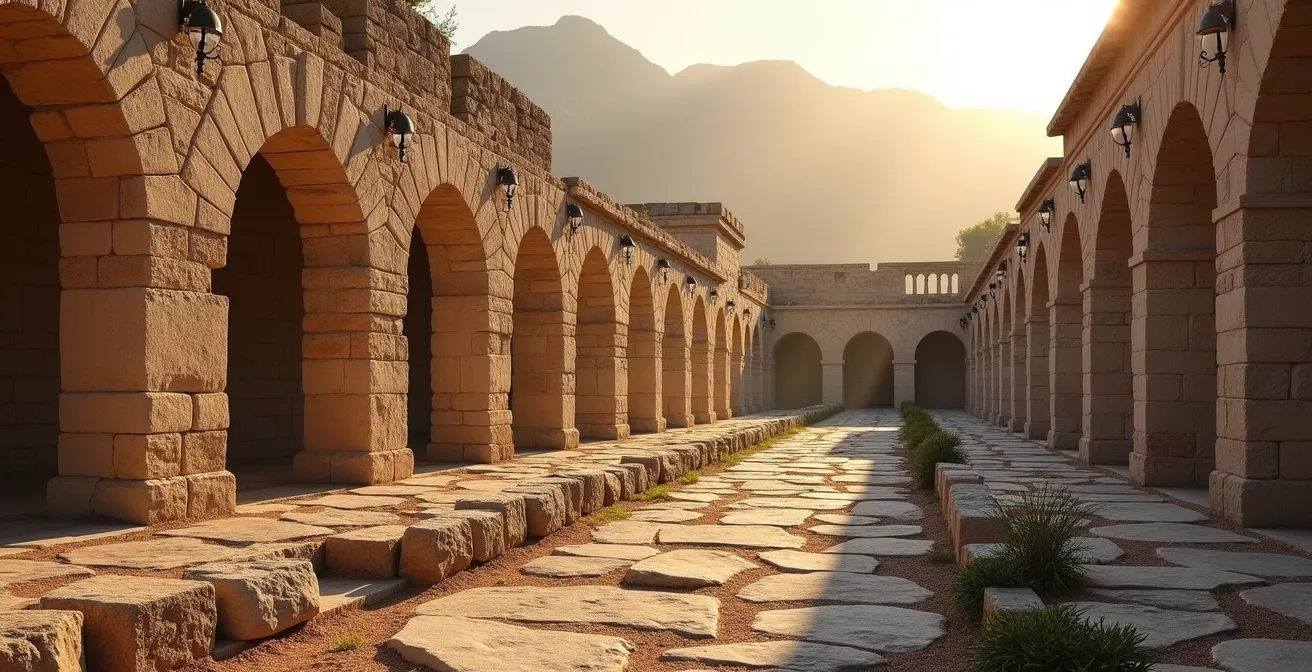
The way a civilization builds is a physical autobiography; its choice of materials and engineering solutions are a direct reflection of its values, knowledge, and ambitions.
- Ancient technologies like Roman concrete reveal a sophisticated understanding of chemistry and a long-term vision of empire.
- Structural forms, such as the evolution from Romanesque to Gothic arches, chart a society’s changing philosophical and theological priorities.
Recommendation: Look beyond a monument’s beauty and learn to question its structure—how it stands, what it’s made of, and how it has aged. In those answers, you will find the true story of its creators.
Every stone structure, from the grandest cathedral to the humblest wall, is a historical document. To the untrained eye, they are silent witnesses to the past. But for those who know how to read them, they tell a vivid story of ingenuity, ambition, and belief. We often focus on the aesthetics of architecture—the soaring heights of a nave or the imposing facade of a fortress. Yet, the real narrative lies deeper, embedded in the very engineering that holds these structures together. It’s a story told not in words, but in lime, sand, and stone.
The common approach is to catalogue architectural styles or marvel at the sheer scale of ancient monuments. But this misses the crucial “why.” Why has Roman concrete endured for millennia while modern equivalents crumble? Why did the pointed arch of the Gothic era supersede the rounded form of the Romanesque? The answers are not merely technical; they are deeply cultural. They speak to a civilization’s understanding of chemistry, its systems of trade, its theological aspirations, and its very perception of its own legacy. This guide moves beyond a simple visual appreciation of masonry.
Our guiding principle is a form of structural forensics: the art of dissecting a building’s engineering to uncover the story of its creators. We will not just look at what was built, but why it was built that way. This is not about memorizing dates and styles. It’s about learning a new language—the language of load paths, material science, and engineered longevity. By understanding the forces at play within a wall or the chemical reactions within a binder, we can gain a more profound connection to the people who shaped our world, one stone at a time. This article will equip you with the tools to read this material narrative, transforming your next visit to a historic site from a passive viewing into an active investigation.
This exploration will delve into the secrets of ancient materials, the structural logic behind iconic styles, and the modern challenges of preserving this fragile legacy. The following sections provide a framework for understanding and interpreting the architectural heritage that surrounds us.
Summary: Reading a Civilization’s History Through Its Masonry
- Why Roman concrete has outlasted modern cement by 2000 years?
- How to photograph massive monuments without distortion?
- Gothic vs Romanesque: identifying the key arch differences
- The cleaning technique that accidentally destroyed century-old patina
- When does the “Golden Hour” hit major landmarks for the best view?
- How to insulate solid brick walls without causing damp issues?
- Why “take nothing but photos” is crucial for structural integrity?
- Why virtual tours are a lifeline for mobility-impaired travelers?
Why Roman concrete has outlasted modern cement by 2000 years?
The remarkable durability of Roman concrete is one of history’s great engineering marvels. Structures like the Pantheon still stand today, a testament to a material that can heal its own cracks. For decades, historians believed the secret lay solely in the use of volcanic ash (pozzolana). However, the true genius of Roman engineering was far more dynamic and, quite literally, hotter. The key lies in a process called “hot mixing,” where quicklime was mixed with other materials at high temperatures before the addition of water.
This process was not an accident or a sign of poor quality control, as once thought. Recent analysis of concrete from the Privernum archaeological site has revealed that the distinctive white chunks, or “lime clasts,” found in the material are not flaws. They are the signature of this advanced technique. The exothermic reaction from hot mixing creates what MIT research reveals as 200°C hot spots, forming a uniquely reactive and resilient concrete. As MIT Professor Admir Masic, a leading researcher in this field, noted his skepticism of old theories:
Ever since I first began working with ancient Roman concrete, I’ve always been fascinated by these features. The idea that the presence of these lime clasts was simply attributed to low quality control always bothered me.
– Admir Masic, MIT Professor of Civil and Environmental Engineering
These lime clasts provide a revolutionary self-healing mechanism. When small cracks form in the concrete and water seeps in, it reacts with the lime clasts, forming a calcium carbonate solution that recrystallizes and fills the void, effectively repairing the structure. This concept of engineered longevity shows the Romans weren’t just building for their time; they were building for eternity. A recent case study confirmed this theory in practice.
Case Study: The Pompeii Construction Site Revelation
Recent excavations at Pompeii’s Regio IX have uncovered an intact ancient construction site, providing definitive proof of the hot mixing technique. The discovery showed quicklime being pre-mixed with dry pozzolan before water was added, a process that creates the exothermic reaction and the all-important lime clasts. This archaeological find moves the theory of self-healing concrete from the lab to the field, confirming how Roman builders consciously engineered structures with self-repairing capabilities.
This material narrative, read from the very chemistry of the concrete, speaks of a civilization that combined empirical knowledge with a profound ambition for permanence, a lesson modern engineering is only now beginning to relearn.
How to photograph massive monuments without distortion?
Documenting massive architectural works presents a significant challenge: distortion. When you tilt a standard camera upwards to capture a tall building, the vertical lines appear to converge, making the structure look like it’s falling backwards. This phenomenon, known as keystone distortion, compromises the architectural integrity of the image and fails to represent the architect’s true design intent. For the historian or enthusiast, capturing a building accurately is essential for proper analysis and documentation.
The professional solution to this problem is not found in software, but in specialized optics: the tilt-shift lens. This remarkable piece of equipment allows the photographer to shift the lens vertically or horizontally relative to the camera’s sensor. By keeping the camera perfectly level and parallel to the building’s facade, and then shifting the lens upwards, you can include the top of the structure in the frame without tilting the camera at all. The result is an image with perfectly straight vertical lines, free from distortion. These lenses are the key to creating magazine-quality architectural photographs that are both aesthetically pleasing and technically accurate.

As the detailed image above suggests, these lenses are instruments of precision, allowing for minute adjustments to achieve a perfect composition. They not only correct perspective but also offer creative control over the plane of focus, enabling photographers to create images with immense depth or selective focus. For anyone serious about architectural photography, understanding the function of a tilt-shift lens is the first step toward capturing the true scale and grandeur of historic monuments.
- Place the camera in a parallel position with the plane of the building, ensuring it is perfectly vertical.
- Use tilt-shift lenses to correct vertical convergence distortion, which simplifies workflow and increases final image quality.
- Shoot panoramas by shifting the lens horizontally. This technique avoids parallax issues and creates extremely high-resolution files suitable for large prints or detailed analysis.
- Use a geared tripod head for the precise, incremental leveling required when working with these specialized lenses.
- Plan your shoot timing using applications like The Photographer’s Ephemeris to find optimal lighting angles that reveal texture and form.
Ultimately, photographing a monument without distortion is an act of respect for the original design, ensuring that the story told by its lines and forms is communicated clearly and truthfully.
Gothic vs Romanesque: identifying the key arch differences
The transition from the Romanesque to the Gothic period in European architecture represents one of the most significant shifts in engineering and theological expression. At the heart of this change is the arch. To an observer, the difference is simple: Romanesque arches are rounded, while Gothic arches are pointed. But this simple geometric change had profound structural and philosophical consequences, allowing for the creation of buildings that were previously unimaginable. This is a perfect example of “load-path philosophy”—where the way a structure directs force reflects the worldview of its builders.
The semicircular Romanesque arch, a direct descendant of Roman engineering, distributes weight outwards. This outward thrust, or pressure, is immense, requiring massive, thick, and heavy walls to contain it. The result is buildings that feel grounded, solid, and fortress-like. Their small windows and dark interiors convey a sense of protective, enclosed faith. The structure itself is a statement of stability and earthly strength.
The invention of the pointed (or ogival) arch was a revolution. A pointed arch channels the load of the roof and vaults more directly downwards toward the ground, rather than outwards. This crucial redirection of force meant that the walls no longer had to be so massive. They could become a skeletal frame, with the remaining outward thrust managed by an external innovation: the flying buttress. This structural freedom allowed for the defining features of Gothic cathedrals: soaring heights, thin walls, and vast expanses of stained glass that flooded the interior with light. The entire building became an aspirational statement, a stone framework reaching towards the heavens, dematerialized by light.
This comparative table breaks down the fundamental differences, linking structural choices directly to the aesthetic and theological outcomes.
| Feature | Romanesque (c. 1000–1150) | Gothic (c. 1150–1500) |
|---|---|---|
| Arch Type | Rounded (semicircular) | Pointed (ogival) |
| Force Distribution | Pushes outward, requiring thick walls | Channels force downward, allowing thinner walls |
| Vault Type | Barrel vaults – heavy, continuous | Rib vaults – complex, weight-distributing |
| Wall Structure | Massive, fortress-like | Skeletal with flying buttresses |
| Window Size | Small, limited by wall strength | Large, made possible by force distribution |
| Theological Statement | Protective, grounded faith | Aspirational, reaching heavenward |
Therefore, when you stand before a medieval church, identifying its arch type is the first step in reading its story. Is it telling a tale of grounded, defensive faith, or one of transcendent, light-filled aspiration?
The cleaning technique that accidentally destroyed century-old patina
The desire to see historical artifacts as they “originally” looked is a powerful, yet dangerous, impulse. In the field of masonry conservation, this has led to controversial and often destructive cleaning campaigns that permanently erase layers of history. The very definition of “clean” is a central debate in conservation ethics. What one generation sees as dirt, another may see as a crucial historical layer known as patina—a protective surface that forms over centuries from environmental exposure, which tells the story of the object’s life.
Perhaps the most infamous example of this is the cleaning of the Parthenon Marbles at the British Museum in the 1930s. This incident serves as a stark cautionary tale about the irreversible damage of aggressive restoration.
The Cautionary Tale of the Elgin Marbles
In an attempt to whiten the stone and match a popular Neoclassical aesthetic of the time, the British Museum’s staff subjected the Parthenon Marbles to an aggressive cleaning. According to historical accounts documented by sources like Britannica, they used copper tools and abrasive compounds that did far more than remove surface grime. The process stripped away the delicate honey-colored patina that had developed over millennia, and with it, the last surviving traces of the original paint (polychromy) that once adorned the sculptures. This act permanently altered the texture and appearance of these priceless artifacts, sparking a debate on conservation ethics that continues to this day. The marbles are now a different color and texture than they were for most of their history.
This case highlights a critical mistake: failing to distinguish between harmful pollutants, like black sulfation crusts that eat away at stone, and the stable, protective patina that is part of the object’s history. Modern conservation has learned from these errors, adopting a far more cautious and scientific approach that prioritizes preservation over restoration.
Action Plan: A Modern Masonry Conservation Checklist
- Analysis First: Differentiate between harmful sulfation crusts and protective patina layers before any intervention. This involves chemical and microscopic analysis.
- Gentle Methods: Use non-abrasive techniques like precision laser cleaning to remove pollutants without damaging the underlying stone substrate. Poultices can also be used for gentle chemical cleaning.
- Documentation: Meticulously document all original tool marks, surface textures, and existing conditions with photography and 3D scanning before any work begins.
- Testing: Always test cleaning methods on small, inconspicuous areas first to assess the impact on the stone and its patina.
- Reversibility: Prioritize interventions that are reversible, and always aim for the minimum necessary intervention to stabilize the object.
The lesson is clear: sometimes the most responsible act of conservation is to resist the urge to “clean” and instead preserve the authentic story of time written on the stone’s surface.
When does the “Golden Hour” hit major landmarks for the best view?
The “Golden Hour,” that magical period shortly after sunrise and before sunset, is renowned by photographers for its soft, warm light. For architectural historians, this is more than an aesthetic choice; it’s an analytical tool. The low angle of the sun creates raking light, which skims across surfaces, casting long shadows and dramatically revealing texture. This is the optimal time to “read” the surface of ancient masonry, as every subtle tool mark, inscription, and sign of weathering becomes visible.
This effect is most pronounced when the sun is at a low altitude. While the exact timing of the Golden Hour varies by location and season, professional photographers know that a 15-20 degree sun angle creates the ideal raking light for revealing texture. This low light doesn’t just make for a beautiful photo; it transforms a flat surface into a detailed map of its own history. The chisel marks of a stonemason from a thousand years ago, invisible under the harsh glare of midday sun, suddenly leap into focus. This is when the hand of the creator becomes most tangible.
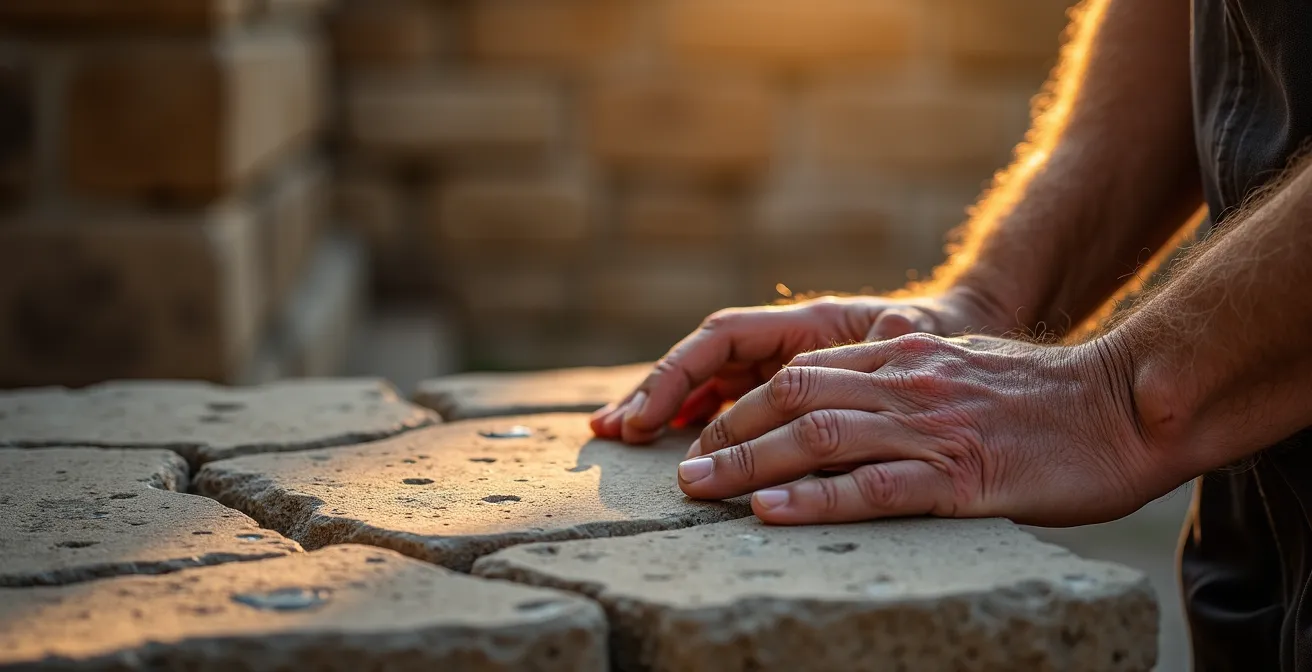
Furthermore, the material itself plays a crucial role in how it interacts with light. The warm tones of sandstone are greatly enhanced during the Golden Hour, giving the structure a vibrant glow. In contrast, the subtle translucency of marble can be best captured during the “Blue Hour,” the period just after the sun has set, when the light is cool and diffuse. Visiting a site like Stonehenge, one of the oldest examples of stonework constructed nearly 5,000 years ago, at different times of day reveals entirely different aspects of the stones’ character and presence.
Planning a visit to a landmark around the sun’s angle is not just about photography; it’s about scheduling an appointment with history, ensuring you arrive when the stone is ready to tell its most detailed stories.
How to insulate solid brick walls without causing damp issues?
Living in or caring for a historic building with solid brick walls presents a modern dilemma: how to improve energy efficiency without harming the original structure. The common approach of applying modern, non-breathable insulation internally can be catastrophic. Solid brick walls are designed to “breathe”—they manage moisture by allowing it to be absorbed into the brick and then evaporate away. Sealing the interior surface with a vapor barrier or non-permeable insulation traps this moisture within the wall, leading to dampness, mold growth, and eventually, the spalling and degradation of the historic brick and mortar.
The key to successful insulation is to work *with* the building’s natural moisture management system, not against it. This means using hygroscopic and vapor-permeable materials that can absorb, store, and release moisture, mimicking the function of the original wall. Materials like wood fiberboard, cork, or hemp-lime plaster are excellent choices. They provide thermal resistance while allowing water vapor to pass through, preventing condensation from becoming trapped within the wall structure. This approach maintains the building’s health and ensures its longevity.
Conservation standards dictate a cautious approach. To avoid creating a cold bridge and condensation risk, building conservation experts recommend a 50mm maximum internal insulation thickness for many applications, ensuring the brickwork behind remains warm enough to prevent moisture issues. Finding the right balance between thermal performance and breathability is paramount. Below are the core principles for safely insulating solid walls:
- Prioritize hygroscopic materials like wood fiber, cork, or hemp-lime that allow the wall to breathe.
- Install a vapor-permeable membrane (a breather membrane) instead of a non-permeable plastic vapor barrier.
- Maintain a small air gap between the insulation and the wall surface where possible to encourage air circulation.
- Consider external insulation as an alternative if the building is not listed and its external appearance can be modified.
- Monitor humidity levels with data loggers before and after installation to verify the solution is performing as expected.
Ultimately, making a historic building more sustainable is not about applying modern solutions wholesale, but about adapting modern materials to respect ancient building physics.
Why “take nothing but photos” is crucial for structural integrity?
The mantra of the responsible tourist, “Take nothing but photos, leave nothing but footprints,” is more than just a catchy phrase; it is a fundamental principle of heritage preservation. While the impact of a single person touching a stone wall may seem negligible, the cumulative effect of millions of visitors over decades is a powerful and destructive force. This is not an abstract concept; it is a measurable process of erosion that slowly erases the very history we seek to experience.
Scientific studies on visitor impact at heritage sites have quantified this damage. Heritage conservation studies show that 5 million visitors touching surfaces over a decade can cause measurable erosion, wearing away delicate carvings and textures. The oils, salts, and acids from our hands chemically alter the stone’s surface, accelerating its decay. What feels like a harmless gesture of connection is, in reality, an act of slow-motion vandalism, multiplied by millions.
The damage goes beyond simple physical wear. By touching these ancient surfaces, we introduce foreign biological matter, creating a new and hostile environment for the stone. This is especially damaging to unique historical markers, as a specific case demonstrates.
The Disappearing Signatures: Banker Marks and Biological Contamination
For centuries, stonemasons have carved personal symbols, known as “banker marks,” onto their finished stones. These marks served as a signature to identify their work for payment and stand today as an invaluable record of individual craftsmanship. When modern visitors repeatedly touch these marks, they are not just eroding the stone; they are introducing a cocktail of microorganisms, oils, and salts. This contamination can accelerate the deterioration of these specific areas, effectively erasing the personal signatures of the artisans who built these incredible structures. Each touch helps to wipe a name from the pages of history.
By choosing to admire with our eyes alone, we ensure that the subtle details, the tool marks, and the stonemasons’ signatures that have survived for centuries will remain for future generations to read.
Key Takeaways
- The engineering behind a structure is a direct reflection of a civilization’s scientific knowledge, resources, and philosophical outlook.
- Modern tools, from tilt-shift lenses to virtual tours, provide new ways to analyze, document, and access heritage without causing harm.
- Conservation is a delicate balance; well-intentioned but ill-informed actions, like aggressive cleaning or improper insulation, can cause irreversible damage.
Why virtual tours are a lifeline for mobility-impaired travelers?
Historic sites are, by their very nature, often inaccessible. Uneven stone floors, narrow spiral staircases, and remote locations can present insurmountable barriers for travelers with mobility impairments, effectively locking them out of shared world heritage. In this context, modern digital technology—specifically high-fidelity virtual tours—has become far more than a novelty. It is a vital lifeline, promoting a more inclusive and democratic access to history.
Using techniques like photogrammetry and drone footage, conservation teams can create meticulous digital replicas of sites. These virtual experiences allow anyone, anywhere, to explore places like the Incan walls of Cusco or the temples of Göbekli Tepe with complete freedom. Users can “walk” through ancient cities, examine artifacts up close, and even gain perspectives impossible for an able-bodied visitor on the ground, such as hovering over a fragile mosaic floor or viewing a complex from above. This technology breaks down physical barriers, ensuring that a person’s ability to connect with history is not limited by their physical ability.
Beyond accessibility, these virtual tours serve another critical function: preservation. As the Heritage Conservation Institute points out, these digital models are not just for viewing; they are essential conservation tools.
Virtual tours serve as critical conservation tools – high-fidelity digital models act as perfect records for continued study without causing wear on real sites and provide essential blueprints for restoration in case of disaster.
– Heritage Conservation Institute, Digital Preservation Best Practices 2024
These “digital twins” create a perfect, un-eroding record of a site at a specific moment in time. They allow for infinite study without causing any wear and tear on the real location and serve as an invaluable blueprint for restoration should the original site be damaged or destroyed. They are a library, an archive, and a gateway all in one.
By embracing virtual access, we are not creating a lesser substitute for the real thing; we are building a more resilient and accessible future for our shared past, ensuring that these stories in stone can be read by everyone.