
The greatest barrier to a profound connection with marine life isn’t a lack of scuba gear, but a lack of specific, easily learned surface-level skills.
- Mastering your equipment, from preventing mask fog to choosing the right type, is the foundation of underwater comfort and safety.
- Efficient movement and breath control are not just for divers; they allow snorkelers to conserve energy, extend observation time, and minimize disturbance to wildlife.
Recommendation: Shift your mindset from being a passive floater to an active, conscious observer by practicing the micro-skills detailed in this guide.
You float on the surface, a window into another world. Below you, vibrant fish dart through intricate structures, and the gentle sway of the ocean reveals a universe of life. Yet, a sense of disconnect remains. Perhaps it’s the nagging anxiety about the deep, a constantly fogging mask, or the simple exhaustion of fighting a gentle current. You’re present, but not truly participating. For many, the advice stops at “get a good mask and fins” or “don’t touch the coral,” leaving you on the periphery of a world you long to understand more deeply.
But what if the key to unlocking a truly immersive and safe underwater experience wasn’t about strapping on a heavy tank and descending into the depths? What if it was about mastering a set of elegant, diver-level micro-skills that transform your relationship with the ocean from the surface? This is the path to achieving aquatic poise—a state of complete comfort, control, and confidence in the water. It’s about moving beyond being a simple tourist and becoming a graceful, conscious observer who can interact with the marine environment safely and respectfully.
This guide is built on that principle. We will deconstruct the essential skills that bridge the gap between casual snorkeling and expert-level observation. We will explore the physics of your gear, the mechanics of efficient movement, and the secrets to remaining calm and motionless as wildlife accepts your presence. By the end, you will have a clear roadmap to not only see the marine world, but to feel a part of it, all without the need for a scuba certification.
This article breaks down the essential skills needed to transform your snorkeling experience. Explore the sections below to master everything from gear preparation to advanced in-water techniques for a safer and more rewarding connection with marine life.
Summary: How to Become a Confident and Eco-Conscious Underwater Explorer
- Why You Shouldn’t Touch the Coral Even if It Looks Like Rock?
- How to Clear a Foggy Mask Underwater Without Surfacing?
- Full-Face vs Traditional Mask: Which Is Safer for CO2 Buildup?
- The Finning Error That Exhausts Snorkelers Against the Current
- How to Prep a New Mask So It Never Fogs Up?
- How to Build Core Strength While Enjoying the Ocean?
- How to Hover Motionless Underwater to Protect Marine Life?
- How to Manage Air Consumption to Extend Dive Time by 15 Minutes?
Why You Shouldn’t Touch the Coral Even if It Looks Like Rock?
The number one rule of any underwater exploration is simple: look, but don’t touch. This is especially true for coral, which can often be mistaken for colorful, inanimate rock. In reality, corals are fragile colonies of thousands of tiny living animals called polyps. These polyps are delicate and covered in a protective mucous layer, similar to the slime coat on fish, which shields them from disease and infection. Touching coral, even lightly with a finger or fin, can scrape off this layer, leaving the entire colony vulnerable to deadly pathogens.
The stakes for these ecosystems are incredibly high. Coral reefs are biodiversity hotspots, yet they are under immense pressure from climate change, pollution, and direct human impact. This fragility is starkly highlighted by the latest assessments, which show that over 44% of all coral species now face a significant threat of extinction. Your actions as a visitor have a direct impact on their survival. The principle of conscious observation means actively working to have zero footprint. This involves maintaining a safe distance, controlling your movements, and understanding that even a minor bump can cause irreparable damage to an organism that may have taken decades or even centuries to grow.
To ensure you are a guardian of the reef, not a threat, it’s vital to turn these principles into a concrete pre-snorkel routine. Before you even enter the water, performing a quick self-audit can hardwire a mindset of protection and awareness.
Your Pre-Snorkel Marine Guardian Checklist
- Points of Contact: Identify all gear and body parts that could make contact. Be mindful of your fins, hands, knees, and any dangling equipment like cameras or snorkels.
- Equipment Inventory: Check your sunscreen—is it reef-safe? Remove unnecessary gear like gloves, which can increase the temptation to touch, and ensure all equipment is secured.
- Mindset Check: Verbally reaffirm your role as a silent, respectful observer. Your goal is to leave the environment exactly as you found it, which means aligning your intentions with a “leave no trace” philosophy.
- Visualize Impact: Picture the difference between a stressed, fleeing fish and a curious one that accepts your calm presence. Your goal is to cultivate the stillness that invites curiosity, not fear.
- Set an Action Plan: For your upcoming snorkel, establish one clear, simple rule. For example: “My hands will remain clasped” or “I will always maintain a fin-kick’s distance from any reef structure.”
How to Clear a Foggy Mask Underwater Without Surfacing?
There is nothing more frustrating than having your vision of a beautiful reef obscured by a curtain of fog inside your mask. For many, the only solution is to return to the surface, breaking the immersive experience. However, learning to clear your mask underwater is a fundamental skill that builds immense confidence and is a cornerstone of equipment symbiosis. It allows you to solve a common problem calmly and efficiently without interrupting your observation. The technique relies on a simple principle of physics: using air from your lungs to displace the water inside your mask.
The process is straightforward once you’ve practiced it. First, you must intentionally let a small amount of water into your mask to practice. You can do this by gently lifting the bottom edge of the mask skirt with your fingers. Once a little water is in, the clearing process begins. Take a deep breath through your mouth via your snorkel. Then, press firmly on the top frame of your mask with your palm or fingers to create a solid seal against your forehead. While maintaining this pressure, tilt your head back slightly to look up toward the surface. Finally, exhale forcefully and continuously through your nose. This burst of air will push the water out from the bottom of the mask skirt, leaving your vision clear.
This close-up view demonstrates the key moment of the technique: the head is tilted back, and pressure is applied to the top of the mask. The visible air bubbles escaping from the bottom seal show the water being successfully displaced by the air exhaled through the nose.
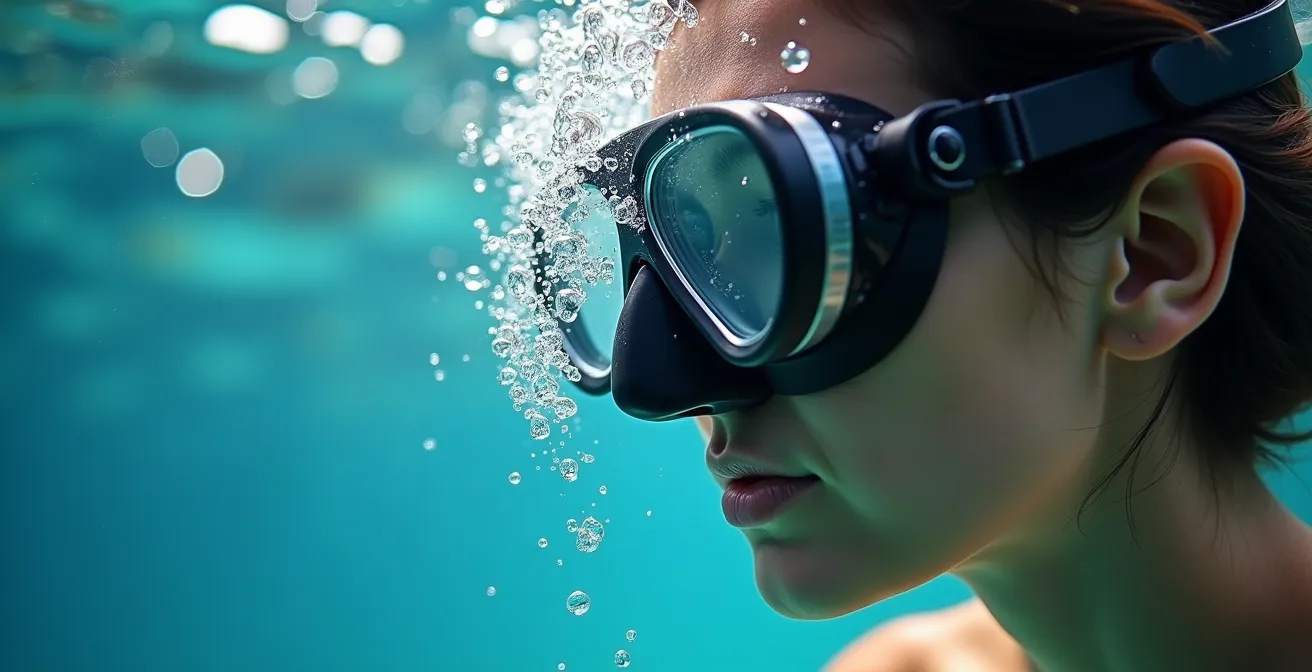
Mastering this skill transforms a potential moment of panic into a minor, manageable adjustment. It is a powerful tool that keeps you comfortable and in control, allowing you to focus on the marine life around you rather than on your equipment. Practice this in shallow, calm water until it becomes second nature. It’s a small skill that pays huge dividends in underwater confidence.
Full-Face vs Traditional Mask: Which Is Safer for CO2 Buildup?
The choice of a mask is one of the most critical decisions for a snorkeler, directly impacting comfort, vision, and, most importantly, safety. In recent years, full-face snorkel masks have gained popularity, promising a wider field of view and the ability to breathe through both nose and mouth. However, this convenience comes with significant safety considerations, particularly regarding the risk of carbon dioxide (CO2) buildup. Understanding the difference in design is key to making an informed choice that aligns with your planned activities and safety priorities.
A traditional mask and snorkel set-up keeps the functions of seeing and breathing separate. You see through the mask and breathe through the snorkel. When you exhale, the CO2-rich air is expelled directly out of the top of the snorkel, with no chance of it being re-inhaled. In contrast, a full-face mask combines these functions. You breathe inside the same large space you see through. While many models have separate channels to circulate air, the large volume of “dead air space” inside the mask creates a higher potential for CO2 to accumulate if the circulation system is flawed or if you are breathing heavily. This can lead to headaches, dizziness, and in severe cases, loss of consciousness—a life-threatening situation in the water.
Furthermore, traditional masks are superior for anyone wishing to do more than just float on the surface. To perform even a shallow “duck dive” to get a closer look at something, you must be able to equalize the pressure in your ears, which involves pinching your nose. This is impossible in a full-face mask. The table below outlines the key differences to help you choose wisely.
| Feature | Traditional Mask | Full-Face Mask |
|---|---|---|
| CO2 Buildup Risk | Low – Direct exhale through snorkel | Higher – Larger dead air space |
| Ease of Clearing | Simple – Standard technique | Complex – Cannot clear underwater |
| Emergency Removal | Quick and easy | More difficult with straps |
| Diving Capability | Can equalize for diving | Cannot equalize – surface only |
| Best Use | All snorkeling activities | Calm, surface observation only |
The Finning Error That Exhausts Snorkelers Against the Current
Observing snorkelers, it’s easy to spot those who will tire quickly. They are often the ones whose knees are pumping up and down furiously, with their fins splashing noisily at the surface. This “bicycle kick” is the single most common and inefficient finning error. It generates very little forward propulsion because it uses small, fast-twitch leg muscles and pushes water up and down rather than backward. This not only wastes a tremendous amount of energy but can also be dangerous if you find yourself needing to swim against a current to return to your boat or shore.
The secret to powerful, efficient finning lies in moving less, not more. Proper technique originates from the hips, using the large, powerful muscles of your glutes and thighs. The legs should remain relatively straight, with only a slight bend at the knee, and the ankles should be relaxed and flexible, allowing the fin to do the work. This creates a slow, deliberate, and powerful motion that propels you through the water with minimal effort. An excellent way to internalize this is to practice the “kick-kick-glide” cycle: take two strong, slow kicks from the hips, then pause for a moment to glide through the water, conserving momentum and energy.
Mastering this “lazy finning” technique is a core component of aquatic poise. It allows you to cover more distance with less effort, which means longer, more enjoyable snorkel sessions. It also makes you a quieter, more graceful presence in the water, reducing the disturbance to marine life. To swim smart, not hard, follow these guidelines:
- Kick from the hips, not the knees, to engage your strongest muscles and avoid the inefficient “bicycle kick.”
- Keep your ankles flexible and relaxed to allow the full blade of the fin to generate propulsion.
- Adopt the kick-kick-glide rhythm to build momentum and then use it to your advantage, saving precious energy.
- Before entering the water, read the current by observing the movement of debris or the direction sea-grass is leaning.
- Use natural features like rock outcroppings as shields to rest or move upstream with less resistance.
How to Prep a New Mask So It Never Fogs Up?
A brand-new dive mask, straight out of the box, is paradoxically the most likely to fog. This is due to a thin, invisible layer of silicone residue left on the inside of the glass lenses from the manufacturing process. This film attracts moisture and causes condensation to form almost instantly once you hit the water. No amount of commercial anti-fog solution will work effectively until this initial layer is physically removed. Properly prepping a new mask is a one-time ritual that is absolutely essential for a lifetime of clear vision.
The most effective and time-tested method for removing this residue is to use a mild abrasive. The key is to scrub the inside of the lenses without scratching them. A simple, non-whitening, non-gel toothpaste is the perfect tool for the job. Apply a small dab of toothpaste to each lens and use your finger to scrub the entire inner surface vigorously for several minutes. Pay special attention to the edges where the glass meets the silicone skirt. Rinse thoroughly with warm water, and repeat the process two or three times to be certain all residue is gone. For those wary of using toothpaste, specialized mask cleaning compounds are also available.
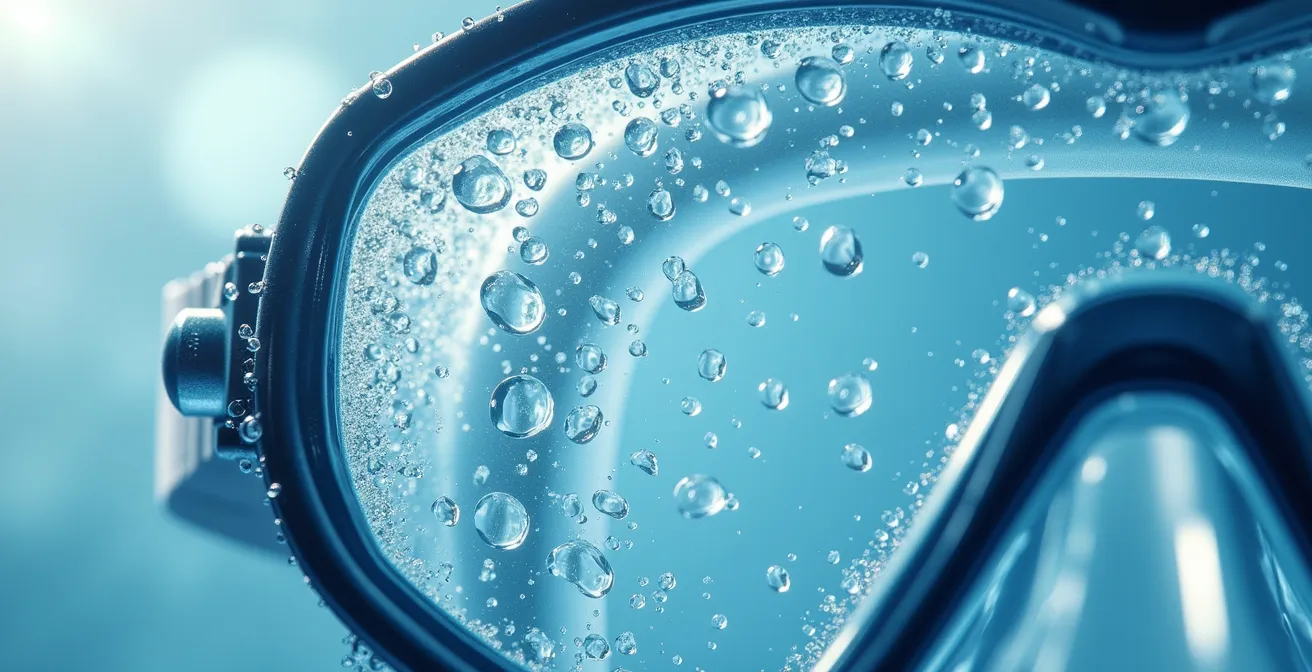
This macro shot perfectly illustrates the goal of proper mask treatment: water droplets bead up and roll off the lens, rather than spreading out and creating a film of fog. This beading effect is the sign of a perfectly clean, hydrophobic surface ready for anti-fog treatment.
Once this initial prep is done, you can move on to your pre-dive ritual. Applying a defog solution is crucial before every single snorkel. Commercial defog drops or even a diluted solution of baby shampoo work wonders. Apply a few drops to the dry, inner lenses, rub it in to coat the entire surface, and then give it a very quick rinse in the water. The goal is to leave a micro-thin layer of the solution behind. From this point on, the golden rule is to never touch the inside of your lenses, as the oils from your fingers will immediately compromise the anti-fog layer.
How to Build Core Strength While Enjoying the Ocean?
The ocean is not just a place for observation; it’s a dynamic environment that can be a powerful and enjoyable natural gym. The constant need to stabilize your body against the water’s movement makes it an ideal place to build functional core strength. A strong core is the secret behind aquatic poise; it’s what allows for graceful movement, effortless hovering, and efficient finning. Instead of thinking of it as a workout, you can integrate specific drills into your snorkeling that build strength while enhancing your underwater skills.
One of the best exercises is practicing horizontal trim. This involves maintaining a perfectly flat, streamlined position in the water, parallel to the surface or the seabed. Holding this position requires constant engagement of your abdominal and lower back muscles to prevent your legs from dropping or your body from swaying. It’s a static hold that builds incredible endurance. You can pair this with flutter kick intervals, alternating between 30 seconds of fast, small kicks and 30 seconds of slow, powerful kicks, all while maintaining that rigid horizontal line. This challenges your core to stabilize against changing forces.
Another excellent drill is the dolphin kick. Performed underwater, this undulating motion, which originates from the core and flows through the entire body, is not only a powerful method of propulsion but also a fantastic exercise for abdominal strength and spinal mobility. For a more static challenge, try vertical finning: position yourself vertically in the water, with your head out, and use only your fin power to keep your body afloat without using your hands. This isolates your leg and core muscles. By incorporating these movements into your time in the water, you’re not just exercising; you’re programming your body for more graceful and controlled underwater exploration.
- Vertical Finning: Maintain a vertical position using only leg power, forcing your core to engage for stability.
- Dolphin Kicks: Practice underwater undulation to improve core strength, control, and spinal mobility.
- Surface Dive Practice: Execute proper “duck dives,” using your core to pivot your body downwards with power and control.
- Sculling Technique: While horizontal, use only your hands and forearms to maneuver, forcing your core to stabilize the rest of your body.
- Horizontal Trim Maintenance: Strive to hold a perfectly streamlined body position, which constantly engages your stabilizing muscles.
How to Hover Motionless Underwater to Protect Marine Life?
The ultimate sign of a conscious observer is the ability to hover, perfectly still and neutrally buoyant, a few feet from the reef. This skill, the pinnacle of aquatic poise, allows you to watch the underwater world unfold without disturbing it. Instead of scaring creatures away with clumsy movements, you become part of the scenery, and marine life will often approach you with curiosity. It prevents accidental contact with fragile corals or stirring up sand and silt that can smother marine organisms. As the Professional Association of Diving Instructors (PADI) emphasizes in their guidelines on responsible marine life interactions, achieving this control is a primary conservation skill.
Hovering isn’t achieved through finning; it’s achieved through breath. This is the art of lung volume control. Your lungs act as your body’s internal buoyancy compensator (BCD). When you take a full, deep breath, the increased air volume makes you slightly more buoyant, and you will slowly rise. When you exhale completely, your body becomes denser, and you will slowly sink. The key to hovering is to find the neutral point in your breathing cycle where you neither rise nor sink. This requires a calm mind and a steady, rhythmic breathing pattern. Panicked, shallow breathing will cause you to bob up and down, while slow, deliberate breaths allow for micro-adjustments in your depth.
Once you are comfortable with breath control, you can refine your position with subtle movements. Your fins should act as rudders and brakes, not engines, using gentle ankle flexes to counteract any slight drift. Your hands should be kept still, either clasped behind your back or held calmly at your sides. Finally, establish a “tripod of stability” by keeping your head still and moving only your eyes. Every unnecessary movement creates drag and requires a counter-movement. True stillness comes from making tiny corrections early rather than large, reactive ones.
- Lung Volume Control: Use a full inhale to rise slightly and a controlled, complete exhale to sink slightly. Find the midpoint for neutrality.
- Fin Finesse: Use your fins for subtle adjustments with gentle sculling or ankle flexes, not for propulsion.
- Tripod of Stability: Keep your head still (move eyes, not head), hands calm, and body in a horizontal trim.
- Micro-Adjustments: Make small, early corrections to your position rather than large, late ones.
- Breathing Rhythm: Establish a slow, steady breathing pattern to maintain a stable position in the water column.
Key Takeaways
- Respect for marine life is an active skill built on control and awareness, not just a passive rule to follow.
- True underwater comfort begins before you enter the water, with proper equipment preparation and selection forming the foundation of safety.
- Mastering your breath and core strength unlocks “aquatic poise,” allowing you to move gracefully and observe wildlife without causing disturbance.
How to Manage Air Consumption to Extend Dive Time by 15 Minutes?
While the concept of “dive time” is typically associated with scuba, the principles of managing air consumption are directly transferable to snorkeling, specifically for extending your breath-hold time for shallow dives. Being able to comfortably hold your breath for 45, 60, or even 90 seconds allows you to duck dive to the seabed in 10-15 feet of water, rest motionless, and observe marine life up close. This skill dramatically enhances the snorkeling experience, transforming it from a 2D surface activity into a 3D exploration. Extending your underwater observation time by even 15-30 seconds per dive makes a huge difference, and it is achieved through technique, not just lung capacity.
The foundation of a longer breath-hold is deep relaxation. Before attempting a dive, spend a couple of minutes on the surface practicing diaphragmatic breathing: slow, deep breaths that originate from your belly, not your chest. This calms your entire nervous system and lowers your heart rate, which in turn dramatically reduces your body’s oxygen consumption. According to experts at the marine conservation and education organization MarineBio.org, this pre-dive relaxation is a critical component of maximizing breath-hold potential. Another powerful technique is to activate the mammalian dive reflex by splashing cool water on your face before a dive, which signals your body to slow its metabolism.
Once you begin your breath-hold, the key is to remain as relaxed as possible, conserving oxygen by minimizing movement. Clear your mind and consciously relax every muscle group. When you surface, it’s crucial to perform recovery breaths—a forceful exhale followed by several quick, deep inhales—to replenish your oxygen levels safely. Extending your breath-hold is a skill that must be trained progressively and safely, never pushing to the point of extreme discomfort.
- Pre-Dive Breathing: Practice a 2-minute diaphragmatic breathing routine on the surface to lower your heart rate and calm your body.
- Activate Dive Reflex: Splash cool water on your face before a dive to trigger the mammalian dive response, which naturally conserves oxygen.
- Relaxation Focus: During the breath-hold, consciously relax all muscle groups and clear your mind to minimize oxygen use.
- Progressive Training: Start with comfortable 30-second holds and gradually increase the duration over weeks of practice. Never train alone.
- Recovery Breathing: Upon surfacing, take several strong recovery breaths to safely restore your oxygen levels.
Now that you are equipped with the knowledge to transform your time in the water, the next logical step is to put it into practice. Start by mastering one skill at a time in a safe, calm environment, and build your confidence progressively. Your journey to becoming a mindful, skilled, and safe underwater explorer starts with your very next trip to the water.