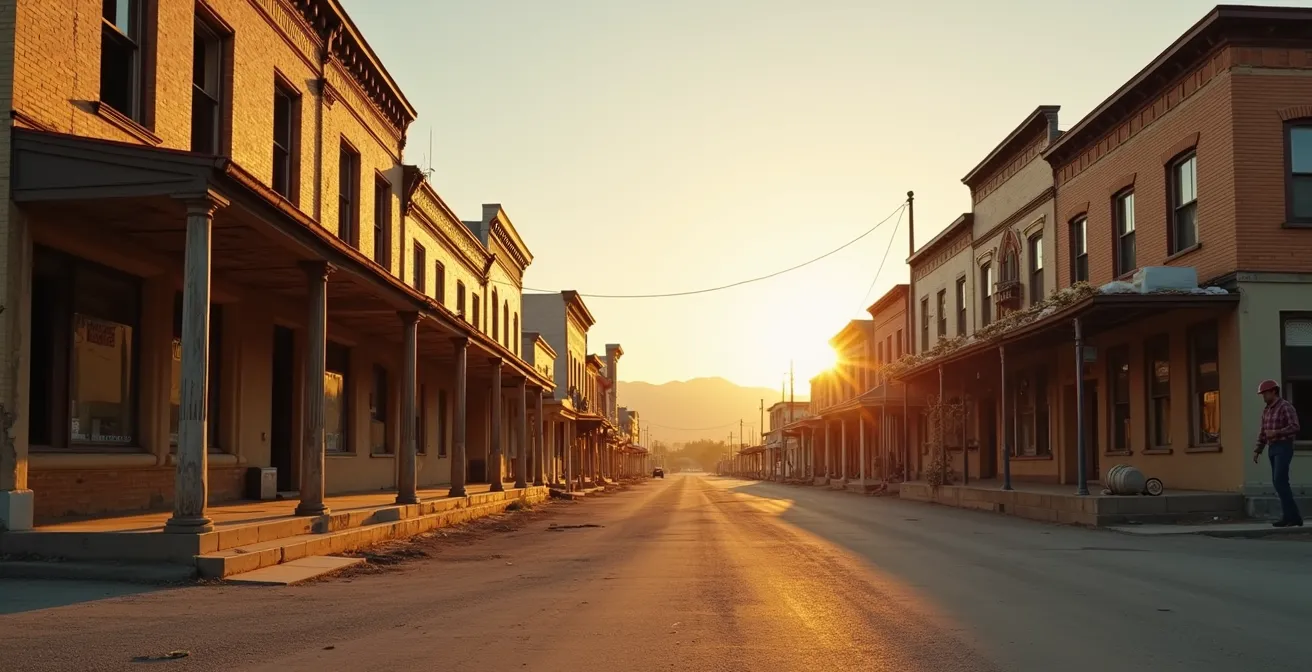
Contrary to popular belief, reviving a ghost town isn’t about attracting people with tax breaks; it’s about building a purpose-driven community that makes people want to stay.
- Financial incentives often fail because they don’t address deeper quality-of-life issues or create a sense of belonging.
- Successful regeneration prioritizes “social infrastructure”—like community spaces and shared projects—before large-scale private investment.
Recommendation: Focus first on creating a vibrant, visible community life through low-cost, high-impact projects to build momentum and de-risk future development.
For urban planners and local council members, the sight of shuttered storefronts and empty streets is a familiar pressure point. The conventional playbook for reversing population decline often involves a desperate chase for a silver bullet: luring a large corporation, slashing property taxes, or launching a glossy tourism campaign. These strategies, while well-intentioned, are often short-term fixes that treat the symptoms of decline rather than the root cause. They attempt to import an economy rather than cultivate one from the ground up.
But what if the fundamental premise is flawed? What if the key to transforming a ghost town isn’t attracting outsiders with financial perks, but building an irresistible social and economic ecosystem from within? This approach shifts the focus from transactional benefits to relational wealth—creating a place so full of purpose, connection, and opportunity that people are drawn to become part of its story. It’s a strategy centered on human capital, where the community itself becomes the primary engine of its own revival. This isn’t about finding a single investor; it’s about empowering a hundred small ones.
This guide provides a strategic framework for this community-led revitalization. We will deconstruct common failures, offer proven alternatives for governance and development, and provide a phased roadmap for building a place that is not just economically viable, but socially vibrant and resilient for the long term.
Table of Contents: A Community-First Blueprint for Urban Revival
- Why tax breaks alone fail to attract long-term residents to rural areas?
- How to build consensus for redevelopment without endless committees?
- Restoration vs Demolition: which yields better ROI for historic centers?
- The gentrification trap that pushes out the locals you wanted to help
- In what order should public amenities be built to trigger private investment?
- How to implement smart city tech that citizens actually trust?
- Franchise vs Independent Startup: which is safer in a volatile economy?
- How to turn a flat roof into a biodiversity haven and insulation layer?
Why tax breaks alone fail to attract long-term residents to rural areas?
The logic seems simple: offer financial incentives, and people will move. Yet, towns that pin their hopes on tax breaks are often disappointed by the lack of sustainable growth. The core issue is that these policies misdiagnose the problem. People don’t just choose a place to live based on a spreadsheet; they choose a life. A tax credit is a transaction, not a reason to belong. It fails to address the deeper needs for community, career opportunities for a spouse, and quality of life amenities that create true “stickiness.”
The reality is that financial precarity often runs deeper than tax rates. For instance, research shows that 40% of rural renter households were cost burdened in 2024, meaning housing costs consume a disproportionate amount of their income. A tax break doesn’t solve this fundamental affordability crisis. A truly effective strategy must pivot from purely financial incentives to what can be called “Purpose Incentives.” This means offering newcomers a meaningful role in co-creating the town’s future, whether through community projects, business incubators, or cultural initiatives.
The story of Glenrio, a ghost town on the Texas-New Mexico border, illustrates this perfectly. Its revival isn’t being driven by tax policy, but by a compelling vision for a wellness destination. The developers are building plunge pools, a dance hall, and even a rodeo. They are selling a purpose and a lifestyle, not a discount. This purpose-driven model creates a powerful narrative that attracts people who want to build something, not just save money, laying the groundwork for a community that is invested emotionally and socially, not just financially.
How to build consensus for redevelopment without endless committees?
One of the greatest obstacles to revitalization is “death by committee.” Traditional governance structures, with their monthly meetings and lengthy approval cycles, can stall momentum and discourage community participation. To move at the speed of opportunity, towns need to adopt more dynamic forms of agile governance. These models prioritize rapid iteration, intensive collaboration, and direct community involvement over bureaucratic procedure. They are designed to produce actionable plans and tangible results in weeks, not years.
This collaborative, high-energy process is best exemplified by a charrette-style planning sprint. These multi-day workshops bring together citizens, planners, designers, and officials to solve a specific problem in real-time.
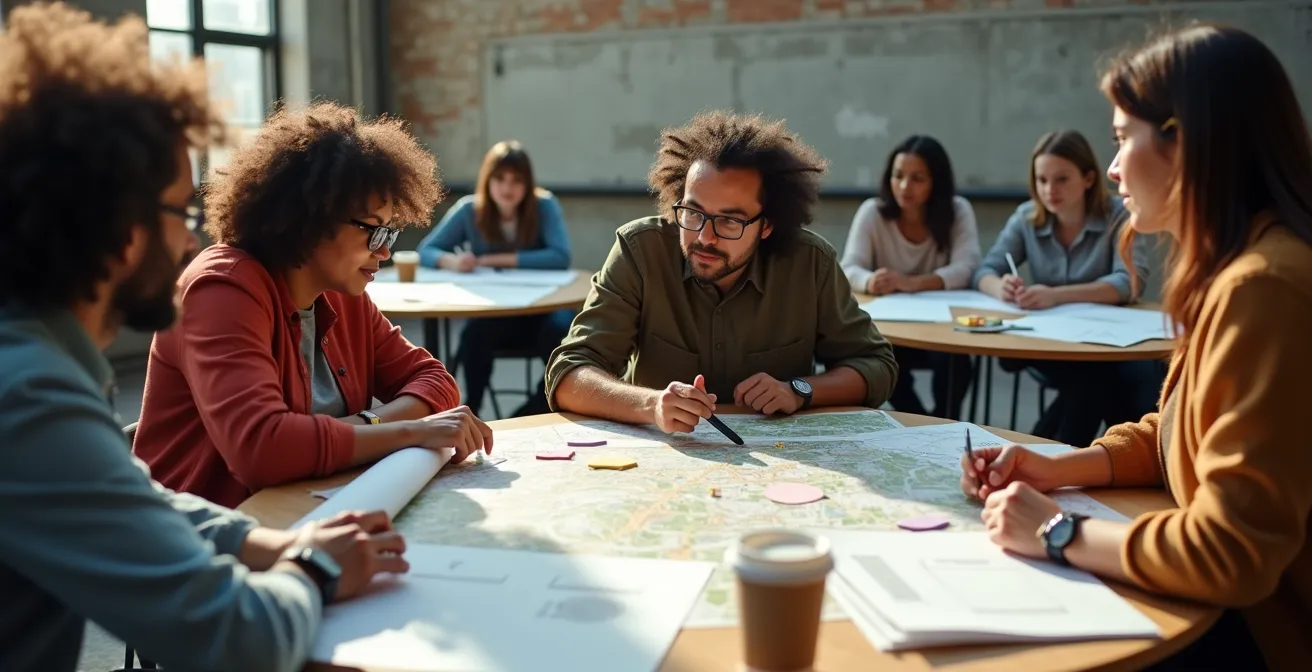
Instead of debating abstract reports, participants co-design visual solutions, building a shared sense of ownership and excitement. The output isn’t a recommendation to be shelved; it’s a tangible design or plan that has already achieved broad consensus. This method transforms governance from a gatekeeper into a facilitator of community vision.
The following table compares the slow, traditional committee model with faster, more engaging alternatives. These agile methods are designed to build buy-in and accelerate decision-making, ensuring that community energy is translated into action before it dissipates.
| Aspect | Traditional Committee | Pop-Up Governance | Charrette Sprint |
|---|---|---|---|
| Duration | Ongoing (years) | 3-6 months | 3-5 days |
| Decision Speed | Slow (monthly meetings) | Fast (weekly sprints) | Immediate |
| Participation | Fixed members | Project-based teams | Open to all |
| Output | Recommendations | Actionable plans | Visual designs |
| Buy-in Level | Low-Medium | Medium-High | Very High |
Restoration vs Demolition: which yields better ROI for historic centers?
When faced with decaying historic buildings, the bulldozer can seem like the cheapest and fastest solution. However, this view overlooks a powerful, irreplaceable asset: narrative capital. A town’s unique history, embodied in its architecture, is a form of capital that new construction can never replicate. Restoration, or “adaptive reuse,” leverages this narrative to create destinations with authentic character, which in turn drives tourism, attracts businesses, and fosters a strong sense of place.
Far from being a financial drain, historic rehabilitation is a potent economic driver, particularly in struggling areas. A report from the National Park Service confirmed that 78% of historic rehabilitation projects in 2022 were in economically distressed areas, demonstrating its effectiveness as a tool for targeted revitalization. These projects create local jobs, increase property values, and generate new tax revenue, all while preserving the very soul of the community.
The transformation of old industrial buildings into modern workspaces is a prime example of adaptive reuse, creating a powerful dialogue between a town’s heritage and its future.
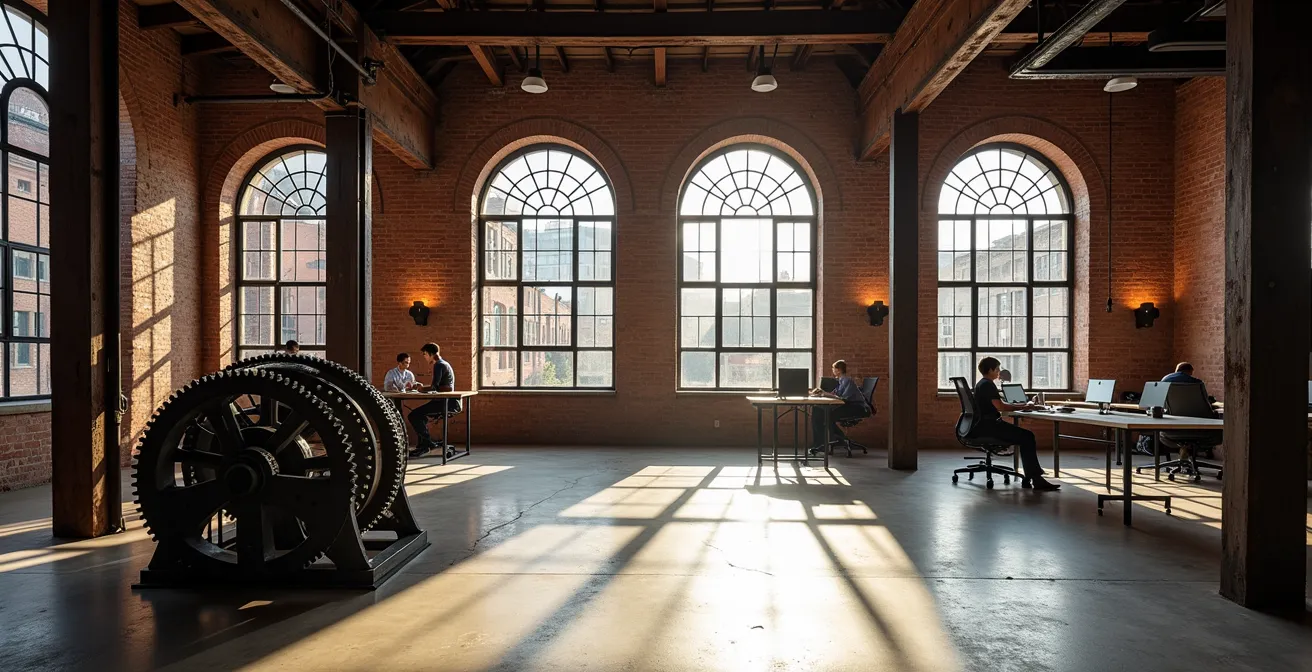
Consider the case of Cerro Gordo, a California mining ghost town. Its new owner has turned the restoration process into a viral online phenomenon. The town’s history as a major source of silver for Los Angeles has become its new “silver cord,” attracting tourists and media attention. This proves that a compelling story, authentically preserved, can generate a return on investment that goes far beyond rent rolls. It creates a brand and an identity that is a magnet for people and capital.
The gentrification trap that pushes out the locals you wanted to help
The tragic irony of many successful revitalization projects is that they can become victims of their own success. As a neighborhood improves, property values and rents rise, ultimately displacing the very residents and small businesses that gave the area its character. This is the gentrification trap. To avoid it, revitalization efforts must be built on a foundation of permanent affordability and community control from day one, not as an afterthought.
The most powerful tool for this is the Community Land Trust (CLT). A CLT is a nonprofit organization that acquires and holds land in trust for the benefit of the community. It sells or rents the buildings on the land to residents at affordable prices but retains ownership of the land itself, typically through a 99-year renewable ground lease. This separates the value of the building from the speculative value of the land, ensuring that housing remains affordable in perpetuity. The impact is significant; data shows that CLTs can reduce home sale prices by up to $150,000 in Houston’s gentrifying wards.
Implementing a CLT and other protective policies before development begins is the only way to ensure that revitalization benefits everyone, not just the newcomers. It is an act of economic self-defense for the existing community.
Action plan: a toolkit for equitable revitalization
- Establish a Community Land Trust (CLT) as the foundational first step before any major development begins.
- Implement 99-year renewable ground leases on CLT properties to ensure permanent housing affordability for future generations.
- Create “Legacy Business” preservation policies, offering local long-standing businesses the first right to purchase their buildings.
- Develop “Right to Return” bonds or housing preferences for former residents who were displaced before protections were in place.
- Set up commercial rent stabilization funds to help existing small businesses weather rising property values.
In what order should public amenities be built to trigger private investment?
Private investment rarely flows into a vacuum. Investors and entrepreneurs are drawn to signs of life and momentum. Therefore, the strategic sequencing of public amenities is critical to sparking a virtuous cycle of growth. The goal is not to build everything at once, but to use small, visible public wins to de-risk the environment for private capital. The key is to start with what creates immediate community buzz and social connection.
As one Urban Development Strategist from the Reimagining Rural Policy Initiative notes, the first step should always be a ‘social anchor’:
Start with a highly visible, low-cost ‘social anchor’—a vibrant town square, a community garden, or a weekly market. This creates an immediate, tangible sense of life and community ‘buzz’ that investors can see and feel.
– Urban Development Strategist, Reimagining Rural Policy Initiative
This “social infrastructure” serves as a proof of concept. Once a place feels alive and engaged, you can move to the next phase of building “enablers” like co-working spaces or shared commercial kitchens that directly support small business formation. Only after these foundational layers are in place does it make sense to pursue large, capital-intensive infrastructure upgrades. This phased approach builds momentum incrementally, making each subsequent investment less risky than the last.
| Phase | Priority Amenities | Investment Level | Timeline | Expected Impact |
|---|---|---|---|---|
| Phase 1: Quick Wins | Town square, community garden, weekly market, murals, pop-up parks | $50K-200K | 0-6 months | Immediate visibility, community morale boost |
| Phase 2: Enablers | Co-working space, shared commercial kitchen, wifi infrastructure | $200K-1M | 6-18 months | Small business support, remote worker attraction |
| Phase 3: Infrastructure | Utilities upgrade, transit, schools, healthcare | $1M+ | 18-36 months | Long-term sustainability, family attraction |
How to implement smart city tech that citizens actually trust?
The term “smart city” often conjures images of invasive surveillance and corporate data mining, creating a significant public trust deficit. A revealing survey found that 66% of Americans say they would not want to live in a smart city. For small towns, imposing top-down, complex technology is a recipe for backlash. The path to building trust lies in a “Dumb Tech, Smartly Used” approach: prioritizing simple, open-source, and citizen-controlled tools that solve real, everyday problems.
Instead of city-wide sensor grids, consider a community-run LoRaWAN network for local farmers to monitor soil moisture. Instead of a centralized municipal app, co-design a simple platform for a tool-sharing library or a carpooling service. The key principles are transparency, co-design, and local ownership. Technology should be a tool for empowerment, not control. Mandating open-source platforms and holding public workshops to design solutions ensures that the community understands and shapes the technology it uses.
The city of Long Beach provides a powerful case study. By focusing on earning public trust through transparency and equitable design, they far exceeded their engagement goals for their digital rights platform. They demonstrated that when residents are treated as partners in technological advancement, they become advocates. Some successful models even implement “Data Dividends,” where the financial savings generated by smart efficiencies are returned directly to the community, making the benefits of technology tangible for everyone.
Key takeaways
- Lasting revitalization comes from building a resilient social and economic ecosystem, not from short-term financial lures.
- Protecting the existing community with tools like Community Land Trusts is not a secondary goal, but a prerequisite for equitable growth.
- Start with small, visible “social anchors” to create momentum and de-risk the environment for larger private and public investments.
Franchise vs Independent Startup: which is safer in a volatile economy?
When trying to fill empty storefronts, attracting a familiar franchise can seem like the “safe” bet. It brings a proven business model and brand recognition. However, this safety is often an illusion. A franchise-heavy economy creates a fragile, leaky bucket. A significant portion of the revenue (15-30%) is siphoned out of the community in fees and royalties. Furthermore, it creates a generic townscape that lacks a unique identity, and each franchise represents a single point of failure if the parent company struggles.
In contrast, fostering a diverse ecosystem of independent, locally-owned startups builds a truly resilient economic ecosystem. As one economic development expert notes, this approach creates a powerful local multiplier effect:
A diverse ecosystem of independent, interdependent startups creates a resilient local economy where money circulates multiple times, strengthening the whole community against external shocks.
– Economic Development Expert, Rural Economic Resilience Study
While the failure risk for any single startup is high, a diverse network of them is incredibly strong. They buy from each other, hire locally, and keep nearly all of their wealth within the community. Worker cooperatives are an even more resilient model, distributing both risk and reward among member-owners. The table below highlights how independent and cooperative models outperform franchises on the metrics that matter most for long-term community wealth and identity.
| Factor | Franchise | Independent Startup | Worker Cooperative |
|---|---|---|---|
| Initial Investment | High ($50K-500K+) | Variable ($10K-100K) | Shared ($5K-50K per member) |
| Failure Risk | Low (proven model) | High (70% fail) | Medium (shared risk) |
| Local Wealth Retention | 15-30% | 80-95% | 90-100% |
| Community Identity | Generic | Unique | Strong |
| Resilience to Shocks | Single point failure | Variable | High (distributed) |
| Economic Multiplier | 1.2x | 2.5x | 3x |
How to turn a flat roof into a biodiversity haven and insulation layer?
This final section serves as a metaphor for the entire revitalization strategy: taking a barren, overlooked asset and transforming it into a living system that provides multiple, compounding benefits. Just as a flat, sun-beaten roof can be turned into a green oasis, a ghost town’s dormant buildings can be brought back to life in a way that is both economically productive and ecologically restorative.
The village of Sagna Rotonda in the Italian Alps, abandoned until 2005, is a testament to this philosophy. Its restorers transformed the village into a sustainable tourist destination, integrating green roofs that serve as both natural insulation and critical pollinator habitats. This approach demonstrates that sustainability is not a cost, but a value-add that enhances the economic model. It creates a powerful story, reduces long-term operating costs, and builds a healthier environment.
A town-wide green roof initiative can become a cornerstone of the new economy. By mapping all flat roofs, a community can create a masterplan for ecological corridors, connecting rooftops with green walls to form a continuous “green ribbon” for wildlife. These roofs can be productive, growing microgreens for local restaurants, or they can host community-owned solar gardens and apiaries producing “ghost town honey.” This creates a new, hyper-local industry, complete with vocational training programs and jobs in green roof installation and maintenance, truly embedding sustainability into the town’s economic DNA.
By applying this integrated, community-first framework, local leaders can move beyond the cycle of decline and begin the rewarding work of cultivating a place that is not just revived, but reborn—resilient, authentic, and alive with purpose.