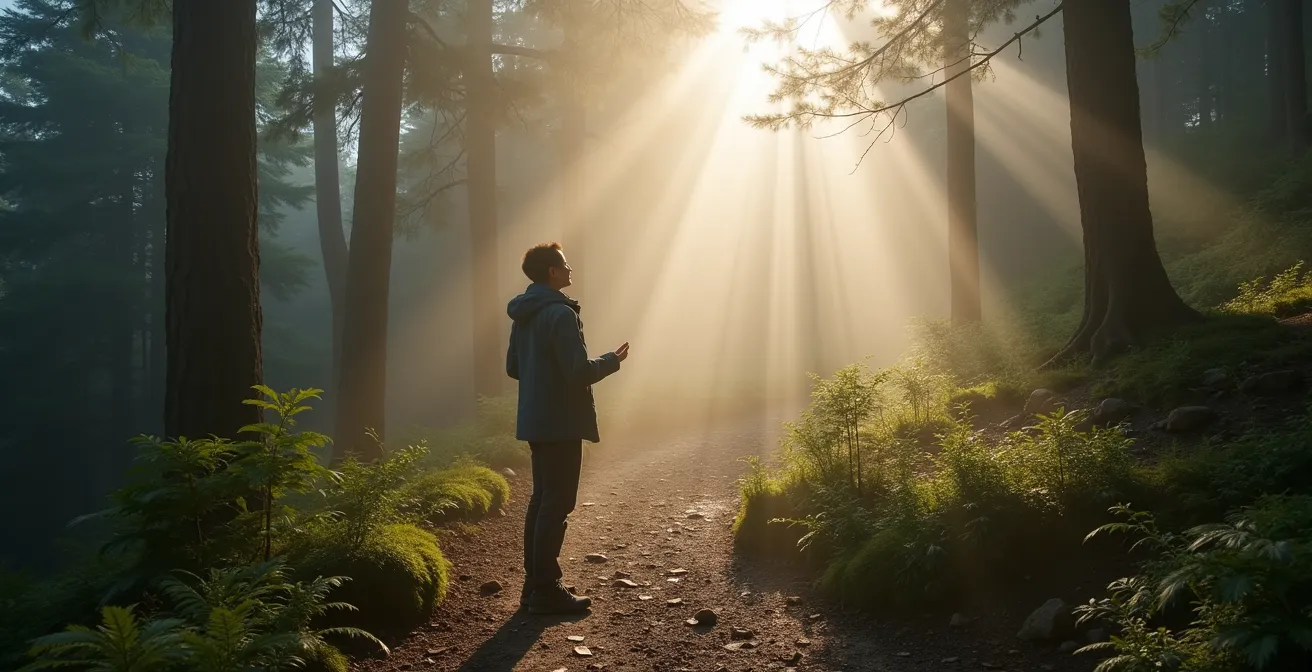
Contrary to popular belief, forest bathing isn’t just a relaxing walk; it’s an active therapeutic practice that directly interrupts your body’s cortisol production cycle.
- Chronic exposure to urban environments depletes cognitive resources and keeps your nervous system in a low-level threat state.
- Targeted techniques, like slow exhalation and digital detoxing, are required to shift your body from “fight-or-flight” to “rest-and-digest” mode.
Recommendation: To be effective, forest bathing must be treated as a form of sensory re-engagement, not a passive activity. Focus on what you can hear, smell, and touch to trigger the physiological benefits.
For the urban professional battling burnout, the constant hum of the city and the glow of screens create a state of perpetual alert. You feel wired but tired, a classic sign of dysregulated cortisol. The common advice is to “get into nature,” but this often feels vague and unfulfilling. You take a walk in the park, phone in hand, and return feeling just as stressed. The problem isn’t the advice itself, but the lack of a proper framework. This is where the Japanese practice of Shinrin-yoku, or “forest bathing,” offers a profound solution when understood correctly.
Many approaches to forest bathing treat it as a passive stroll, missing its true therapeutic power. They overlook the deep-seated anxiety that comes with disconnecting or the specific physiological triggers that actually lower stress hormones. But what if the key wasn’t simply being *in* nature, but actively *engaging* with it through specific, science-backed protocols? This guide moves beyond the platitudes to reveal forest bathing as a clinical tool for mental health restoration. It’s not about escaping your life, but about rewiring your nervous system to better handle it.
We will explore the precise mechanisms by which green spaces reduce anxiety and provide actionable strategies to overcome the hurdles of a 50-hour work week and digital dependency. You will learn not just the “what,” but the “why” and “how”—from the biophysics of breathing to the psychology of solitude—to transform a simple walk into a potent antidote for high cortisol.
Summary: How to Use Forest Bathing to Systematically Lower Your Cortisol
- Why Lack of Green Space Exposure Increases Anxiety in Adults?
- How to Commit to a Phone-Free Weekend Without Withdrawal Anxiety?
- Solo Hiking vs Group Camping: Which Recharges Introverts Better?
- The Hydration Mistake Novice Hikers Make on Short Trails
- How to Fit a Nature Escape into a 50-Hour Work Week?
- Why Bottling up Anger Leads to Physical Exhaustion?
- The Isolation Risk That Leads to a Productivity Drop After 6 Months
- Why Slow Exhalation Physically Forces Your Heart Rate Down?
Why Lack of Green Space Exposure Increases Anxiety in Adults?
The anxiety so many urban professionals experience isn’t a personal failing; it’s a predictable environmental response. From an ecopsychological perspective, our brains are hardwired to find safety in natural environments. The chronic absence of these cues, combined with the relentless demands of city life, keeps the nervous system in a state of sympathetic dominance—the “fight-or-flight” mode. This isn’t just a feeling; it’s a physiological state driven by a cascade of stress hormones, with cortisol at the helm. A landmark 2024 meta-analysis of 59 studies confirmed that green spaces significantly moderate the risk of psychiatric disorders, including anxiety.
Three core mechanisms explain this connection. First is Attention Depletion. Urban settings force our brains into “hard fascination,” where we must constantly direct our attention to navigate traffic, respond to alerts, and process dense information. This depletes resources in the prefrontal cortex, leading to mental fatigue and heightened irritability. Second, Sensory Overload from abrupt noises and fast movements bombards our nervous system, while other senses like smell and touch are starved. Nature, in contrast, offers “soft fascination” with gentle, complex patterns that allow our directed attention to rest and recover.
Finally, the Biophilia Hypothesis posits that humans have an innate need to connect with nature. Greenery, the sound of water, and fractal patterns in leaves are ancient safety signals. Their absence in a concrete jungle is interpreted by our primal brain as a persistent low-level threat, contributing to chronic anxiety. To counter this, experts now recommend the “3-30-300 green space rule”: ensuring you can see at least 3 trees from your home, live in a neighborhood with 30% tree canopy coverage, and are within 300 meters of a park.
How to Commit to a Phone-Free Weekend Without Withdrawal Anxiety?
The advice to “leave your phone at home” is simple, but for many, it triggers genuine withdrawal anxiety and a fear of missing out (FOMO). A successful digital detox isn’t about willpower; it’s about a structured “tapering” process that weans your nervous system off the constant dopamine hits of notifications. It involves replacing the digital tether with a physical, analog anchor that grounds you in the present moment. This could be a journal, a camera, or even a smooth stone you carry in your pocket.
The goal is to mindfully redirect the impulse to check your phone towards a sensory engagement with your immediate environment. This illustration captures the essence of this shift: replacing the screen’s glow with the tactile reality of pen on paper, surrounded by the textures of the forest. It’s about substituting one habit with a more restorative one.

As you can see, the focus is entirely on the tangible and the natural. This practice of using an analog anchor creates a new neural pathway, giving your hands and mind something meaningful to do. Instead of fighting the urge for stimulation, you are satisfying it in a way that lowers cortisol instead of raising it. This methodical approach makes a phone-free experience not a source of anxiety, but a gateway to deep restoration.
Your Digital Tapering Protocol for Forest Bathing
- Thursday: Begin by turning off all non-essential app notifications and carving out specific 2-hour phone-free windows in your day.
- Friday: Communicate your limited availability to key contacts, set up auto-responder messages, and practice short, 20-minute nature walks without your device.
- Saturday morning: Leave your phone at home or powered completely off. Intentionally replace it with an analog anchor object like a journal, a film camera, or a worry stone.
- Weekend activities: Plan engaging nature activities that provide natural dopamine rewards, such as identifying bird calls, trying cold water immersion, or exploring a new trail.
- Re-entry Sunday evening: Reintroduce your phone gradually with clear boundaries. Commit to maintaining at least one daily phone-free nature session going forward.
Solo Hiking vs Group Camping: Which Recharges Introverts Better?
For an introvert, the term “recharge” has a specific meaning: a recovery from social and cognitive overstimulation. While both solo hiking and group camping offer nature’s benefits, they serve fundamentally different restorative purposes. As a study in the International Journal of Environmental Research and Public Health highlights, “Self-guided forest therapy provided an opportunity for self-reflection… while guided… programs promoted social bonds.” For an introvert suffering from burnout, the choice depends on the type of depletion they are experiencing.
Self-guided forest therapy provided an opportunity for self-reflection to focus on and think about one’s inner self, while guided forest therapy programs provided positive emotional changes and promoting social bonds through interaction with others.
– Kim, J. G., & Shin, W. S., International Journal of Environmental Research and Public Health
Solo hiking is the ultimate tool for cognitive defragmentation. It allows for 100% focus on sensory input from nature, providing the “soft fascination” that restores directed attention. With no social cues to process, the brain can fully enter a state of rest, leading to a maximum reduction in cortisol. It is the ideal prescription for someone feeling mentally exhausted and overstimulated by constant meetings and communication.
Conversely, group camping addresses emotional depletion. While it demands some social processing, the shared experience and mutual support can boost oxytocin, the “bonding hormone,” which counteracts stress. It’s best for those feeling isolated or disconnected. The key is to find a balance, as this table illustrates.
| Aspect | Solo Hiking | Group Camping |
|---|---|---|
| Primary Hormone Effect | Maximum cortisol reduction (12% lower after forest walk) | Oxytocin boost through social bonding |
| Cognitive Recovery | Complete mental defragmentation without social input | Partial recovery with social processing demands |
| Sensory Immersion | 100% focus on nature’s stimuli | Divided attention between nature and social cues |
| Best For | Cognitive exhaustion, overstimulation | Emotional depletion, need for connection |
| Hybrid Solution | Structured Solitude Model: Group camping with mandatory 2-hour solo forest bathing sessions each morning | |
The Hydration Mistake Novice Hikers Make on Short Trails
One of the most overlooked saboteurs of a restorative nature walk is dehydration. Many people heading out for a “short” one-hour trail assume they don’t need water, a critical mistake that can completely negate the stress-reducing benefits they seek. The physiological link is direct and unforgiving: research on stress biomarkers shows that even mild dehydration triggers the adrenal glands to release cortisol. You may be mentally unwinding, but your body is entering a state of physiological stress, undoing all your good work.
The mistake is not just forgetting water, but failing to pre-hydrate. Your body’s hydration level upon starting the activity is far more important than what you drink during it. For a forest bathing session to be effective, your system must be in a state of balance from the outset. This requires a conscious protocol, not an afterthought.
Instead of viewing water breaks as a necessity, reframe them as moments of mindful practice. When you take a sip, don’t just gulp it down. Feel the coolness of the water. Listen to the sound of it pouring. Notice the sensation in your throat. This integrates the act of hydrating into the sensory re-engagement of forest bathing itself, turning a simple task into a grounding ritual. A proper protocol involves drinking about 500ml two hours before your walk and then taking mindful sips every 20 minutes, ensuring your body remains in a state of calm and balance.
How to Fit a Nature Escape into a 50-Hour Work Week?
The idea of a weekend-long forest escape can seem impossible for someone with a demanding career. This “all or nothing” mindset is a primary barrier to accessing nature’s benefits. The key, however, lies in a concept from pharmacology: the “minimum effective dose.” You don’t need a full day; you need consistent, targeted exposure. Research is clear that the benefits of nature start accumulating with surprisingly short durations. For example, studies on urban dwellers demonstrate that just 17 minutes daily in a natural setting can significantly improve health and well-being.
This is the principle of nature micro-dosing. It’s about integrating small, potent moments of nature into the fabric of your existing urban life. A walk through a city park during your lunch break, consciously leaving your phone in your pocket, can be a powerful intervention. It’s not about the grandeur of the wilderness but the quality of your attention during the time you have.

The scene above isn’t a vacation; it’s a strategic pause. This person is actively lowering their cortisol in the middle of a workday. By finding a small pocket of green, closing their eyes, and focusing on the sound of the wind or the feeling of the sun, they are engaging in a targeted therapeutic session. This approach makes nature accessible to everyone, regardless of their schedule.
Case Study: The Power of Nature Micro-dosing
The NPR Life Kit program, building on a 2019 study, documented a powerful micro-dosing protocol. The original study found that just 15 minutes of walking through woods could relieve stress. The program’s participants were asked to take 20-minute walks in a local park, focusing on just one sense (e.g., hearing, then smell) for 5-minute intervals. The results showed that this structured, multi-sensory approach produced an accelerated relaxation response, with participants reporting benefits equivalent to much longer, unstructured sessions in deep forest environments.
Why Bottling up Anger Leads to Physical Exhaustion?
Chronic physical exhaustion in high-achievers is often misdiagnosed as simple overwork. From an ecopsychological standpoint, it’s frequently the result of suppressed anger, a potent emotion that consumes vast amounts of energy. When you “bottle up” anger—often stemming from what researchers call “relative deprivation,” the feeling of being in a disadvantageous position you don’t deserve—your body holds that emotional charge as muscular tension. This constant state of “muscular armoring” in the jaw, neck, and shoulders is metabolically expensive, draining your physical resources and leading to profound exhaustion.
Forest bathing offers a unique modality for releasing this stored energy. It’s not about “thinking” your way out of anger, but physically and symbolically discharging it. One powerful, non-verbal technique involves using the environment as a tool for emotional processing. This protocol provides a structured way to do just that:
- Identify Muscular Armoring: Before you even enter the forest, stand still and notice the tension. Is your jaw clenched? Are your shoulders raised? Acknowledge the physical manifestation of your anger.
- Find a Heavy Stone: Walk until you find a stone that feels right. Its weight should feel symbolic of the emotional burden you are carrying.
- Imbue with Feeling: Hold the stone in your hands. Close your eyes and, with focused breathing, consciously visualize transferring the feeling of anger, resentment, or frustration from your body into the stone.
- Physical Release: Walk to a specific spot—the base of a large tree, the edge of a stream—and intentionally leave the stone behind. This act creates a powerful physical and psychological distance from the emotion.
- Movement Integration: Afterward, continue your walk, focusing on uneven terrain. The natural, varied movements will help your body release any residual muscle tension that was holding the emotion.
This is not a metaphor; it is a psychophysical process. By giving the emotion a physical form and then creating distance from it, you are sending a clear signal to your nervous system that the threat has been managed, allowing the body to finally stand down and conserve energy.
The Isolation Risk That Leads to a Productivity Drop After 6 Months
While many professionals embrace remote work for its flexibility, a hidden risk often emerges after about six months: a profound sense of isolation that quietly sabotages productivity. This isn’t just loneliness; it’s the erosion of incidental social connection that once buffered workplace stress. The data on this is stark; pandemic research revealed that over 95% of people reported PTSD symptoms and 45% reported anxiety during prolonged periods of isolation. This sustained psychological stress directly impairs executive functions like focus, planning, and motivation, leading to a noticeable drop in performance.
The solution isn’t necessarily a forced return to the office, but the cultivation of a “Third Place”—a concept from urban sociology referring to environments outside of home (First Place) and work (Second Place). For remote professionals, local green spaces can become powerful Third Places. A 2024 study highlighted how neighborhood parks provide opportunities for “parallel activities.” This involves being in the presence of others without the pressure of direct interaction—walking the same paths, sitting on nearby benches, or seeing familiar faces.
This low-pressure sense of community and belonging is deeply restorative. The study found that among disadvantaged groups using parks as Third Places, 70% showed reduced stress markers. These spaces combat the cognitive rigidity and emotional flatness of isolation by offering gentle, ambient social stimulation. Committing to a daily walk in the same local park can rebuild the sense of community that remote work dismantled, providing the psychological foundation needed for sustained productivity and well-being.
Key Takeaways
- Forest bathing is an active practice of sensory engagement, not a passive walk, designed to interrupt the cortisol cascade.
- Effective stress reduction requires specific, science-backed techniques like digital tapering and controlled breathing.
- Even small, consistent “micro-doses” of nature (15-20 minutes) in urban parks can significantly lower stress levels.
Why Slow Exhalation Physically Forces Your Heart Rate Down?
The most powerful tool for stress reduction is one you carry with you at all times: your breath. However, the generic advice to “breathe deeply” is often ineffective because it misses the key physiological mechanism. The magic is not in the inhalation, but in the slow, extended exhalation. This specific action is what physically forces your heart rate to decrease by activating the vagus nerve, the primary nerve of the parasympathetic nervous system.
When you inhale, your heart rate naturally speeds up slightly. When you exhale, it slows down. By consciously making your exhale longer than your inhale, you are amplifying this natural process and telling your body’s control system to switch from “fight-or-flight” to “rest-and-digest.” As Forestry England’s guide explains, this is a direct biological signal.
Extending the exhalation of air to twice the length of the inhalation sends a message to the body that it can relax.
Combining this breathing technique with the sensory input of a forest environment creates a powerful synergistic effect. The goal is to synchronize your internal rhythm with the external rhythm of nature. This can be achieved through a simple, structured practice:
- Step 1: Find Your Baseline. Stand still in a quiet spot and count your normal, unconscious breathing rate for one minute.
- Step 2: Establish a Walking Rhythm. Begin to walk at a slow, deliberate pace. Inhale for a count of two steps.
- Step 3: Activate the Vagus Nerve. Exhale slowly and fully over a count of four or five steps. The key is making the exhale significantly longer than the inhale.
- Step 4: Entrain with Nature. As you walk, try to match the rhythm of your breathing to a natural sound, like the rustling of leaves in the wind or the call of a distant bird.
- Step 5: Integrate and Sustain. Maintain this breathing pattern for a minimum of 10 minutes. This is the approximate time needed to chemically shift your body into a state of parasympathetic dominance and lower cortisol.
By integrating these targeted, science-backed practices, you can transform a simple walk in the woods into a powerful and systematic intervention to lower cortisol, combat burnout, and restore your mental and physical well-being.