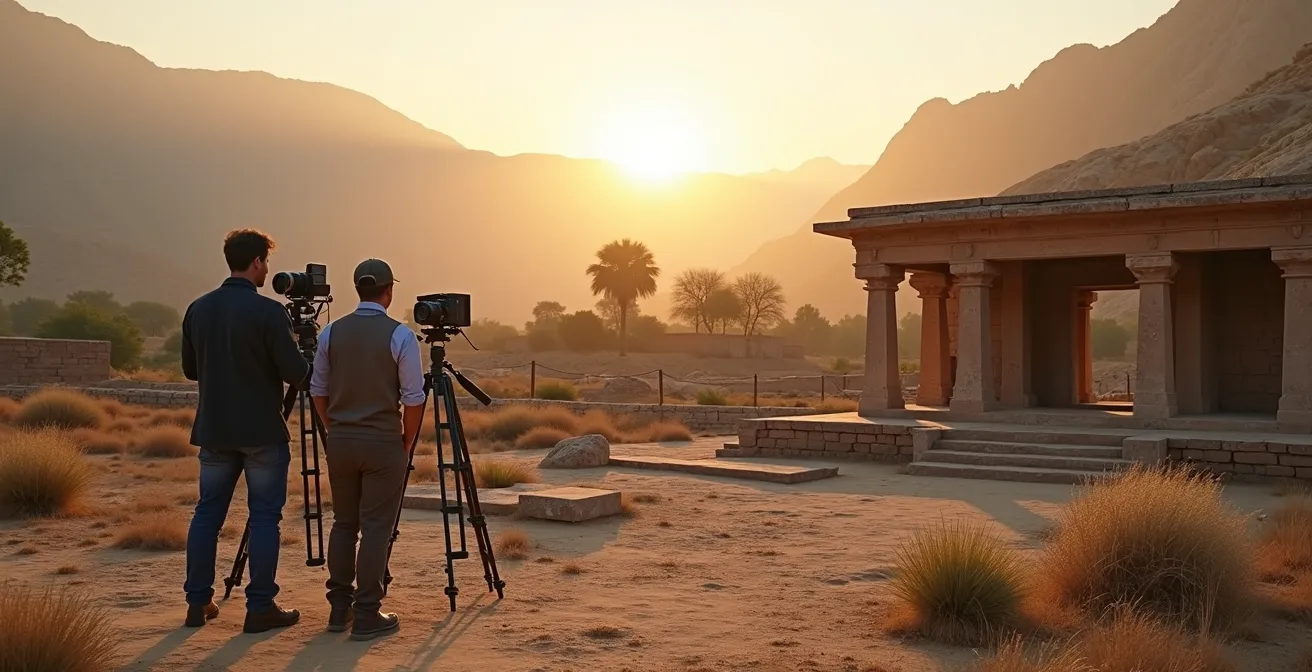
Effective virtual preservation is more than just creating a 360° video; it’s about achieving digital authenticity through deliberate technical and pedagogical choices.
- True immersion relies on “six degrees of freedom” (6DoF) VR, allowing users to physically move through and interact with a space, which is critical for learning.
- Accurate digital models are built using techniques like photogrammetry, creating a foundational “digital twin” for both exploration and long-term monitoring.
Recommendation: Prioritize platforms and methods that ensure both an immersive user experience and the long-term integrity of the digital asset for future generations.
Many of the world’s most profound cultural and historical sites are paradoxically out of reach. They may be too fragile to withstand foot traffic, too remote for easy travel, or physically inaccessible to individuals with mobility impairments. For decades, the proposed solution has been the “virtual tour,” a term that often conjures images of clicking through a series of flat, panoramic photos. While well-intentioned, these experiences frequently lack the depth and engagement necessary to convey the true significance of a place.
The conversation in digital archaeology is shifting. The critical question is no longer *if* we can visit these sites virtually, but *how* we can create an experience that possesses digital authenticity. This is an approach that goes beyond mere visual representation to foster a genuine sense of presence, intellectual engagement, and emotional connection. It respects both the integrity of the physical site and the intelligence of the virtual visitor. It transforms a passive viewing into an active exploration.
This guide moves past the platitudes to deconstruct the essential pillars of meaningful virtual preservation. We will explore the technical, methodological, and ethical choices that separate a forgettable slideshow from a powerful educational tool. From the specifics of data capture to the nuances of user experience and the strategy for long-term digital stewardship, you will learn what it truly takes to use VR not just to see a fragile site, but to understand it.
To navigate this complex but rewarding field, this article breaks down the core components of creating authentic virtual heritage experiences. The following sections provide a roadmap for educators, travelers, and institutions looking to harness the true power of VR for preservation and access.
Summary: A Specialist’s Guide to Virtual Heritage Preservation
- Why virtual tours are a lifeline for mobility-impaired travelers?
- How to capture a 360-degree tour with consumer gear?
- True VR vs 360 Video: which offers better immersion for students?
- The frame rate error that makes VR tours nauseating
- When to use virtual tours to prep for a physical field trip?
- How to identify structural instability in abandoned factories?
- The procurement error that leaves cities with outdated sensors in 2 years
- Audio Guide vs Human Docent: which offers better retention?
Why virtual tours are a lifeline for mobility-impaired travelers?
For a significant portion of the population, the dream of exploring ancient ruins or remote historical landmarks is barred by physical reality. Uneven terrain, lack of accessible infrastructure, and the sheer physical demands of travel can make these sites off-limits. Virtual reality is rapidly evolving from a novelty into an essential tool for inclusive cultural access. It dismantles physical barriers, offering an equitable opportunity for exploration and learning to those who would otherwise be excluded. This isn’t just about remote tourism; it’s about fostering a sense of connection and participation in our shared global heritage.
The impact of this technology is not a niche interest; it represents a significant and growing field. In fact, industry projections show that the global virtual tourism market is projected to reach USD 111.16 billion by 2033, a figure driven in large part by the demand for more accessible experiences. Projects like Google’s Open Heritage initiative have specifically highlighted this benefit, noting that many of its digitized locations are difficult to visit in person. VR provides an immediate and profound solution for users with limited mobility, allowing them to explore these treasures from their own homes.
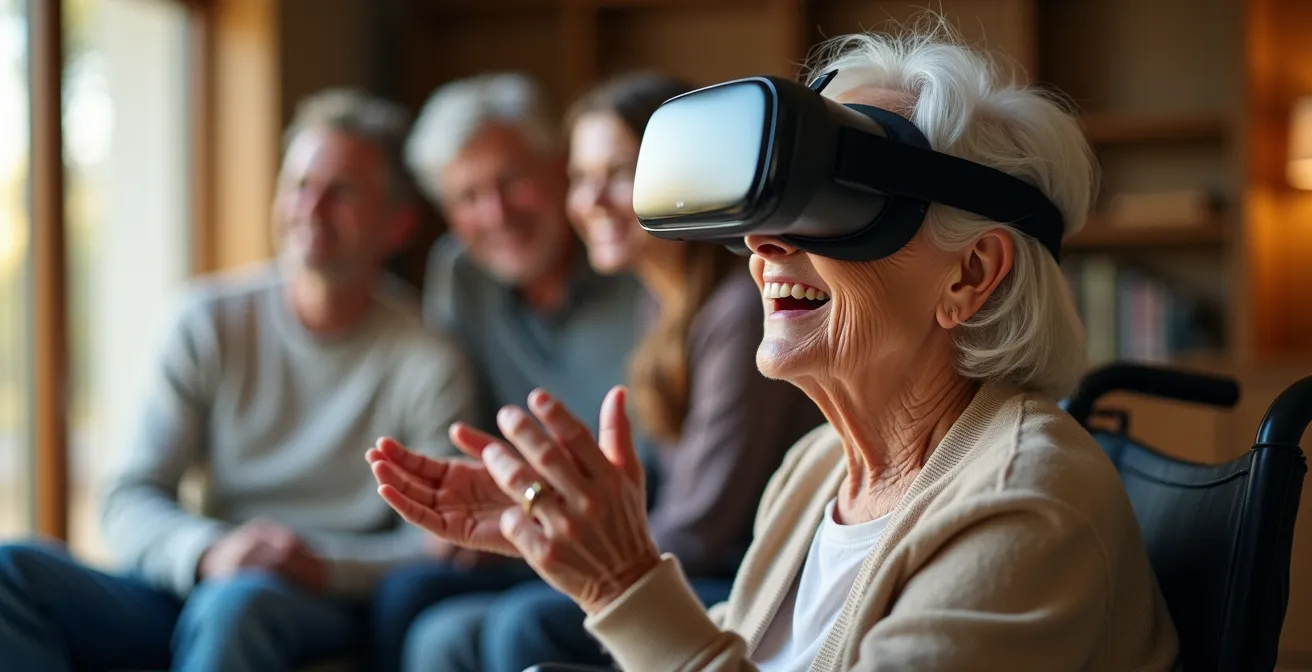
Furthermore, modern VR platforms are increasingly social. They allow users to explore these virtual spaces with family, friends, or classmates, transforming a solitary activity into a shared journey. This social dimension is crucial, as it replicates the communal aspect of travel and discovery, helping to combat the isolation that can sometimes accompany physical limitations. The experience becomes not just about seeing a place, but about sharing that moment of wonder with others.
How to capture a 360-degree tour with consumer gear?
The creation of a high-fidelity virtual heritage site begins with a crucial first step: data capture. While the term “360-degree tour” is common, it often refers to simple panoramic videos. For true digital authenticity, we must build a complete three-dimensional model. The most accessible method for this is photogrammetry, a technique that uses hundreds or thousands of overlapping photographs to computationally reconstruct a 3D object or environment. The unique textures and complex geometry of heritage places make them ideal subjects for this process, allowing even consumer-grade DSLRs or high-end smartphones to serve as powerful data collection tools.
This process is the start of what can be called a preservation pipeline. Once the initial high-detail model is created from the photographs, it must be computationally optimized. This involves reducing its geometric complexity so that it is small enough to be rendered in real-time by a VR headset’s graphics processor. By combining this optimized model with high-resolution texture maps, the final result can look nearly identical to the original detailed scan while performing smoothly in an interactive environment. This technique allows for the creation of experiences with “six degrees of freedom” (6DoF), a concept we will explore next.
For educators and institutions considering a digitization project, understanding the different capture methods and their trade-offs is essential. The following table breaks down the most common approaches, from accessible photogrammetry to high-precision Lidar scanning, which uses lasers to measure distances with extreme accuracy. This comparison, based on an analysis of VR in cultural heritage, helps clarify the relationship between cost, accuracy, and the intended use case.
| Method | Equipment Cost | Accuracy Level | Best Use Case |
|---|---|---|---|
| Photogrammetry | Low (DSLR/smartphone) | Medium-High | Educational outreach |
| 3D Scanning | Medium | High | Research documentation |
| Lidar Scanning | High | Very High | Archival preservation |
Choosing the right method depends entirely on the project’s goals. For broad educational outreach, the quality of photogrammetry is often more than sufficient. For scientific analysis or archival preservation, the millimeter-level precision of Lidar is indispensable.
True VR vs 360 Video: which offers better immersion for students?
Not all virtual experiences are created equal. The distinction between a 360-degree video and a “true VR” environment is fundamental to its educational value. A 360 video is a passive experience; you are placed at a fixed point and can only look around (3 Degrees of Freedom, or 3DoF). In contrast, a true VR environment, built from a full 3D model, offers six degrees of freedom (6DoF). This means you can not only look around but also physically walk, crouch, and move through the virtual space. This ability to move is not a gimmick; it is the key to unlocking genuine immersion and deeper learning.
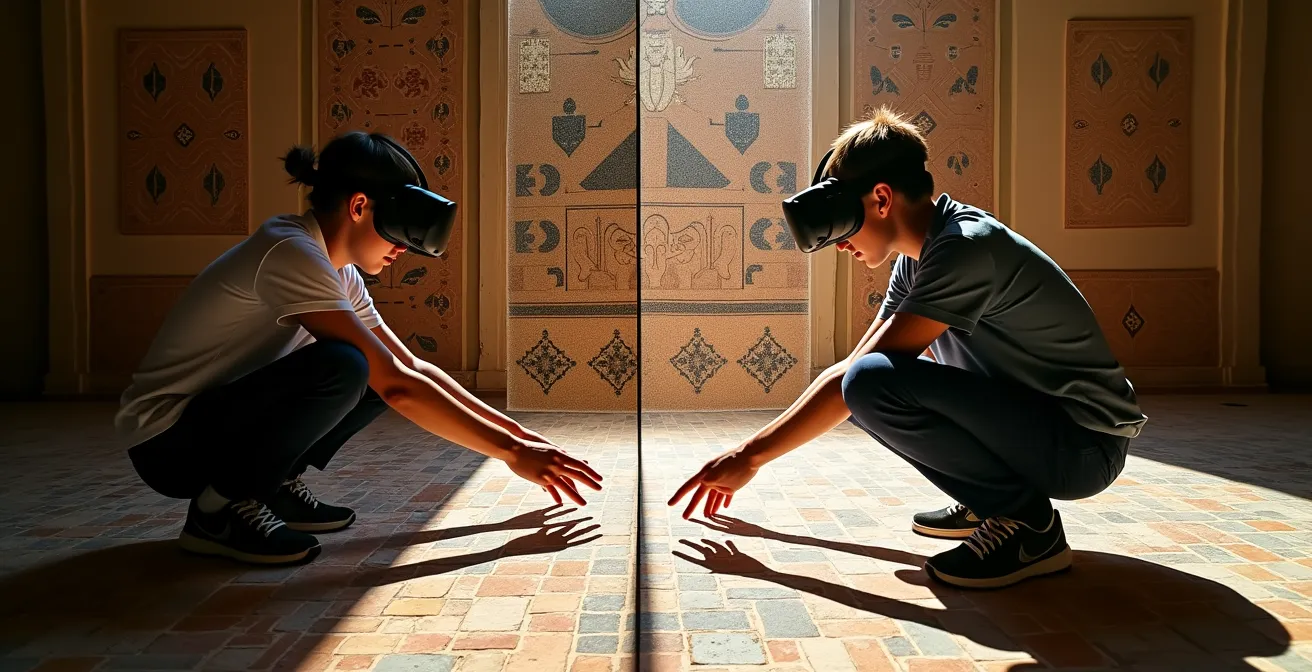
This difference is critical for a concept known as embodied cognition: the theory that our physical actions and interactions with the environment are deeply intertwined with our thought processes. In a 6DoF environment, a student can physically crouch to examine floor mosaics, lean in to see the texture of a stone carving, or walk around a sculpture to understand its form from all angles. This physical engagement triggers a more profound cognitive and spatial understanding than passively watching a video. The data supports this, as research shows 6DoF experiences are used more frequently than 3DoF in cultural heritage applications, with a preference of 68% to 32%.
This concept of engagement goes beyond simple physical interaction. As digital heritage expert Erik Champion notes, the most powerful virtual worlds create a sense of “cultural presence.”
Virtual worlds and related computer games have dimensions that could afford environmental presence, social presence and cultural presence… where cultural presence is ‘a distinctly situated sense of inhabitation, of social values and behaviors preserved and transmitted through ritual, artifact and inscription’
– Erik Champion, Frontiers in Education
A 6DoF experience is the only way to achieve this “situated sense of inhabitation.” By allowing the user to exist and move within the space as an active agent, we transform a virtual visit into a genuine exploration, fostering a much deeper connection to the history and culture of the site.
The frame rate error that makes VR tours nauseating
One of the biggest technical hurdles to the widespread adoption of VR is cybersickness. This feeling of nausea or disorientation is a physiological response to a sensory mismatch: your eyes tell your brain you are moving, but your inner ear (the vestibular system) reports that you are stationary. This disconnect is the primary culprit behind an uncomfortable VR experience, and it can completely derail any educational or exploratory goal. The most common cause of this issue is an inadequate frame rate or high latency (the delay between your movement and the screen’s update).
To ensure a comfortable and immersive experience, the industry has established clear technical benchmarks. As confirmed in technical studies on comfortable VR heritage experiences, wearable-VR applications must maintain a consistent refresh rate of 90 Hertz (Hz) or more. This means the image displayed to each eye must update at least 90 times per second. Anything less can introduce noticeable motion blur or “judder,” which are major triggers for cybersickness. This is further compounded by latency; the time from a user’s head movement to the corresponding visual update must be incredibly low, ideally under 20 milliseconds.
Achieving this level of performance with the highly complex 3D models of heritage sites is a significant challenge. It requires careful optimization at every stage of the preservation pipeline. Developers use a range of sophisticated techniques to balance visual fidelity with real-time performance, ensuring the experience remains smooth and comfortable even on consumer-grade hardware. For any institution commissioning a VR project, specifying these performance targets is non-negotiable.
Action Plan: Optimizing Heritage VR Performance
- Implement foveated rendering, a technique that prioritizes visual quality only in the center of the user’s gaze, saving processing power.
- Use adaptive Level of Detail (LOD) systems, which automatically switch to simpler 3D models for objects that are far away from the user.
- Leverage modern game engines and powerful mobile GPUs, which are increasingly capable of handling complex digitization outcomes.
- Carefully balance the polygon count of 3D models with the resolution of texture maps to find the sweet spot between detail and performance.
- Rigorously test the experience on the target consumer-grade headsets to ensure it is accessible and comfortable for the intended audience.
Ultimately, a VR experience, no matter how visually stunning, is useless if it makes the user feel ill. Prioritizing technical performance is fundamental to creating an effective and enjoyable educational tool.
When to use virtual tours to prep for a physical field trip?
While VR is a powerful tool for providing access to the inaccessible, its utility also extends to supplementing physical visits. For educators planning a field trip, a VR pre-visit can be a transformative pedagogical tool that significantly enhances the on-site learning experience. Traditional preparation often involves studying 2D maps, photographs, and texts, which can struggle to convey a true sense of a site’s scale, layout, and atmosphere. A VR pre-visit bridges this gap by providing crucial spatial understanding before students even set foot on the site.
By navigating a 3D model of the location beforehand, students can build a mental map of the area. They arrive on-site already familiar with the layout, the relationship between different structures, and the overall scale of the environment. This pre-familiarization allows them to spend less time on basic orientation and more time on deeper observation and critical analysis during the physical trip. The engagement level shifts from passive information consumption to active exploration from the moment they arrive.
Moreover, VR is an unparalleled tool for protocol training, especially for trips to fragile or sensitive archaeological sites. Educators can create interactive simulations where students practice specific procedures, such as how to move through a delicate area without causing damage or how to handle replicated artifacts. This interactive practice is far more effective than simply reading a list of rules. Students internalize the protocols through action, ensuring they behave more safely and responsibly on-site, thus contributing to the site’s preservation.
The VR pre-visit, therefore, serves a dual purpose. It primes the students for a more efficient and impactful learning experience while also reinforcing the principles of conservation. It transforms the physical field trip from a simple visit into the culminating chapter of a broader, more deeply integrated educational journey.
How to identify structural instability in abandoned factories?
The role of VR in preservation extends beyond public access into the critical domain of scientific analysis and monitoring. For fragile sites—be they ancient temples, historic buildings, or industrial heritage like abandoned factories—understanding and tracking structural decay is paramount. VR, when combined with high-precision scanning technologies like Lidar or photogrammetry, allows experts to conduct remote diagnosis and collaborative inspections without physically endangering themselves or the structure.
The process begins by creating a baseline “digital twin” of the site—a 3D model with millimeter-level accuracy. This model serves as a perfect snapshot of the structure’s condition at a specific point in time. By conducting periodic re-scans (e.g., annually), preservation teams can overlay the new data onto the original model. This allows them to precisely measure and visualize changes over time, such as the widening of a crack, the sagging of a roof, or the erosion of a foundation. This data-driven approach is far more rigorous than intermittent visual inspections.
The true collaborative power is unlocked when this digital twin is loaded into a multi-user VR platform. A team of experts—structural engineers, architects, and archaeologists—from anywhere in the world can meet inside the virtual model. They can walk through the site together, point out areas of concern, and overlay additional data layers, such as thermal imaging to detect water infiltration or ground-penetrating radar to inspect foundations. Issues can be documented with spatial annotations placed directly within the 3D model, creating a comprehensive and geographically accurate record of the site’s condition. The field of VR for heritage conservation is advancing rapidly, with research activity reaching its highest point in 2024, demonstrating the growing reliance on these remote diagnostic workflows.
This method of remote, collaborative diagnosis represents a paradigm shift in heritage management. It makes expert analysis more accessible, reduces the costs and risks associated with on-site inspections, and provides a far more detailed and objective record for long-term preservation planning.
The procurement error that leaves cities with outdated sensors in 2 years
While the focus is often on the exciting front-end technology of VR, a critical, long-term consideration for any heritage institution is the back-end strategy for data management. Creating a digital twin is a significant investment; ensuring its longevity is a matter of technological stewardship. A common and costly procurement error is investing in proprietary, closed-platform solutions. These systems lock an institution’s valuable data into a single vendor’s ecosystem, creating a high risk of digital obsolescence.
When a vendor controls the data format and the software needed to view it, the institution becomes dependent on that company’s survival and business decisions. If the company goes out of business, changes its pricing model, or discontinues the software, the digital asset can become inaccessible—a digital dead end. Migrating massive 3D datasets from one proprietary system to another is often technically difficult, expensive, or simply impossible. This leaves the institution with an “outdated sensor”—a digital archive that can no longer be read or used effectively within a few short years.
The strategic alternative is to prioritize open-source platforms and open data formats. By using non-proprietary standards, an institution retains full ownership and control over its data. The long-term viability of the digital asset is supported by a community of developers rather than a single corporate entity, and the data can be easily migrated to new software platforms as technology evolves. The following comparison highlights the fundamental differences in these two approaches.
| Platform Type | Data Ownership | Long-term Viability | Migration Flexibility |
|---|---|---|---|
| Open Source | Institution retains | Community-supported | High adaptability |
| Proprietary | Vendor-controlled | Dependent on company | Limited options |
For any organization committed to true, long-term preservation, the choice of platform is an ethical one. Opting for open standards is a declaration that the digital heritage being created is a cultural asset for the future, not just a short-term product. It is the only sustainable path for responsible digital preservation.
Key Takeaways
- VR’s greatest impact on heritage is providing equitable access to those with mobility limitations, transforming it into an essential tool for inclusion.
- Authentic immersion depends on 6DoF technology, which allows for physical movement and embodied cognition, leading to deeper learning than static 360° videos.
- Long-term preservation requires a commitment to open-source platforms and data formats to avoid proprietary lock-in and ensure digital assets remain accessible for future generations.
Audio Guide vs Human Docent: which offers better retention?
A visually accurate 3D model is only the canvas; the story of a site is told through its interpretive layer. This is the collection of narratives, data, and contextual information that transforms an empty space into a living museum. Traditionally, this role has been filled by human docents or pre-recorded audio guides. While human docents offer interactivity, they are not scalable. Audio guides are scalable but are typically linear and passive. The future of virtual interpretation lies in a third option: the AI-powered virtual docent.
By leveraging Large Language Models (LLMs) and AI voice synthesis, institutions can create virtual guides that are both scalable and interactive. These AI docents can be contextually aware, providing information based on where the user is looking or standing within the VR environment. They can tell stories, play historically accurate ambient sounds through spatial audio, and even engage in real-time question-and-answer sessions with the user. This creates a deeply personalized and dynamic learning experience that combines the expertise of a docent with the scalability of a digital platform.
A highly successful early example of this approach was the “Ask Dalí” experience at the Dalí Museum, where visitors could interact with an AI representation of the artist himself. As a case study by the virtual reality agency Rock Paper Reality notes, combining this AI interactivity with immersive VR can make experiences “even more personalized and interactive.” Imagine walking through a virtual Roman villa and asking the AI representation of its owner about the mosaics on the floor, or querying an AI archaeologist about the carbon dating of a specific artifact you are examining.
This intelligent interpretive layer is the final component of digital authenticity. It breathes life into the digital twin, ensuring that the experience is not just a technical marvel but a profound and memorable educational journey. It offers a level of depth and interactivity that no traditional audio guide can match, and potentially surpasses the retention offered by a human docent by allowing for infinite curiosity and repetition.
For educators and institutions, the path forward is clear. The next step is to evaluate these principles when commissioning or selecting a virtual heritage experience, ensuring it moves beyond a simple tour to become a true conduit for learning, access, and long-term preservation.