The secret to avoiding crowds isn’t just buying a ticket in advance; it’s applying operational logistics to your entire travel plan.
- Strategically group attractions by geography to eliminate wasted transit time.
- Master the timing of your daily activities, from meals to museum visits, to operate outside of peak tourist flows.
Recommendation: Shift your mindset from a passive tourist to a proactive trip manager who actively designs an efficient, low-friction cultural experience.
The image is a familiar one: a sea of people snaking around a historic square, inching towards the entrance of a world-famous museum. For culture-focused travelers, the prospect of visiting the Louvre, the Vatican, or other iconic landmarks is often tainted by the reality of high-density tourism—long queues, overwhelming crowds, and a pervasive sense of inefficiency. The standard advice is always the same: buy skip-the-line tickets, go early, or book a tour. While these tips have merit, they only treat the symptoms, not the underlying problem.
These reactive measures fail to address the fundamental friction points that drain your time and energy. The real challenge isn’t just the main queue; it’s the wasted hours in transit between poorly planned sites, the frustrating search for an authentic meal during the tourist rush, and the mental exhaustion that sets in after just a few hours in a packed gallery. What if the solution wasn’t just to find a shortcut, but to re-engineer your entire approach? The key to a seamless cultural experience lies not in simple tips, but in mastering the operational logistics of your trip.
This guide provides a strategic framework for the culture-savvy traveler who values efficiency as much as art. By adopting the mindset of a logistics expert, you can learn to control variables like time, space, and energy to design a journey that is not only crowd-free but also more memorable and deeply rewarding. We will explore how to leverage off-season timing, group monuments for maximum efficiency, make data-driven decisions on city passes, and pace your trip to avoid the dreaded “museum fatigue.”
This article provides a structured approach to transforming your travel methods. The following sections detail specific, actionable strategies that you can apply to your next cultural trip, turning potential frustration into a smoothly executed plan.
Summary: A Strategic Guide to Beating the Crowds at Major Landmarks
- Why visiting Venice in November changes the entire experience?
- How to group monuments geographically to save 2 hours of transit?
- City Card vs Pay-as-you-go: mathematical breakdown for 3-day trips
- The distraction technique pickpockets use near major landmarks
- When to eat lunch to avoid the “tourist trap” service rush?
- How to pace a multi-stop trip to avoid travel fatigue?
- How to use transit apps to predict delays before leaving the house?
- How to cure “museum fatigue” and actually remember what you saw?
Why visiting Venice in November changes the entire experience?
The conventional wisdom for avoiding crowds is to travel in the “shoulder seasons” of spring and autumn. But a true logistics expert pushes this concept further by embracing the deep off-season, where the perceived disadvantages can be turned into unique strategic advantages. Venice in November, during its “Acqua Alta” (high water) period, is a prime example of this principle in action. While many are deterred by the prospect of flooding, the strategic traveler sees an opportunity for an entirely different, and far more authentic, experience.
Instead of shoulder-to-shoulder crowds, you find nearly empty alleyways and quiet canals shrouded in fog. This is a city transformed, offering a dramatic and moody atmosphere that few visitors ever witness. From a practical standpoint, the challenges are easily managed. Elevated walkways are deployed in key areas, and renting a pair of rubber boots becomes part of the adventure. For photographers, this period is unparalleled; the flooded St. Mark’s Square turns into a vast mirror, creating the “city of reflections” and offering surreal, stunning visual opportunities unavailable at any other time of year.
This approach is about time-space arbitrage: trading the “perfect” weather of summer for the near-exclusive access and unique ambiance of the off-season. The experience shifts from passive sightseeing to active engagement with the city’s natural rhythm. You can visit local ‘bacari’ (wine bars) after 5 PM and find them filled with Venetians, not tourists, or wake early to capture the silent, fog-covered canals. To make this work, a little proactive planning is key, like confirming your hotel’s flood protocols and downloading a tide prediction app. By doing so, you exchange a high-friction, crowded experience for a memorable, low-friction one.
How to group monuments geographically to save 2 hours of transit?
One of the biggest hidden time sinks in any multi-stop trip is not the queue at a single attraction, but the cumulative hours lost to inefficient transit between them. A tourist might visit the Colosseum in the morning and the Vatican in the afternoon, wasting over an hour on cross-city travel alone. A logistics expert, however, treats a city map like an operational grid, clustering destinations to minimize movement and maximize sightseeing time. This is the core of the “Anchor & Orbit” method.
This strategy involves selecting a major, time-intensive “Anchor” monument for the day, such as the Colosseum in Rome or the Louvre in Paris. You then identify all other points of interest that are within a short walking distance—the “Orbit” sites. For the Colosseum anchor, the orbit includes the Roman Forum, Palatine Hill, and Circus Maximus, all accessible within a 10-minute walk. This creates a geographically condensed tour zone, effectively eliminating major transit time during peak hours. Travelers employing this method consistently report saving an average of two hours per day.
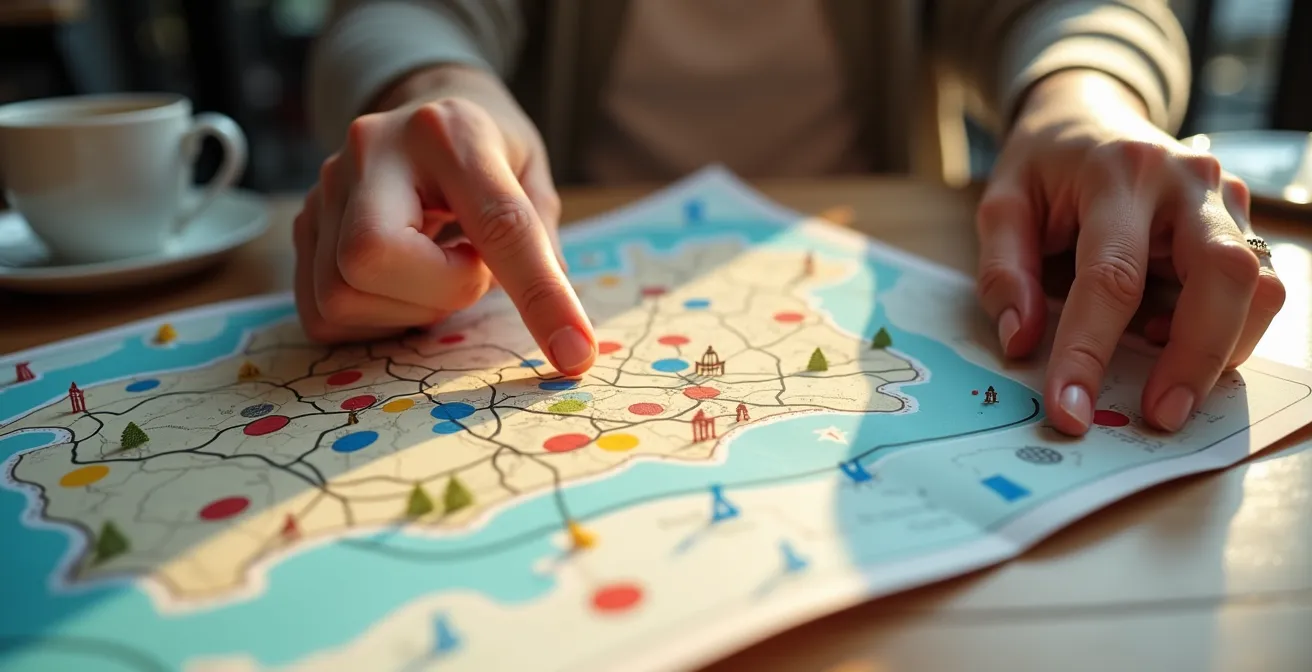
The “Anchor & Orbit” method also introduces flexibility. By using a tool like Google Maps’ “Popular Times” feature on your phone, you can get a live look at crowd levels for your orbit sites. If the Roman Forum is unexpectedly packed, you can dynamically adjust your plan and walk over to the less-crowded Palatine Hill first, optimizing your time in real-time. This proactive grouping transforms your itinerary from a rigid checklist into a fluid, efficient system that responds to changing conditions on the ground.
City Card vs Pay-as-you-go: mathematical breakdown for 3-day trips
The debate between purchasing an all-inclusive city pass and paying for attractions individually is a classic travel dilemma. For the logistics-minded traveler, the decision should not be based on vague feelings of convenience but on a clear mathematical breakdown. A city card is a tool, and its value is determined by your specific operational plan. The primary calculation involves comparing the card’s cost to the sum of individual entrance fees for the attractions you realistically plan to visit.
For a short, intensive trip of around three days, the pass often provides clear monetary value. For example, a multi-day pass in a major European city can easily be justified by visiting just two major museums and using the included public transport. The break-even point is a critical metric to calculate. The real, often-overlooked value, however, lies in the “skip-the-line” access that most passes provide. This benefit must be quantified not in euros or dollars, but in hours. As an analysis of queue times shows, priority access can reclaim an average of 3 hours at major venues.
This table offers a simplified value analysis for a 3-day trip in several popular cities, highlighting not just the potential monetary savings but the crucial time saved by bypassing general admission queues. As this comparative analysis demonstrates, the benefits are significant.
| City | Pass Cost | Individual Tickets Total | Time Saved (Hours) | Break-Even Attractions |
|---|---|---|---|---|
| Paris | €159 | €185 | 4.5 | 3 museums + transport |
| Rome | €135 | €165 | 6 | Vatican + Colosseum + 1 |
| London | £85 | £110 | 3 | 4 paid attractions |
Ultimately, a city pass is an investment in operational efficiency. For a packed itinerary, it streamlines access and removes the friction of purchasing multiple tickets. For a more relaxed trip with fewer paid attractions, the pay-as-you-go model may be more economical. The correct choice depends entirely on a pre-planned itinerary and a cost-benefit analysis that values your time as much as your money.
The distraction technique pickpockets use near major landmarks
While most travelers are aware of the general risk of pickpocketing in crowded areas, few understand the sophisticated psychological tactics deployed by professional thieves. Their methods are not random; they are a calculated exploitation of a predictable human behavior known as cognitive overload. This is particularly effective in the immediate vicinity of major landmarks like the Eiffel Tower, the Colosseum, or Times Square.
Security experts have documented that thieves specifically target the brief, 15-second window when a tourist first lays eyes on an iconic sight. In this moment of awe, the brain is flooded with sensory information, and studies show that a tourist’s situational awareness can drop by as much as 70%. This is the precise moment when organized teams strike. One member creates a minor, plausible distraction—dropping something, asking for directions, staging a fake stumble, or aggressively pushing a petition to be signed. While your attention is diverted for a split second, a partner performs the theft. You only realize your wallet or phone is missing minutes later, long after the team has disappeared into the crowd.
Defending against this requires moving from a passive “be aware” mindset to a proactive security ritual. It’s about creating a buffer zone to manage your own cognitive load before you are exposed to the high-risk environment. By consciously pausing and securing your belongings before you reach the main viewing area, you separate the administrative task of security from the emotional experience of seeing the landmark, thereby closing the window of opportunity that thieves rely on.
Your Pre-Landmark Security Audit
- Stop and assess 50 meters before reaching any major landmark’s main viewing point or plaza.
- Physically move your wallet to a front pocket and confirm all bag compartments are fully zipped.
- Perform a deliberate 360-degree scan of your immediate surroundings, noting crowd dynamics.
- Identify the locations of uniformed security personnel or police and potential exit routes from the crowd.
- Verbally confirm a meeting point with your travel companions in case you are separated.
When to eat lunch to avoid the “tourist trap” service rush?
Finding an authentic, reasonably priced meal near a major tourist attraction can feel like an impossible task. The primary reason for this is a fundamental mismatch in timing. Most tourists, driven by conventional schedules, flood restaurants between 12:30 PM and 2:00 PM. This surge creates a “service rush” where kitchens are overwhelmed, staff is stressed, and the quality of both food and experience plummets. This is the prime operating environment of the “tourist trap.”
A logistical approach to dining involves shifting your meal times to operate outside of this peak. Restaurant data from major European cities like Paris and Rome reveals a clear pattern. As one analysis of dining patterns shows, locals eat on a later schedule. By strategically eating your lunch either very early (11:45 AM – 12:15 PM) or very late (after 2:30 PM), you avoid the rush entirely. The early window is particularly advantageous: the kitchen is fresh, the staff is attentive, and you get first pick of the daily specials before they sell out. Some travelers even adopt a “Reverse Meal Day” strategy—having a large, late lunch around 4:00 PM when restaurants are quiet, which often corresponds to lower prices and a more relaxed atmosphere.
Beyond timing, it’s crucial to be able to identify the red flags of a tourist trap from a distance. These establishments are designed for high-volume, low-quality turnover and exhibit predictable characteristics. Learning to spot them is a key skill for preserving both your budget and your culinary experience. Common warning signs include:
- Menus displayed in four or more languages, often with large, faded photos of the food.
- A host or “barker” on the street actively trying to solicit passersby.
- A location directly facing the entrance of a major landmark.
- Pre-made food visible in window displays, looking tired under heat lamps.
- A complete absence of local diners, even during that city’s traditional peak meal times.
How to pace a multi-stop trip to avoid travel fatigue?
Travel fatigue is an insidious problem that can ruin the second half of any ambitious trip. It’s more than just physical tiredness; it’s a state of cognitive and emotional exhaustion that makes it impossible to appreciate new experiences. The common mistake is to pack consecutive days with high-intensity activities—major museums, extensive walking tours, and late nights. This approach treats your energy reserves as limitless, leading to an inevitable crash.
A more sustainable model is the “Pulse & Rest” rhythm. This strategy, backed by travel psychology research, involves deliberately alternating high-intensity “Pulse” days with low-intensity “Rest” days. A Pulse day might involve a visit to the Louvre and a walking tour of Montmartre. A Rest day is not about staying in the hotel, but about engaging in low-cognitive-load activities: relaxing in the Luxembourg Gardens, taking a leisurely food tour, or exploring a quiet neighborhood without a strict agenda. Studies show this method of systemic pacing maintains energy levels 40% better than back-to-back intense sightseeing.
On a micro-level, it’s also crucial to manage the typical afternoon energy slump that affects a majority of tourists. One scientifically proven technique to combat this is the “Caffeine-Nap.” This involves drinking a shot of espresso or a small cup of coffee and immediately taking a short, 20-minute nap. Caffeine takes approximately 20-30 minutes to take full effect. By timing the nap this way, you wake up just as the caffeine is reaching its peak effectiveness in your system, providing a powerful, clear-headed boost of energy that can carry you through the rest of the afternoon without the grogginess of a longer nap.
How to use transit apps to predict delays before leaving the house?
Public transportation is the circulatory system of any major city, and mastering it is key to operational efficiency. While Google Maps provides a solid baseline for navigation, relying on it exclusively means you’re missing out on a layer of real-time, localized intelligence. True transit mastery comes from using city-specific apps that offer superior data and proactive features, allowing you to anticipate and avoid delays before you even leave your hotel.
Local transit authorities and specialized companies often develop apps with features tailored to their specific systems. For instance, Citymapper, popular in cities like London and Paris, provides “get-off” alarms and tells you which train car to board for the quickest exit at your destination station—a micro-optimization that can save 3-5 minutes per journey. The official RATP app in Paris often delivers real-time disruption alerts up to 15 minutes before they appear on more generic platforms. These apps transform you from a reactive rider, who discovers a problem upon arriving at the station, to a proactive commuter who can adjust their route or departure time based on advance warnings.
The key is to integrate these tools into your pre-departure routine. Setting up proactive alerts for your most-used lines can save you from heading into a known service disruption. The process is simple and takes only a few minutes:
- Download the recommended city-specific transit app before you arrive.
- Upon arrival, “star” or “favorite” your hotel’s nearest station and your top 3-4 target destinations.
- Enable push notifications for the lines you’ll be using most frequently.
- In the evening, pre-load your next morning’s journey so it’s accessible even if you have poor connectivity.
This small investment in digital preparation reduces transit uncertainty, a major source of travel stress, and ensures your schedule remains on track.
Key takeaways
- True travel efficiency comes from proactive logistical planning, not just reactive tips.
- Mastering time-space arbitrage—by grouping sites and choosing off-peak hours for activities—is the most effective way to beat crowds.
- Pacing your energy with a “Pulse & Rest” rhythm is as important as managing your time and budget.
How to cure “museum fatigue” and actually remember what you saw?
You’ve successfully bypassed the queues, navigated the crowds, and arrived at the masterpiece. But after two hours, a familiar feeling sets in: a mental fog known as “museum fatigue.” The artworks start to blur together, your feet ache, and your ability to absorb any more information plummets. This is a well-documented phenomenon; visitor behavior studies reveal that the average museum visit duration before significant cognitive fatigue sets in is only 2-3 hours. Pushing past this point results in diminished returns, where you are physically present but mentally checked out, retaining very little of what you see.
Curing museum fatigue requires a strategic, less-is-more approach. First, abandon the idea of “seeing everything.” It is logistically and cognitively impossible to appreciate the 35,000 works on display at the Louvre in a single visit. Instead, be selective. Before you go, identify a maximum of 5-7 specific pieces or one to two galleries that are your absolute priorities. Go directly to those, spend quality time with them, and consider anything else you see a bonus. This transforms your visit from a marathon of overwhelming data into a targeted, rewarding mission.
Second, structure your visit with built-in breaks. Don’t wait until you’re exhausted to stop. Plan a 15-minute break in a museum café or courtyard for every 60-75 minutes of viewing. This allows your brain to reset and process what it has seen. Finally, to improve retention, engage with the art actively, not passively. Instead of just reading the plaque, take a moment to write down one observation or feeling about your favorite piece in a small notebook or a note on your phone. This simple act of encoding the experience drastically improves long-term recall, ensuring your visit is not just a fleeting moment but a lasting memory.
By shifting your perspective from that of a conventional tourist to a strategic travel manager, you can systematically dismantle the friction points of modern travel. The ultimate goal is not just to see more, but to experience it all more deeply. Begin implementing these logistical frameworks now to transform your next cultural journey into a seamless, enriching, and truly memorable operation.