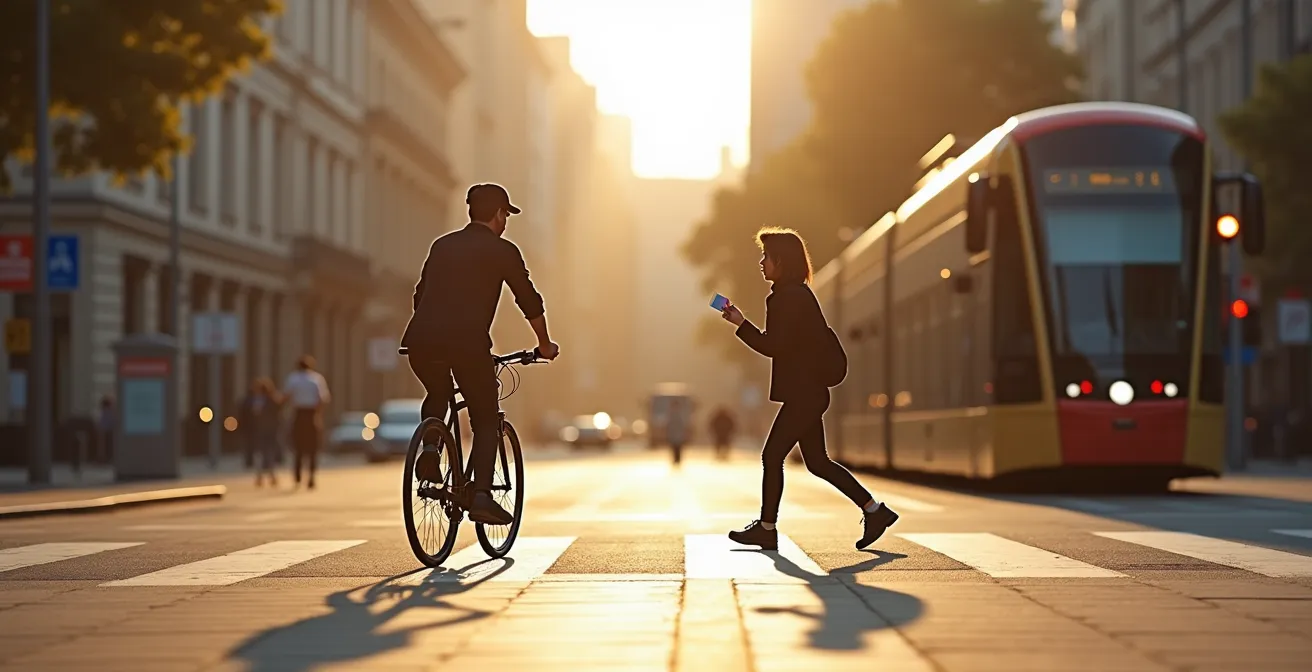
The key to a stress-free commute is not avoiding delays, but building a resilient personal logistics system that absorbs them.
- Treat your daily journey as a supply chain to be optimized, not a single route to be endured.
- Use real-time data from transit apps as a predictive dashboard for proactive decision-making.
- Implement strategic time buffers for each potential point of failure, from transfers to weather.
Recommendation: Start by mapping your current “modal stack” and identifying the single biggest friction point you can eliminate this week.
The daily commute. For millions, it’s a source of chronic stress, a twice-daily battle against traffic, crowds, and the tyranny of the clock. The conventional wisdom is to find a better route, leave earlier, or distract yourself with a podcast. We’re told the problem is the traffic jam or the delayed train. But what if the problem isn’t the event, but the system’s inability to handle it? What if the stress comes from relying on a fragile, single-mode plan with one point of failure?
Thinking like a logistics expert reveals a different path. Instead of trying to perfect a single, rigid route, the goal is to build a flexible, resilient, and multi-layered personal logistics network. This approach transforms your commute from a source of anxiety into an optimized process you control. It’s not about hoping for a clear road; it’s about designing a system where a blocked road is just one data point, not a catastrophe. It involves intelligently stacking different modes of transport—train, scooter, walking, bike—to create a journey that is not only faster but fundamentally more robust.
This guide will deconstruct the commute into its logistical components. We will explore how to analyze friction points, deploy strategic time buffers, use technology as a predictive tool, and select the right “hardware” for each leg of your journey. By the end, you will have a framework for re-engineering your daily travel into a seamless and stress-free experience.
This article provides a complete framework for re-engineering your journey. The following sections will guide you through each step of building your personal, multimodal commute system for maximum efficiency and peace of mind.
Summary: A Logistics-Based Approach to a Seamless Commute
- Why switching modes is often less stressful than sitting in traffic?
- How to use transit apps to predict delays before leaving the house?
- Folding bike vs Electric scooter: which fits better on a crowded train?
- The schedule buffer mistake that makes intermodal travel a nightmare
- How to save $50/month by combining subscription passes intelligently?
- How to implement smart city tech that citizens actually trust?
- Walking Shoes vs Running Shoes: the heel drop difference explained
- How to transform a ghost town into a thriving economic hub?
Why switching modes is often less stressful than sitting in traffic?
The core assumption for many commuters is that a single-seat journey—typically a private car—is the path of least resistance. From a purely logistical standpoint, however, this creates a system with a single point of failure. Any disruption, from an accident to unexpected congestion, brings the entire system to a halt. This lack of control is a primary driver of commute-related stress. The feeling of being trapped, with no alternative actions to take, elevates anxiety far more than the delay itself.
Switching to a multimodal approach fundamentally alters this dynamic by introducing options and restoring a sense of agency. A delay on one leg of your journey (e.g., a stalled subway) becomes a data point that informs your next decision (e.g., switching to a bikeshare for the last mile), rather than a hard stop. This ability to react and adapt is the essence of a resilient system. It replaces the passive stress of waiting with the active engagement of problem-solving.
Furthermore, the physical environment of sitting in traffic contributes significantly to stress. Beyond the psychological toll of congestion, there’s the physiological impact of constant, low-frequency noise. Research from the World Resources Institute shows that over 100 million Americans are exposed to harmful levels of noise pollution, much of it from transportation. Escaping this environment, even for portions of a commute, by walking through a park or riding on a quiet electric train, can dramatically reduce your cumulative stress load. The goal is to optimize for well-being and resilience, not just theoretical travel time.
How to use transit apps to predict delays before leaving the house?
The modern commuter’s most powerful tool is data. Transit apps like Citymapper or Google Maps have evolved from simple route planners into sophisticated, real-time dashboards. The strategic shift is to stop using them as a reactive tool when you’re already on your way, and start using them as a predictive pre-departure dashboard. The goal is to make the most informed decision before you even walk out the door, turning potential disruptions into manageable variables.
A logistics expert doesn’t just check the manifest once; they monitor it constantly. Before your commute, a five-minute systems check can preemptively solve problems. This involves more than just looking at the ETA. You should be cross-referencing multiple data layers: official service alerts for planned disruptions, real-time GPS tracking to see where vehicles actually are (not just where they’re scheduled to be), and crowdsourced user reports for on-the-ground intelligence about crowding or unexpected issues. This 360-degree view allows you to choose your initial transport “stack” based on the day’s actual conditions, not just the static timetable.

For example, seeing a 10-minute delay on your primary train line might lead you to leave five minutes earlier and take a more reliable bus route to a different station. Setting up smart alerts for your specific lines or stations pushes this information to you, transforming your phone from a passive map into an active early-warning system. This proactive use of data is the difference between being a victim of the system and being its operator.
Your Pre-Departure Systems Check
- Service Alerts: Check for official announcements of disruptions, track work, or re-routes on your primary and secondary lines.
- Vehicle GPS: Review real-time vehicle positions to confirm they are running on schedule, not just relying on the timetable.
- User Reports: Scan crowdsourced data for unreported delays, platform changes, or heavy crowding that might impact your journey.
- Route Comparison: Actively compare 2-3 multimodal route options with their live departure times and total journey friction.
- Smart Alerts: Configure push notifications for your most critical transfer points and lines to get ahead of any emerging issues.
Folding bike vs Electric scooter: which fits better on a crowded train?
The “last mile” is often the most critical and highest-friction part of a multimodal commute. Choosing the right personal vehicle—like a folding bike or electric scooter—is a key logistical decision. The choice isn’t about which is “better” in a vacuum, but which has the lowest “friction score” for your specific journey, particularly during the crucial transfer onto a train or bus. This friction is measured in time, effort, and space.
An electric scooter generally wins on speed of deployment. Folding or unfolding a scooter typically takes less than 10 seconds, a significant advantage when you’re rushing to catch a train. Bikes, while often faster to ride, can take up to 30 seconds to fold properly. Ergonomically, a 10-15 lb scooter is often easier to carry with one hand, leaving the other free to tap a transit card or hold a handrail. A bulkier 15-20 lb folding bike usually requires a two-hand carry.
However, the most overlooked factor is cleanliness. A folding bike’s exposed chain and gears pose a constant risk of transferring grease to your clothes or fellow passengers in a crowded car. Most electric scooters, by contrast, have a much cleaner design, minimizing dirt transfer. When analyzing which option is best, creating a simple scorecard based on the unique constraints of your route is the most effective approach.
This comparative analysis highlights the specific friction points each device introduces into your commute, allowing for a data-driven choice.
| Factor | Folding Bike | Electric Scooter |
|---|---|---|
| Fold/Unfold Time | 15-30 seconds | 5-10 seconds |
| Carry Ergonomics | Two-hand carry (15-20 lbs) | One-hand possible (10-15 lbs) |
| Rolled Mobility | Can be rolled when folded | Most models rollable |
| Train Space Required | 3×2 feet folded | 2×1.5 feet folded |
| Cleanliness Factor | Chain grease risk | Minimal dirt transfer |
The schedule buffer mistake that makes intermodal travel a nightmare
The most common advice for avoiding commute stress is to “leave early.” This is a blunt and inefficient tool. A logistics expert doesn’t just add generic slack; they build in strategic resilience buffers allocated to specific, high-risk points in the system. The biggest mistake commuters make is having a single, large buffer at the beginning of their trip, which often gets consumed by the very first leg, leaving no resilience for subsequent transfers.
A truly robust intermodal schedule is built on a framework of multiple, targeted buffers. Instead of leaving “20 minutes early,” you should allocate that time with surgical precision. This means breaking down your journey into segments and assigning a buffer based on the volatility of each segment. A reliable train with a 99% on-time record might only need a 3-minute buffer, whereas a notoriously unpredictable bus line might require a 10-minute buffer.
This framework must also account for the friction of the transfers themselves. The physical act of moving between modes needs its own dedicated buffer. Think through the entire process: How long does it take to fold your scooter? How long does it take to walk from the bus stop to the correct train platform in a large, confusing station? Each of these actions is a potential point of delay and requires its own 2-5 minute allocation. By distributing your buffer time across these specific friction points, you create a system that can absorb multiple small delays without causing a catastrophic failure (i.e., missing your final connection).
- Transfer Buffer: Allocate 5-7 minutes for the physical act of walking or rolling between your connection points.
- Service Volatility Buffer: Add time based on the historical reliability of the service—less for reliable trains, more for unpredictable buses.
- Contingency Buffers: Add an extra 5 minutes for external factors you can’t control, such as navigating crowds or adverse weather like rain or snow.
– Preparation Buffer: Reserve at least 2 minutes for any necessary “mode-switching” actions, like folding a bike or packing away a scooter.
How to save $50/month by combining subscription passes intelligently?
Optimizing your personal commute logistics isn’t just about time and stress; it’s also about cost. A multimodal strategy unlocks significant financial savings that are impossible to achieve with a single-mode, car-dependent approach. On a macro level, the savings are staggering; the American Public Transportation Association calculates that an individual can save over $13,000 per year by switching to public transit from driving. But achieving maximum savings requires a micro-level strategy of intelligently stacking subscriptions and passes.
The goal is to avoid paying the full “per-ride” fare for any leg of your journey. This involves conducting an audit of your monthly travel patterns and identifying the optimal combination of passes. This might mean buying a monthly unlimited pass for your primary mode (e.g., the train) but using a pay-as-you-go system topped up with a pre-tax commuter benefit for a secondary mode (e.g., bikeshare) that you use less frequently. Don’t overlook corporate or municipal incentive programs, which can add another layer of savings.

The key is to find the break-even point for each pass. If a monthly bus pass costs $60 and a single ride is $2.50, you need to take more than 24 trips a month for it to be worthwhile. By tracking your actual usage for a month, you can build a “subscription stack” that precisely matches your behavior, potentially saving $50 or more each month compared to a disorganized pay-per-ride approach.
Case Study: The CommuterCash Reward Program
A prime example of subscription stacking is the CommuterCash program in the Washington DC area. This program allows commuters to earn up to $600 per year simply by logging their multimodal trips during peak hours. Users track their journeys through an app that monitors their transport modes, effectively rewarding them for choosing more efficient options. This demonstrates how combining a standard transit pass with a rewards program can directly translate your logistical optimizations into financial gain.
How to implement smart city tech that citizens actually trust?
A city can be filled with “smart” technology—from real-time bus trackers to integrated payment systems—but these tools are useless if citizens don’t trust them enough to build a commute around them. From the perspective of the individual commuter, trust isn’t built through marketing campaigns; it’s earned through consistency, reliability, and transparency. Your personal logistics system can only be as strong as the data it runs on.
The key to leveraging smart city tech is to treat it as an input, not as gospel. While a city’s transit app might provide the official schedule, your trust should be placed in the aggregate of all available data: the official schedule, the real-time GPS, and the crowdsourced reports from fellow commuters. When the official app says a bus is “On Time” but the GPS shows it hasn’t moved in ten minutes, you learn to trust the GPS. This process of personal validation is how you build a reliable operational picture from a mix of imperfect city-provided tools.
As transportation research from Liftango points out, the core function of this technology is to reduce uncertainty.
Apps use data to give travelers live updates and reduce uncertainty about travel times. When they have access to this data, travelers can choose the ideal mode based on their scheduling constraints.
– Liftango Transportation Research, Multimodal Transportation: Benefits and Strategies Report
Ultimately, citizens trust technology that empowers them and gives them a sense of control. This is especially critical when public transit infrastructure has gaps. For example, WRI research reveals that only 27% of the workforce in major US metropolitan regions has access to high-quality transit. In such an environment, smart tech becomes the bridge, enabling commuters to stitch together a functional journey from a patchwork of services. You implement trust by using the tech to successfully navigate the system, proving its value one trip at a time.
Walking Shoes vs Running Shoes: the heel drop difference explained
A truly optimized logistics system accounts for every component, right down to the “hardware” on your feet. The walking portions of an intermodal commute—from the front door to the bus stop, or from the train station to the office—are not trivial. Choosing the right footwear is a micro-optimization that has a major impact on comfort, safety, and all-day readiness. The primary distinction to understand is between walking shoes and running shoes, which centers on the concept of heel-to-toe drop.
Heel drop refers to the height difference between the heel and the forefoot. Running shoes typically have a high drop (8-12mm) to absorb impact and promote a heel-striking gait. While great for a run, this can feel unnatural and unstable for the slower, more rolling motion of walking. Walking shoes, conversely, feature a lower drop (4-8mm), which supports a more natural foot-roll and provides a more stable base, especially important when standing on a moving train or navigating slick station floors.
Beyond heel drop, other factors come into play. Walking shoes often have wider, more durable soles designed for grip on urban surfaces, whereas running shoes prioritize lightweight cushioning. For a commuter, this means better stability and durability. Furthermore, the aesthetic of a walking shoe is often more versatile, blending more easily into an office environment than a brightly colored, high-performance running shoe. Selecting the right shoe is a practical decision that reduces physical friction and ensures you arrive at your destination comfortable and prepared.
This matrix breaks down the key performance indicators for commuter footwear, helping you select the optimal choice for your daily journey.
| Criteria | Walking Shoes (4-8mm drop) | Running Shoes (8-12mm drop) |
|---|---|---|
| Natural Gait Support | Excellent for slow pace | Optimized for heel strike |
| Station Floor Grip | Wide, stable sole | Variable traction |
| All-Day Comfort | Superior arch support | More cushioning |
| Weather Resistance | Often water-resistant | Usually mesh/breathable |
| Office Appropriate | More formal options | Sportier appearance |
Key Takeaways
- Shift your mindset from perfecting a single route to building a flexible, multi-layered personal logistics system.
- Use transit apps as a predictive “commuter dashboard” to make proactive decisions before you leave home.
- Allocate strategic, targeted time buffers to specific friction points in your journey, rather than relying on one large, generic buffer.
How to transform a ghost town into a thriving economic hub?
On the surface, a single person’s commute seems like a small, personal challenge. But when viewed through a logistical lens, each optimized journey is a vital component of a much larger system: the economic and environmental health of a city. The question of transforming a “ghost town” is not just about empty buildings; it’s about a lack of efficient movement and connection. By re-engineering your commute, you are, in microcosm, modeling the very solution that revitalizes urban centers.
Every decision to leave a car at home and adopt a multimodal journey contributes directly to a more efficient, livable, and prosperous community. Congestion is a massive drain on economic productivity, and reducing the number of single-occupancy vehicles frees up our infrastructure for commerce and services. Furthermore, a shift toward cleaner transportation is critical for meeting climate goals. According to modeling by the America Is All In coalition, improved transportation systems can contribute up to one-third of the needed emissions reductions to keep climate targets within reach.
Your optimized commute becomes a vote for this kind of future. It demonstrates demand for better bike lanes, more reliable transit, and safer pedestrian infrastructure. As the World Resources Institute states, this is a collaborative effort with wide-ranging benefits.
States, tribes, cities, universities and businesses have vital roles to play in developing clean multi-modal transportation systems that work for the entire community while fostering health, safety and economic prosperity.
– World Resources Institute, Health and Economic Benefits of Multimodal Transportation
Transforming your personal “commute ghost town”—a stressful, inefficient, and isolating daily experience—into a thriving hub of efficiency and control is the first step. When multiplied across a community, this individual optimization is precisely what transforms a gridlocked city into a dynamic, connected, and economically vibrant hub.
Start today by mapping your own journey. Identify your primary friction points and begin applying these logistical principles to engineer a smarter, more resilient, and ultimately stress-free commute.