
The key to resetting your internal clock isn’t fighting fatigue, but actively synchronizing your body’s master and peripheral clocks with specific environmental signals (Zeitgebers).
- Morning sunlight exposure within 30 minutes of waking sets your brain’s ‘master clock’ (SCN).
- Time-restricted eating and fasting align your body’s ‘peripheral clocks’ in the liver and gut.
Recommendation: Combine precise light exposure and meal timing protocols to rapidly and efficiently adjust your entire system to new time zones or demanding shift work schedules.
For frequent travelers and shift workers, the feeling of desynchronization is a constant battle. The persistent grogginess, brain fog, and disrupted sleep are not signs of weakness but symptoms of a biological mismatch. Your internal master clock, located in the suprachiasmatic nucleus (SCN) of your brain, is out of sync with your environment and your body’s peripheral clocks. The conventional advice to “just push through it” or “avoid coffee” fails because it ignores the fundamental mechanisms at play.
The truth is, your body operates like a complex orchestra with dozens of internal clocks, and they all take their cues from powerful environmental signals called Zeitgebers (German for “time-givers”). The most potent of these are light and food. Fighting against your biology is a losing strategy. A far more effective approach is to become the conductor of your own internal orchestra, using these signals with precision to engineer your circadian rhythm.
This guide moves beyond generic wellness tips. We will explore the specific, science-backed protocols that allow you to take direct control of your hormonal and metabolic systems. You will learn not just *what* to do, but *why* it works, from the cellular level to the systemic response. By understanding how to manipulate light and meal timing, you can command your body to adapt, whether you’ve just crossed six time zones or are preparing for a week of night shifts.
To navigate this complex but powerful system, this article breaks down the essential protocols into manageable, evidence-based steps. Below is a summary of the key strategies we will cover to help you regain control over your internal time.
Summary: Resetting your internal clock with scientific precision
- Why viewing sunlight within 30 minutes of waking boosts energy?
- How to use fasting to shift your time zone 3x faster?
- SAD Lamps vs Normal LEDs: what lux intensity is actually required?
- The eating window mistake that leads to metabolic disease in night shifts
- When to eat your last meal to avoid disrupting growth hormone release?
- When to trigger the “sunset” mode in your smart home system?
- How to get Vitamin D without aging your skin prematurely?
- The spectrum mistake in “night mode” apps that still wakes you up
Why viewing sunlight within 30 minutes of waking boosts energy?
The single most powerful signal for anchoring your circadian rhythm is viewing bright, natural light within the first 30-60 minutes of waking. This is not a wellness trend; it is a direct biological command to your brain’s master clock, the suprachiasmatic nucleus (SCN). When low-solar-angle sunlight (the kind present shortly after sunrise) enters your eyes, it specifically activates melanopsin retinal ganglion cells. This activation sends a direct signal to the SCN, which then initiates a crucial hormonal cascade.
This light exposure triggers a healthy spike in cortisol, a hormone that promotes wakefulness and alertness. Simultaneously, it shuts down the production of melatonin, the hormone of sleep. This process effectively sets a timer for your entire day. By getting this light signal consistently, your brain learns precisely when to be alert and, just as importantly, when to begin preparing for sleep about 14-16 hours later. The power of this natural reset was demonstrated in a University of Colorado study where just two days of camping, with only natural light exposure, completely realigned participants’ drifted melatonin and cortisol rhythms to the natural day-night cycle.
Action Plan: Your Morning Light Exposure Protocol
- Get outside within 30-60 minutes of waking, even before coffee.
- Face the general direction of the sunrise for 5-10 minutes on clear days. Do not wear sunglasses.
- On overcast days, double the exposure time to 20 minutes, as cloud cover significantly reduces light intensity.
- If you wake up before sunrise, use a 10,000 lux SAD lamp for 15-20 minutes, then get natural light once it’s available.
- Avoid viewing your morning light through a window, as glass filters out the specific wavelengths and intensity needed, reducing effectiveness dramatically.
Failing to get this morning signal leaves your master clock “drifting,” resulting in lower daytime energy and difficulty falling asleep at night. It is the non-negotiable foundation of circadian health.
How to use fasting to shift your time zone 3x faster?
While light sets the master clock in your brain, your meal schedule governs the “peripheral clocks” in your liver, gut, and muscles. When traveling or working shifts, these two clock systems can become desynchronized, leading to metabolic chaos. Fasting provides a powerful method to un-anchor your peripheral clocks and then re-anchor them to a new schedule with remarkable speed.
The mechanism is elegant: by withholding food for 14-16 hours, you essentially make your food-related clocks highly sensitive to the next meal. When you finally break your fast at the desired *local* breakfast time, that first meal acts as a powerful Zeitgeber, loudly announcing the “new morning” to your metabolic system. This effect is amplified when you combine it with the primary Zeitgeber: light. Getting local morning sunlight *before* that first meal ensures your master clock and peripheral clocks receive the same synchronizing signal at the same time, forcing your entire system to align.
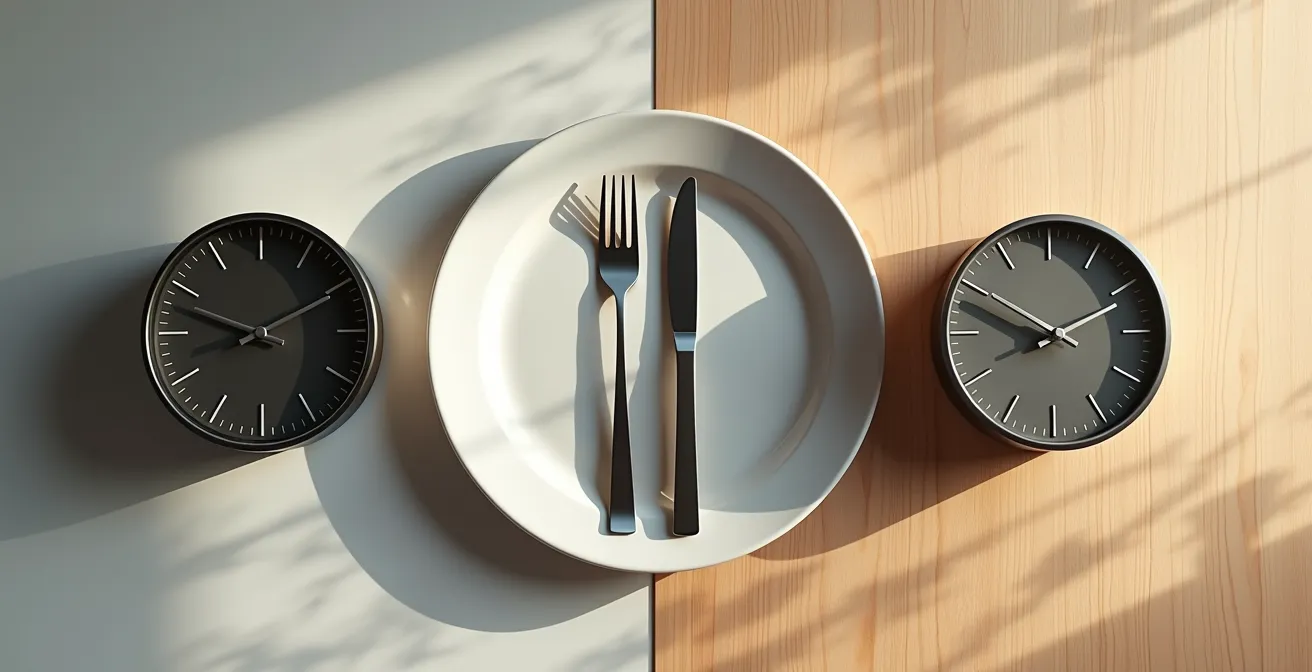
This strategy, sometimes known as the Argonne Diet, allows travelers to snap their entire biology—from brain to liver—onto a new time zone in as little as one day, bypassing much of the typical misery of jet lag. The key is to resist the urge to eat during travel and wait until the appropriate mealtime in your destination.
SAD Lamps vs Normal LEDs: what lux intensity is actually required?
When natural sunlight is unavailable, particularly for those waking before dawn or living in regions with dark winters, a SAD (Seasonal Affective Disorder) lamp can be an effective substitute. However, not all light is created equal. The critical factor for resetting your circadian clock is light intensity, measured in lux. Standard indoor lighting is simply not powerful enough to send the strong “wake up” signal your SCN requires.
Your brain’s clock mechanism evolved to respond to the immense intensity of sunlight. To replicate this, you need a light source that delivers at least 10,000 lux at the distance you will be using it. As the table below illustrates, a typical indoor LED bulb provides only 200-500 lux, which is insufficient to trigger the necessary cortisol spike. Even sitting by a window provides a fraction of the required intensity, as glass filters out a significant portion of the light. According to research, the required intensity for a circadian shift is orders of magnitude greater than what typical indoor environments provide.
| Light Source | Lux at Working Distance | Recommended Duration | Effectiveness for Circadian Reset |
|---|---|---|---|
| Natural Sunlight (Clear Day) | 50,000-100,000 lux | 5-10 minutes | Optimal |
| Natural Sunlight (Overcast) | 10,000-50,000 lux | 15-20 minutes | Very Good |
| 10,000 Lux SAD Lamp | 10,000 lux at 12-16 inches | 20-30 minutes | Good |
| Standard Indoor LED | 200-500 lux | Not effective | Insufficient |
| Window Light | 1,000-2,000 lux | 60+ minutes | Minimal |
Therefore, when choosing an artificial light source, a lamp specifically rated for 10,000 lux is essential. It’s not about making the room bright; it’s about delivering a concentrated dose of photons to the specific retinal cells that communicate with your master clock.
The eating window mistake that leads to metabolic disease in night shifts
For night shift workers, the most common and damaging mistake is eating throughout their nocturnal work hours. While it may seem logical to eat when you are active, doing so sends a profoundly confusing signal to your body. Your SCN, guided by the light-dark cycle, is screaming “it’s nighttime, time to rest and repair.” Meanwhile, a meal at 2 AM sends a powerful “it’s daytime, time to digest and metabolize” signal to the peripheral clocks in your gut and liver.
This conflict between the master and peripheral clocks is a primary driver of the metabolic diseases common in long-term shift workers, including obesity, type 2 diabetes, and cardiovascular disease. The body is essentially in a state of perpetual internal jet lag. A compelling systematic review of 128 studies confirmed this, finding that night shift workers who ate during their shift had significantly worse glucose tolerance and insulin resistance than those who confined their eating to their “subjective day,” even when total calories were identical.
The solution is to adopt a time-restricted eating (TRE) window that aligns with your master clock, not your work schedule. This means consuming all of your calories in a window during your subjective “day”—for example, eating a large meal before your shift begins and another upon returning home, while consuming only water or non-caloric beverages during the night shift itself. This keeps your internal clocks synchronized, mitigating metabolic damage.
When to eat your last meal to avoid disrupting growth hormone release?
The timing of your final meal has a profound impact on sleep quality and overnight repair processes, primarily through its interaction with insulin and Growth Hormone (GH). During the first few hours of deep sleep, your body releases a large, crucial pulse of GH, which is essential for tissue repair, muscle growth, and metabolic health. However, this process is highly sensitive to insulin levels.
Eating a meal, particularly one high in carbohydrates, causes a significant spike in insulin that can last for several hours. If insulin is still elevated when you go to sleep, it will severely blunt or even completely suppress the natural release of GH. This means your body misses a critical window for overnight recovery. The goal, therefore, is to time your last meal so that insulin has returned to baseline levels before you fall asleep. As a general rule, you should stop eating at least three to four hours before your intended bedtime.
As detailed in a comparative analysis from the Sleep Foundation, the composition of your meal also plays a role in the duration of the insulin response. While high-fat meals have a lower impact, all food intake initiates a response that can interfere with GH.
| Meal Type | Insulin Response Duration | GH Suppression Level | Recommended Latest Time |
|---|---|---|---|
| High Carbohydrate | 3-4 hours | High | 4 hours before sleep |
| High Protein | 2.5-3.5 hours | Moderate-High | 3.5 hours before sleep |
| High Fat | 2-3 hours | Low-Moderate | 3 hours before sleep |
| Mixed Balanced | 3-3.5 hours | Moderate | 3.5 hours before sleep |
Adhering to this pre-sleep fasting window is a simple yet powerful way to optimize your hormonal health and ensure you get the full restorative benefits of your sleep.
When to trigger the ‘sunset’ mode in your smart home system?
Just as bright morning light signals “day,” the absence of bright, blue-spectrum light signals “night.” In the modern world, we sabotage this signal by surrounding ourselves with powerful overhead lights and screens long after the sun has set. This exposure, especially to blue light, powerfully suppresses the production of melatonin. In fact, Harvard research demonstrates that blue light can suppress melatonin for about twice as long as green light, shifting circadian rhythms by twice as much.
A smart home system can be a powerful tool to manage this, but it must be used correctly. The goal is to mimic a natural sunset. You should trigger your “sunset mode” approximately 2-3 hours before your intended bedtime. This process should be gradual. First, dim all overhead lights to less than 50% intensity and shift their color temperature from cool white to a warm, orange-yellow hue. This mimics the light quality of the setting sun.
In the final hour before bed, the transition should be even more dramatic. Ideally, all lights should shift to a dim, red-only spectrum. Red light has a much longer wavelength and has a minimal impact on melatonin suppression, making it the ideal color for evening and nighttime navigation. Using dim red lights in hallways and bathrooms prevents a blast of bright light from disrupting your melatonin production if you wake during the night.
How to get Vitamin D without aging your skin prematurely?
It’s a common misconception that the same morning sunlight used for setting your circadian clock is also optimal for Vitamin D production. These are two distinct biological processes triggered by different qualities of light. Morning light is rich in UVA wavelengths and sets your clock, but it contains very little of the UVB radiation necessary for your skin to synthesize Vitamin D. UVB is most prevalent when the sun is directly overhead, typically around solar noon.
However, UVB is also the primary cause of sunburn and long-term skin aging. The protocol for safe Vitamin D synthesis is therefore about maximizing UVB exposure in a short, controlled burst while minimizing skin damage. The key is to expose large surface areas of your body (like your back, torso, and legs) for a brief period, while protecting the more sensitive and chronically exposed skin of your face, neck, and hands.
A safe protocol involves 10-20 minutes of midday sun exposure on these larger body areas when the UV index is moderate. This is often enough to trigger substantial Vitamin D production without significantly increasing the risk of skin damage. This protocol should be used in conjunction with regular blood tests to monitor Vitamin D levels and supplementation with Vitamin D3, especially during winter months when sufficient UVB exposure is impossible for most people.
Key Takeaways
- Morning sunlight is non-negotiable for anchoring your master clock and initiating the daily hormonal cascade.
- Meal timing is a primary lever for synchronizing the peripheral clocks in your organs; fasting is the tool to reset them.
- Evening light exposure must be managed by both dimming intensity and shifting the color spectrum towards red to permit natural melatonin release.
The spectrum mistake in ‘night mode’ apps that still wakes you up
Many people diligently use the built-in “night mode” or “night shift” functions on their smartphones and computers, believing they are protecting their sleep. While this is better than nothing, these features often make a critical mistake: they only filter out a portion of the blue light spectrum, while largely ignoring the green light spectrum. Research clearly shows that green light, while less potent than blue, still has a significant ability to suppress melatonin production and disrupt sleep.
A truly effective screen filter for evening use must do more than just make the screen look warmer. It needs to aggressively remove as much of the blue and green wavelengths as possible. The most effective state is a screen that is shifted to be entirely red and black. As the comparative data shows, standard built-in modes have only a moderate effect, whereas more advanced software or a red-only filter offers far superior protection for your melatonin cycle.
| Filter Type | Blue Light Blocked | Green Light Blocked | Brightness Reduction | Melatonin Impact |
|---|---|---|---|---|
| Built-in Night Mode | Partial (460-480nm) | Minimal | None | Moderate suppression |
| f.lux/Iris Software | Adjustable | Adjustable | Yes | Low suppression |
| Red-Only Filter | Complete | Complete | Yes | Minimal suppression |
| Blue-Blocking Glasses | Complete | Partial | No | Low suppression |
Even dim light can interfere with a person’s circadian rhythm and melatonin secretion. A mere eight lux—a level of brightness exceeded by most table lamps and all backlit devices—has an effect.
– Harvard Medical School researchers, Harvard Health Publishing
For anyone serious about protecting their sleep, especially shift workers trying to sleep during the day, relying solely on a device’s default night mode is a significant mistake. The optimal strategy is to avoid screens entirely in the 1-2 hours before bed or, if they must be used, to enable a red-only filter.
By systematically applying these protocols for light exposure and meal timing, you are no longer a passive victim of your schedule. You become the active architect of your own biology, empowered to build a resilient and synchronized circadian rhythm, regardless of time zones or work demands. Start today by implementing the morning sunlight protocol; it is the cornerstone upon which all other circadian adjustments are built.