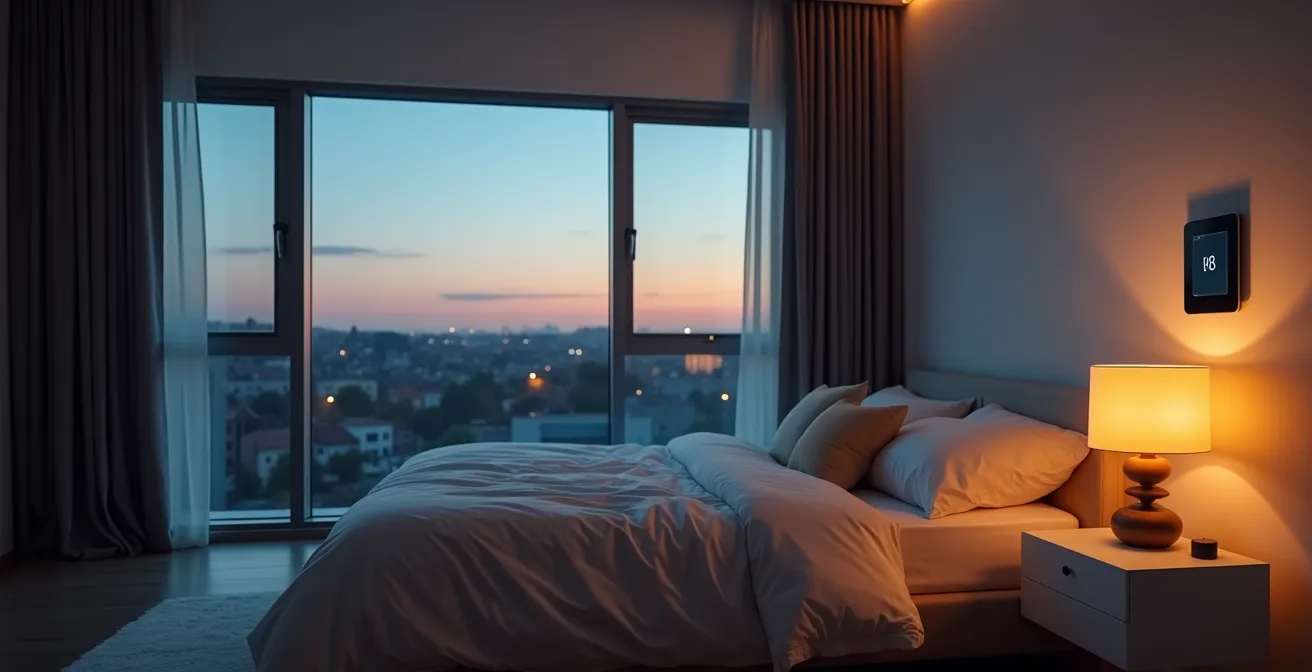
The persistent feeling of being tired is rarely about the hours you spend in bed; it’s about the quality of those hours being systematically degraded by your environment.
- Your body’s ability to regulate temperature and produce melatonin is sabotaged by subtle factors like mattress material, specific light wavelengths, and even air quality.
- Vague advice like “keep your room dark and cool” is insufficient. True restorative sleep requires a precise, engineered approach to your bedroom’s microclimate.
Recommendation: Stop guessing and start measuring. Use the protocols in this guide to diagnose your environment’s weak points and systematically rebuild your bedroom into a true sleep sanctuary.
The frustration is familiar: you go to bed on time, clock in a solid eight hours, yet you wake up feeling as though you’ve barely slept. You’re groggy, unfocused, and reliant on caffeine to power through the day. You’ve tried the common advice—a dark room, less screen time, a quiet atmosphere—but the profound, restorative sleep you crave remains elusive. This persistent fatigue isn’t a sign that you need more time in bed; it’s a signal that your sleep architecture is compromised.
The conventional wisdom on sleep hygiene often fails because it treats the bedroom as a passive space. It overlooks the subtle environmental aggressors that actively disrupt your natural sleep cycles. The reality is that achieving deep, efficient sleep isn’t about following a simple checklist. It’s an act of engineering. As a sleep environment architect, your role is to move beyond generic tips and start treating your bedroom as a high-performance system designed for one specific purpose: maximizing cellular repair and cognitive restoration during your REM and deep sleep stages.
This guide will deconstruct that system. We won’t just tell you to keep your room cool; we’ll show you how to design a personal thermal microclimate. We won’t just warn you about “blue light”; we’ll expose the precise spectral contaminants that even “night mode” apps miss. It’s time to stop being a passive occupant of your bedroom and become its chief architect, systematically eliminating the hidden variables that are robbing you of true rest.
For those who prefer a condensed format, the following video provides a comprehensive overview of the core tools and protocols for optimizing your sleep and sleep-wake timing, complementing the detailed engineering blueprints in this guide.
This article provides a detailed blueprint for transforming your bedroom. By understanding and controlling each environmental variable, you can systematically rebuild your sleep from the ground up. The following sections break down each critical component of your sleep sanctuary.
Summary: An Architect’s Blueprint for Your Sleep Environment
- Why You Wake up Tired Even After 8 Hours in Bed?
- How to Maintain a 18°C Ambient Temperature Without Freezing?
- Memory Foam vs Latex: Which Sleeps Cooler for Hot Sleepers?
- The Spectrum Mistake in “Night Mode” Apps That Still Wakes You up
- When to Stop Drinking Water to Prevent Night Wakings?
- Why 6000K Light in the Bathroom Destroys Your Melatonin Production?
- Why Standard Drywall Off-Gassing Affects Your Sleep Quality?
- How to Reset Your Internal Clock Using Natural Light Protocols?
Why You Wake up Tired Even After 8 Hours in Bed?
The primary disconnect between time spent in bed and actual restfulness lies in a metric called sleep efficiency. This isn’t about the total hours you log, but the percentage of that time you are genuinely asleep. Waking up tired after a full night is a classic symptom of poor sleep efficiency, where your sleep is fragmented by micro-arousals you may not even remember. These disruptions, however brief, pull you out of deep and REM sleep stages, preventing the crucial restorative processes from completing.
The goal is to stop chasing a specific number of hours and start engineering for a high-quality sleep percentage. According to sleep specialists, a healthy target is 85% or higher. Anything less indicates an underlying issue that needs to be addressed. In fact, sleep specialists consider 85% sleep efficiency as the minimum threshold for healthy sleep patterns, and consistently falling below this number is a key indicator of an insomnia-like condition, even if you are in bed for 8-9 hours.
To move from guessing to knowing, you must first diagnose your own sleep. Calculating your efficiency is the first step in your architectural survey of the problem. Only by establishing this baseline can you measure the impact of the environmental changes you are about to make.
- Track your actual time asleep (not just time in bed) using a sleep tracker or a simple manual log.
- Divide your total time asleep by your total time in bed, then multiply by 100 to get your percentage.
- If your score is below 85%, your environment is likely the culprit. This is your call to action.
- A counterintuitive but effective strategy for low efficiency is to initially reduce your time in bed. This increases “sleep pressure” and helps consolidate your sleep, boosting the percentage.
- Finally, consider an often-overlooked factor: air quality. Poor ventilation can lead to high CO2 levels, which can fragment sleep. Ensure your room is well-ventilated to keep CO2 below 1000 ppm.
Ultimately, shifting your focus from the quantity of hours to the quality of your sleep efficiency is the foundational mindset of a sleep architect. It transforms the problem from “I’m not sleeping enough” to “How can I engineer an environment that eliminates disruptions?”
How to Maintain a 18°C Ambient Temperature Without Freezing?
One of the most powerful levers for improving sleep is temperature. Your body’s core temperature needs to drop by about 1-2 degrees Celsius to initiate and maintain sleep. A cool room facilitates this drop. The scientifically identified sweet spot isn’t just “cool,” it’s precise: research consistently points to 65°F (approximately 18°C) as the optimal ambient temperature for most adults to achieve restorative sleep. However, setting the thermostat to 18°C can feel uncomfortably cold for many, especially if their partner has different thermal needs.
The solution is not to endure the cold but to engineer a thermal microclimate. This architectural approach decouples the room’s ambient temperature from your personal comfort. The goal is a cool room but a warm, cozy bed. This is achieved through strategic layering of specific materials that manage heat and moisture effectively, allowing your body to thermoregulate without overheating.
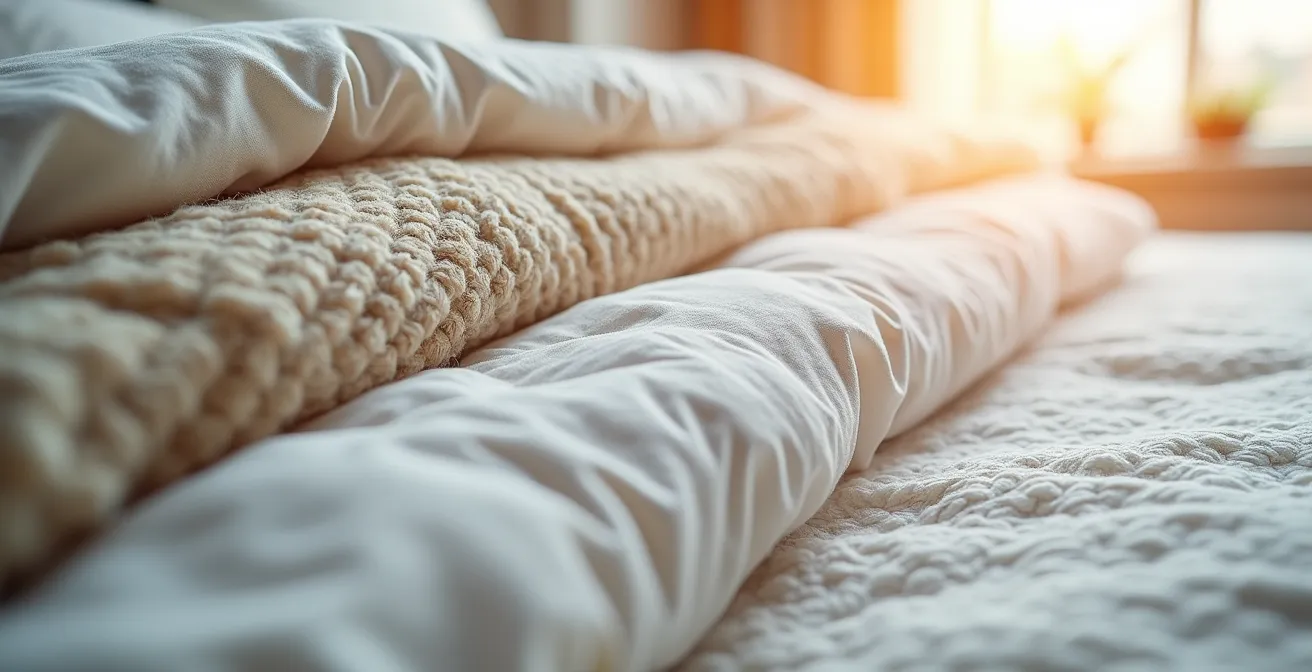
As this image demonstrates, the key is in the layers. Instead of a single, heavy duvet, use multiple, lighter layers of breathable fabrics. Materials like merino wool, Tencel (derived from eucalyptus), and bamboo are superior to synthetic fabrics or even heavy cotton because they excel at wicking moisture away from the skin. This prevents the clammy feeling that occurs when you sweat, which can cause your body to cool down too rapidly and trigger an awakening. A top layer of a light wool comforter can then provide insulation without trapping excessive heat.
This strategy allows you to get the physiological benefits of a cool environment without the psychological discomfort of feeling cold, a crucial distinction in sleep engineering.
Memory Foam vs Latex: Which Sleeps Cooler for Hot Sleepers?
Your mattress is the single largest surface your body interacts with during sleep, making it a critical component of your thermal microclimate. For individuals who “sleep hot,” the wrong mattress material can completely undermine efforts to maintain a cool sleep environment, acting as a giant heat sink that traps body warmth and disrupts sleep cycles. The choice between memory foam and latex is a pivotal one in sleep architecture.
Traditional memory foam, or viscoelastic polyurethane foam, is known for its body-contouring properties. It creates a “cradling” effect by responding to your body heat and pressure. However, this very mechanism is its thermal downfall. The material’s dense, closed-cell structure restricts airflow, trapping the heat it absorbs from your body. While newer generations of memory foam incorporate cooling gels, graphite, or copper infusions to mitigate this, the fundamental physics of the material limit their effectiveness for truly hot sleepers.
Natural latex, on the other hand, offers a fundamentally different thermal profile. Derived from the sap of rubber trees, its molecular makeup is naturally more breathable. More importantly, the manufacturing process for latex mattresses typically involves creating an open-cell structure riddled with perforations or “pinholes.” This design actively promotes airflow, allowing heat and moisture to dissipate away from your body rather than being trapped against your skin. Latex provides support through responsive bounce rather than slow-sinking contouring, which also means less of your body surface is enveloped by the material, further enhancing ventilation.
While memory foam offers excellent pressure relief, if your primary sleep disruptor is heat, the natural cooling properties of a perforated latex mattress will almost always yield a more significant improvement in sleep quality.
The Spectrum Mistake in “Night Mode” Apps That Still Wakes You up
The advice to “avoid blue light” before bed has become ubiquitous, leading to the widespread adoption of “night mode” or “warm shift” features on our devices. While well-intentioned, this advice is an oversimplification that masks a more significant problem: spectral contamination. The issue isn’t just “blue” light; it’s the specific wavelengths that our brains are most sensitive to, and many apps and screen settings fail to eliminate them completely.
Our internal clock is powerfully regulated by specialized neurons in our eyes called intrinsically photosensitive Retinal Ganglion Cells (ipRGCs). These cells are what signal “daytime” to the brain, suppressing the release of the sleep hormone melatonin. As sleep science expert Dr. Andrew Huberman explains, their sensitivity is not uniform across the blue spectrum.
It’s not just ‘blue light’, but the entire spectrum’s effect on the intrinsically photosensitive Retinal Ganglion Cells (ipRGCs) with peak sensitivity at ~480nm in the cyan range
– Dr. Andrew Huberman, Huberman Lab Podcast – Sleep Toolkit
This is the critical mistake: many “night modes” reduce the blue-violet end of the spectrum but leave significant energy in the blue-green or cyan range (~480nm), which is precisely where the ipRGCs are most receptive. Even if a screen appears “warm” or “orange,” it can still be emitting enough of this specific wavelength at a sufficient intensity (lux) to signal your brain that it’s still daytime, delaying or reducing your melatonin production and fragmenting your sleep architecture later in the night.
Action Plan: Complete Home Light Audit Protocol
- Replace all bedroom bulbs with 2200K or lower warm lights. This color temperature inherently has less energy in the disruptive blue-cyan spectrum.
- Install dimmer switches for all overhead and bedside lighting to allow for a gradual reduction of light intensity as the evening progresses.
- Use true blue-blocking glasses that are rated to filter all wavelengths below 550nm after sunset. This is the only guaranteed way to protect yourself from device screens and ambient light.
- Cover or remove all LED indicators on electronics (chargers, TVs, smoke detectors) with black electrical tape. These single points of light can be potent melatonin suppressors.
- On all devices, set the screen to its maximum warm shift setting AND manually reduce the brightness to below 10%. Intensity matters as much as color.
Treating all light after dusk as a potential contaminant is the only way to architect a truly dark environment that allows for a robust and timely melatonin release.
When to Stop Drinking Water to Prevent Night Wakings?
Waking up in the middle of the night to use the bathroom—a condition known as nocturia—is one of the most common and disruptive saboteurs of sleep continuity. The standard advice is simply “don’t drink water before bed,” but this is a crude approach that can lead to dehydration, which itself can impair sleep quality. The architectural solution is not restriction, but strategic scheduling: a hydration protocol that front-loads your water intake to the earlier parts of the day.
Your body’s ability to process fluids and regulate hormones like vasopressin (which concentrates urine during sleep) follows a circadian rhythm. By aligning your hydration with this rhythm, you can ensure you are fully hydrated without overloading your bladder during the night. The key is to consume the majority of your water long before you even start thinking about sleep.

This visual timeline illustrates the principle perfectly. Instead of sipping water consistently until bedtime, you should aim to get the bulk of your hydration done by mid-afternoon. In fact, research suggests consuming 70-80% of daily water intake before 3 PM is an effective strategy to significantly minimize the likelihood of nighttime urination. This gives your kidneys ample time to process the fluid and your body to achieve homeostasis well before you lie down. A small amount of water in the evening is fine if you’re thirsty, but the large-volume rehydration should be complete.
This simple shift in timing can be one of the most impactful changes you make, ensuring your bladder doesn’t become the alarm clock that shatters your deep sleep cycles.
Why 6000K Light in the Bathroom Destroys Your Melatonin Production?
Even if you’ve perfected your bedroom’s darkness, a single, brief trip to the bathroom can completely derail your night’s sleep architecture. The culprit is the bright, cool-toned lighting commonly installed over bathroom vanities. These lights are often chosen for their clarity during the day for tasks like applying makeup, but at night, they are a physiological disaster. Typically, these bulbs have a color temperature of 5000K to 6500K, mimicking bright, midday sun—the exact opposite signal your brain needs at 2 a.m.
The problem is twofold: color and intensity. This 6000K light is heavily concentrated in the blue-cyan spectrum that is most potent at suppressing melatonin. Compounding this, the intensity is far beyond what is necessary for simple navigation. A quick check with a light meter would reveal that bathroom vanity lights can easily expose you to 800-1000 lux or more upon flicking the switch. This is a massive “daylight” signal to your brain, which needs less than 10 lux to navigate a space safely. This sudden, intense exposure can halt melatonin production, making it significantly harder to fall back asleep and disrupting the quality of subsequent sleep cycles.
To architect a sleep-safe bathroom, you must implement a dual-lighting system that separates daytime task lighting from nighttime navigation lighting. This ensures safety without sacrificing your circadian rhythm.
- Primary System: Install a secondary, low-wattage red or very warm amber light bulb (ideally under 2200K) on a completely separate switch.
- Nighttime Protocol: Use only this red light for any and all bathroom visits after you have started your wind-down routine for the evening.
- Strategic Placement: To minimize direct eye exposure, position this secondary light at a low height, such as a plug-in nightlight at knee level, rather than overhead.
- Automation: For a more advanced setup, connect the main bright lights to a smart switch or timer that automatically disables them after a certain hour (e.g., 9 PM).
By neutralizing this common threat, you preserve the carefully constructed darkness of your sleep sanctuary and protect your melatonin from accidental annihilation.
Why Standard Drywall Off-Gassing Affects Your Sleep Quality?
The most insidious threats to your sleep are often the ones you can’t see, hear, or feel. While we focus on light and temperature, the very air you breathe can be a source of chronic, low-grade disruption. Many common building materials, including standard drywall, paints, and new furniture, release Volatile Organic Compounds (VOCs) into your indoor environment. This “off-gassing” can persist for months or even years, and your bedroom, a relatively small and often closed-off space, can become a concentration chamber for these chemicals.
VOCs such as formaldehyde and benzene are systemic irritants. When inhaled during sleep, they can contribute to low-level inflammation, place a burden on your body’s detoxification systems, and subtly activate your nervous system. This constant, low-grade stress can prevent you from reaching the deepest stages of sleep and may contribute to unexplained night wakings or a feeling of being unrested upon waking. While you may not notice a strong smell, your body is still processing these airborne chemicals, diverting resources that should be dedicated to cellular repair and memory consolidation.
Engineering clean air is a non-negotiable part of creating a true sleep sanctuary. It requires a proactive decontamination protocol, especially in new or recently renovated homes. The goal is to minimize exposure and actively purify the air you breathe for eight hours every night. Based on guidelines from agencies like the U.S. Environmental Protection Agency, an effective protocol involves several steps.
- Material Selection: When renovating or furnishing, choose only materials certified as low- or no-VOC, such as those with a Greenguard Gold certification.
- “Bake Out” Procedure: Before occupying a new or renovated room, heat the space to a high temperature (around 30°C / 85°F) for 48-72 hours while ventilating it to the outside at maximum capacity. This accelerates the off-gassing process.
- Active Filtration: Install a high-quality HEPA air purifier that includes a substantial activated carbon filter. The carbon is crucial as it is specifically designed to adsorb and trap VOCs, while the HEPA component handles particulate matter.
- Continuous Ventilation: Maintain a constant flow of fresh air, even in colder months. This can be achieved through trickle vents, opening a window slightly, or using an Energy Recovery Ventilator (ERV) system.
A sleep sanctuary must be pure not just in light and sound, but in the very air that sustains you through the night.
Key Takeaways
- Sleep efficiency is more important than hours in bed; target a minimum of 85% to ensure restorative rest.
- Engineer a thermal microclimate with a cool room (~18°C) and layered, breathable bedding to manage body temperature effectively.
- Light is a potent drug; eliminate spectral contamination by blocking specific cyan wavelengths and minimizing all light intensity after sunset.
- Anchor your circadian rhythm by getting direct sunlight exposure shortly after waking, and use technology (SAD lamps) if natural light is unavailable.
How to Reset Your Internal Clock Using Natural Light Protocols?
The final and perhaps most crucial piece of sleep architecture isn’t about what you do at night; it’s about what you do the moment you wake up. Your circadian rhythm, the master internal clock that governs your sleep-wake cycle, is not a fixed entity. It must be actively and precisely calibrated every single day. The most powerful tool for this calibration is morning light. Exposing your eyes to bright light shortly after waking sends a powerful signal to your brain’s master clock, the suprachiasmatic nucleus, which in turn sets a timer for melatonin release approximately 14-16 hours later.
Failing to get this morning light signal is a common reason why people struggle to feel sleepy at the appropriate time. It leaves the circadian clock “drifting,” without a firm anchor. The protocol for this is specific and non-negotiable, as articulated by experts in the field.
View sunlight within 30-60 minutes of waking for 5-10 minutes on a clear day, 15-20 on an overcast day. This maximizes activation of ipRGCs to properly set your circadian clock.
– Dr. Andrew Huberman, Huberman Lab Newsletter – Toolkit for Sleep
This is not a passive activity. You must go outside; looking through a window is not sufficient as glass filters out a significant portion of the relevant wavelengths. Do not wear sunglasses. The goal is to get photons into your eyes to trigger the ipRGCs we discussed earlier. This morning light exposure also triggers a healthy release of cortisol, which promotes alertness and focus during the day and helps ensure a robust drop-off in the evening, further facilitating sleep.
For those in climates where morning sunlight is unreliable, technology can replicate this signal. A “SAD” (Seasonal Affective Disorder) lamp can be used to simulate the sun’s intensity. According to clinical studies, 10,000 lux light therapy for 20-30 minutes upon waking can effectively replicate the circadian-anchoring effects of natural morning sunlight. Place the lamp at a 45-degree angle to your face, about 16-24 inches away, while you have your coffee or read.
This daily act of circadian anchoring is the defining habit of a true sleep architect, ensuring that all your nighttime environmental engineering has a robust, well-timed biological rhythm to work with.