In summary:
- Precision agriculture for small farms is a mindset focused on data-driven decisions, not just expensive equipment.
- Affordable tools like soil sensors and consumer drones provide actionable data to surgically manage water and spot problems early.
- Correct data analysis is crucial; focusing on trends over single readings prevents costly mistakes like over-fertilization.
- Securing your farm’s IoT network is as important as locking your barn door to prevent digital sabotage.
- Leveraging technology for transparency (e.g., QR codes on products) builds powerful brand loyalty with consumers.
For the smallholder and neo-farmer, the dream of independence is often challenged by the realities of volatile weather, fluctuating input costs, and the constant pressure to produce more with less. Many look towards technology for answers, hearing buzzwords like ‘smart farming’ and ‘precision agriculture’. The common advice often involves a daunting shopping list of high-tech gadgets, suggesting that the path to higher yields is paved with expensive equipment. This can feel overwhelming and disconnected from the core values of small-scale, sustainable farming.
But what if the true power of precision agriculture wasn’t in the tools themselves, but in the thinking they enable? What if the revolution on your small plot comes not from industrial-scale technology, but from adopting a scientific, data-driven decision-making framework? The key is to move from reacting to problems to proactively managing your farm’s ecosystem with surgical precision. This approach transforms technology from a cost center into a powerful ally for achieving genuine resource sovereignty.
This guide demystifies precision agriculture for the small-scale operator. We will explore how to leverage accessible technology to make smarter decisions, boost organic yield, and build a more resilient and independent farm. We’ll move from the foundational data beneath your feet to the bird’s-eye view from above, covering the critical choices, common pitfalls, and market opportunities this new mindset unlocks.
This article provides a structured roadmap for integrating a precision mindset into your operations. Below, the summary outlines the key levers you can pull, from ground-level sensors to building a transparent, tech-enabled brand that resonates with today’s consumers.
Summary: The Small-Scale Farmer’s Guide to Precision Yield
- Why soil sensors pay for themselves in one harvest season?
- How to use consumer drones to spot irrigation leaks from the air?
- Hydroponics vs Traditional Soil: which is more resilient to climate shifts?
- The data analysis mistake that leads to over-fertilization
- When to harvest based on predictive weather models vs the almanac?
- The security gap in IoT devices that hackers exploit in 5 minutes
- How to build brand loyalty through genuine sustainability practices?
- Whole Foods vs Fortified Products: where to get your iron?
Why soil sensors pay for themselves in one harvest season?
The single most impactful step into precision agriculture begins right under your feet. Soil sensors are the nervous system of a smart farm, providing direct, real-time feedback on the one resource you can’t afford to mismanage: water. For a small farm, where every drop and every dollar counts, moving from a fixed watering schedule to data-driven irrigation is not just an optimization—it’s a game-changer for profitability and resilience. The concept is simple: you water only when and where the soil actually needs it, based on direct moisture readings.
The return on investment (ROI) is remarkably fast. By eliminating guesswork, you drastically reduce both water consumption and the energy costs associated with pumping. More importantly, you create the perfect growing environment. Plants are never over-watered (which can lead to root rot and fungal diseases) or under-watered (which causes stress and reduces yield). This consistent, optimal moisture level leads to healthier plants and significantly higher output. In fact, on-farm monitoring data consistently shows that this targeted approach can lead to a 25% yield increase and 45% water savings. For a small-scale operation, that level of improvement can easily cover the initial cost of the sensors in a single season.
Case Study: Irrigation Optimization on a Danish Organic Farm
Godis Grønt, an organic vegetable farm in Denmark, provides a clear example of this principle in action. By deploying a simple network of soil sensors in their fields and greenhouses, the farmer was able to move from a reactive to a proactive irrigation strategy. Receiving notifications directly on their phone, they could make precise adjustments remotely, ensuring crops received the exact amount of water needed. This not only saved time and resources but also improved crop consistency, demonstrating the accessibility and immediate impact of sensor technology on a small, organic scale.
To integrate this effectively, it’s not about drowning in data but about establishing a simple, repeatable workflow. A weekly rhythm of checking baseline moisture, cross-referencing with weather forecasts, and making informed decisions creates a powerful feedback loop. You start building a deep, data-backed understanding of your specific fields that no almanac can provide.
How to use consumer drones to spot irrigation leaks from the air?
While soil sensors give you a precise understanding of what’s happening underground, a consumer-grade drone offers an invaluable perspective from above. For a small farmer, a drone is not a toy; it’s a multi-purpose scouting tool that can save thousands of gallons of water and hours of manual labor. One of its most effective uses is the early detection of irrigation leaks, blockages, or inefficiencies. Walking every line of a drip system on a multi-acre plot is time-consuming and often ineffective. A five-minute drone flight can do the job with far greater accuracy.
The most effective method is to fly the drone at dawn. The low-angle sunlight reflects off wet surfaces, making pools of water, damp patches from slow leaks, or unusually dry zones instantly visible against the darker soil. This visual contrast provides an immediate, actionable map of your irrigation system’s health. You can spot a cracked emitter or a clogged filter from 100 feet in the air, a problem that might go unnoticed for weeks at ground level, wasting water and stressing crops.
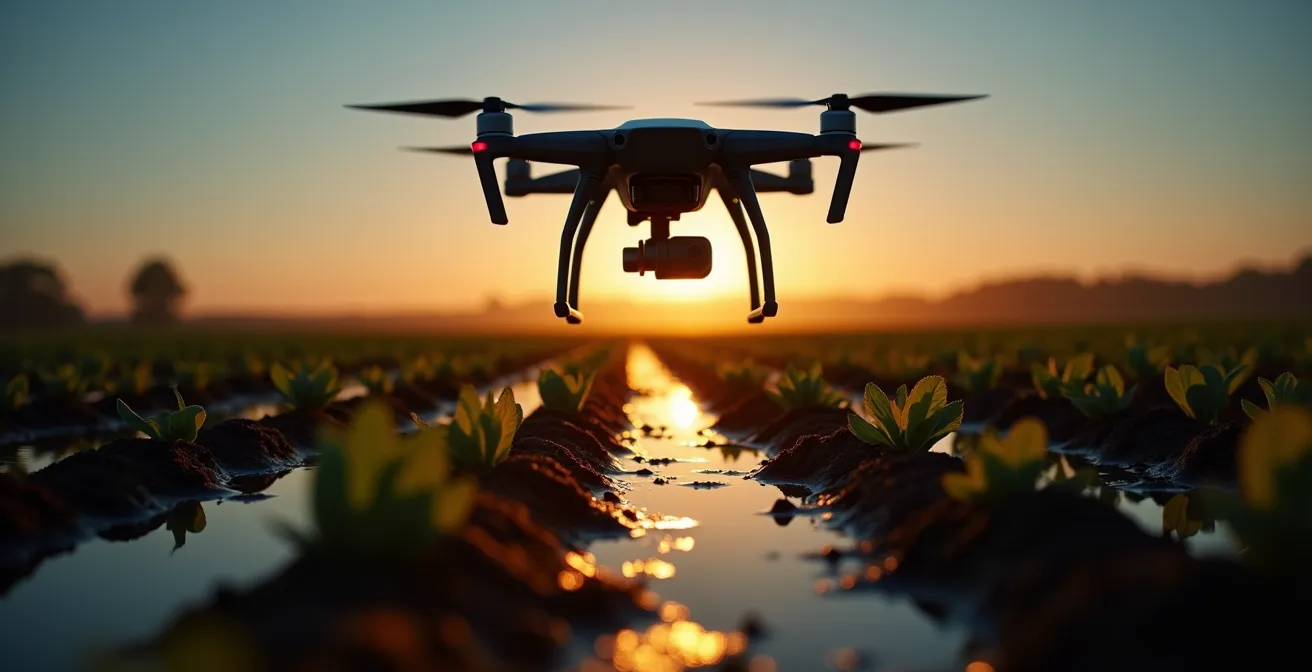
As this image illustrates, the unique perspective from a drone transforms the entire field into a single, analyzable dashboard. While more expensive thermal cameras can detect water temperature differences at any time of day, a standard RGB camera on a sub-$1000 drone is more than sufficient for most small-scale operations when used during these optimal light conditions. The use of AI-powered digital scouting tools can further enhance this, with market research showing that the first-year ROI was three times higher when using these tools compared to traditional scouting efforts alone.
Choosing the right method depends on your budget and specific needs, but even the most basic setup provides a massive leap in efficiency.
| Method | Equipment Cost | Best Time | Effectiveness |
|---|---|---|---|
| Standard RGB Camera | $500-1,500 | Dawn (low-angle light) | 85% detection rate |
| Thermal Camera | $3,000-10,000 | Any time | 95% detection rate |
| NDVI Analysis | $500 + free software | Midday | 80% for stress patterns |
This bird’s-eye view is a cornerstone of a precision mindset, enabling you to manage your entire plot with an efficiency that was previously impossible without a large labor force.
Hydroponics vs Traditional Soil: which is more resilient to climate shifts?
As climate patterns become more unpredictable, building resilience is a primary goal for any small farm. This raises a fundamental strategic question: is it better to double down on improving traditional soil-based systems or to shift towards a controlled environment like hydroponics? There is no single right answer; the choice depends on your farm’s specific goals, resources, and definition of “resilience.” Each system has a distinct profile of strengths and vulnerabilities.
Hydroponics offers near-total control over the growing environment. By delivering a nutrient-rich water solution directly to the plant roots in a closed-loop system, it’s possible to grow crops year-round, shielded from droughts, floods, and unseasonal frosts. This method is incredibly water-efficient, often using up to 90% less water than traditional soil farming. However, this control comes at the cost of high dependency. Hydroponic systems are entirely reliant on a constant supply of electricity to run pumps and lights, and their nutrients are typically manufactured products sourced from a complex supply chain. A power outage or a supply chain disruption can be catastrophic.
Traditional soil farming, on the other hand, boasts a higher degree of self-sufficiency and natural buffering. A healthy, organic soil ecosystem has a remarkable ability to retain moisture, regulate temperature, and provide nutrients through natural processes like composting. It has low power dependency and can often be sustained with on-site or local inputs, reducing supply chain risk. Its weakness, however, is its direct exposure to the elements. Extreme weather events like prolonged drought, hailstorms, or heatwaves can wipe out a crop, even in the best-managed soils.
The choice is a trade-off between control and independence. The table below outlines these key resilience factors, highlighting that the most resilient system might be a hybrid one, using soil for staple crops and a small hydroponic setup for high-value, sensitive greens.
| Factor | Hydroponics | Traditional Soil |
|---|---|---|
| Power Dependency | High – requires constant electricity | Low – natural processes |
| Input Self-Sufficiency | Low – relies on manufactured nutrients | High – can use on-site compost |
| Climate Control | High – controlled environment | Moderate – natural buffering |
| Water Efficiency | 90% less water use | Standard irrigation needs |
| Supply Chain Risk | High – specialized inputs | Low – local amendments possible |
The data analysis mistake that leads to over-fertilization
Collecting data with soil sensors and drones is only the first step. The real value—or danger—lies in how you interpret it. The single most common and costly mistake in precision agriculture is reacting to a single data point instead of analyzing a trend. A sensor might show low nitrogen on a Tuesday, prompting an immediate application of fertilizer. However, this reading could be an anomaly caused by a recent heavy watering or a temporary change in soil temperature. The real trend, observed over a week, might show that nutrient levels are perfectly stable.
This reactive, knee-jerk decision-making leads directly to over-fertilization. Not only does this waste expensive inputs, but it can also harm your crops, damage the soil’s microbial life, and contribute to environmental runoff. A precision mindset requires a shift from reaction to reflection. The goal is to understand the “why” behind the data before taking action. For instance, if nutrient levels appear low, the first step isn’t to add more; it’s to test the soil pH. The nutrients may be present in the soil but “locked up” and unavailable to the plants due to incorrect pH. Adding more fertilizer in this case is like pouring gasoline into a car with a dead battery—it doesn’t address the root problem.
Adopting a disciplined analytical approach is proven to optimize input usage. A 2021 study confirmed that simply using precision technologies correctly can result in a 7% reduction in fertilizer use, a significant saving for a small operation. The key is to build a decision-making framework that prioritizes verification and trend analysis over impulsive action. This deliberate process is the heart of true precision management.
To avoid these common pitfalls, a simple audit checklist can guide your interventions, ensuring every action is justified by solid data and observation over time. It transforms data from a potential source of error into your most reliable farm management tool.
Your Action Plan: Avoiding Data Interpretation Errors
- Establish a Baseline: Always maintain a small, untreated “control plot” to provide a baseline for comparison against your treated areas.
- Analyze Trends, Not Points: Focus on multi-day or weekly data trends to make proactive decisions, avoiding reactions to single, potentially anomalous readings.
- Verify Before Acting: Use sensors for early detection, but always follow up with visual inspection or a secondary test (like a pH test) before making a major intervention.
- Test for Root Cause: Before adding a nutrient, test for underlying issues. For example, check soil pH to ensure existing nutrients aren’t simply locked and unavailable to plants.
- Document Everything: Keep a log of all sensor readings, interventions, and observed outcomes to identify patterns and build a powerful, farm-specific knowledge base season over season.
When to harvest based on predictive weather models vs the almanac?
For generations, farmers have relied on experience, observation, and the trusted farmer’s almanac to decide the optimal time to harvest. This traditional knowledge is invaluable, built on a deep, intuitive connection to the land. However, as climate change makes historical patterns less reliable, augmenting this wisdom with modern, data-driven tools is becoming essential for securing the value of a crop. The decision of when to harvest is a high-stakes balancing act between ripeness, yield, and the imminent threat of damaging weather.
Predictive weather models, now accessible via smartphone apps and farm management software, offer a level of short-term accuracy that traditional methods cannot match. They don’t just predict rain; they provide detailed forecasts on temperature fluctuations, wind speeds, humidity levels, and the probability of hail. This data allows a farmer to make a surgical decision. For example, if your tomatoes are reaching peak ripeness but a major storm system with high winds is forecast in 48 hours, you can make the calculated choice to harvest slightly early, protecting 100% of a marketable crop from damage rather than risking a 50% loss for two more days of ripening.
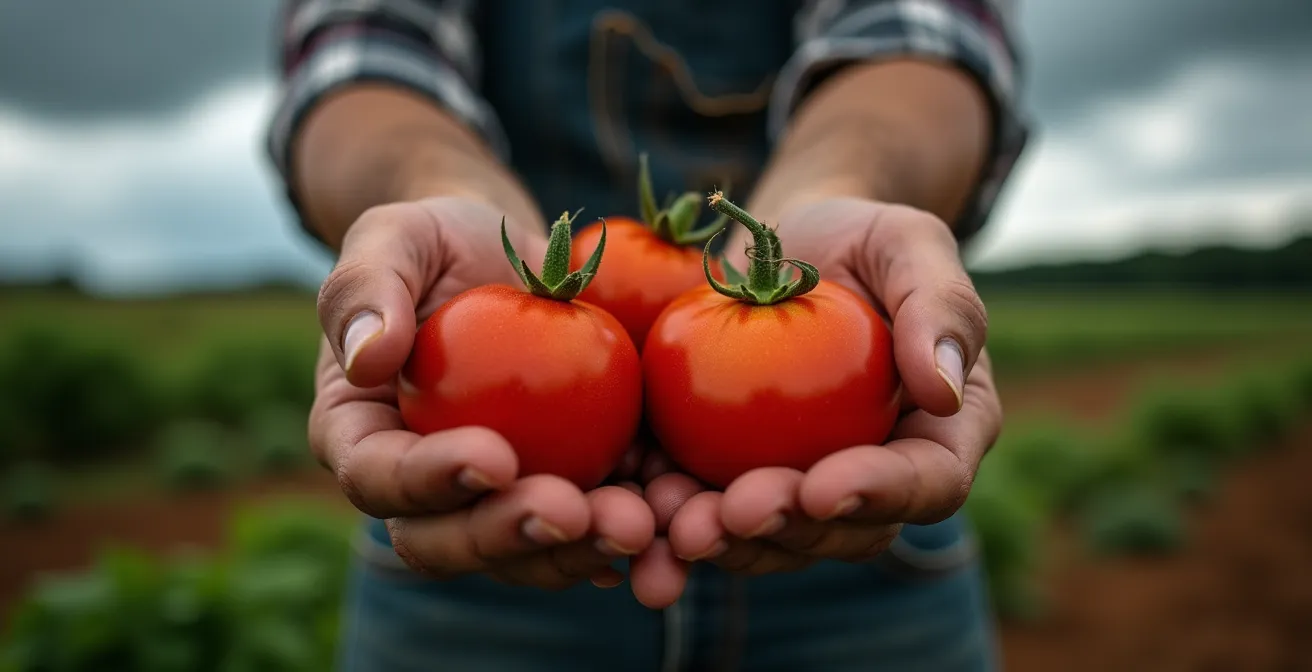
This image captures that critical moment of decision, where human experience meets hard data. The goal is not to replace the farmer’s intuition but to enhance it. The almanac is excellent for long-term planning—understanding the general arc of a season. Predictive models are for tactical execution—making the best possible decision in the 24-72 hour window before harvest. A precision mindset involves integrating both: using traditional knowledge to get the crop to 95% readiness and using predictive data to nail the final 5% of the timing perfectly, safeguarding your hard work against nature’s increasing unpredictability.
Ultimately, this approach is about risk mitigation. It empowers the small farmer to protect their revenue and ensure that the quality and yield they worked all season to achieve make it safely from the field to the market.
The security gap in IoT devices that hackers exploit in 5 minutes
As you connect your farm with an array of smart sensors, automated irrigators, and drones, you are also creating a new, invisible attack surface. The Internet of Things (IoT) devices that power precision agriculture are notoriously insecure out of the box. Many are shipped with default, easily guessable passwords (like “admin” or “1234”), and their software is rarely updated. For a hacker, this is an open door. In less than five minutes, a malicious actor can scan for unprotected farm devices on the internet and take control of them.
The consequences are not just digital; they are physical and can be devastating. A hacker could shut down your irrigation system during a heatwave, killing your crops. They could manipulate sensor data to trigger massive over-fertilization, poisoning your soil. They could even use a drone to scout your property for valuable equipment to steal. For a small farm, whose entire operation might be run by a handful of connected devices, this represents an existential threat. Securing your “FarmNet” is as fundamental as locking the barn door at night.
As experts in the field note, the benefits of connectivity are immense, but they hinge entirely on proper implementation and security hygiene. The convenience of automation cannot come at the cost of crippling vulnerability.
Combining precision farming techniques with powerful data analytics enables optimization of inputs, waste reduction, and higher yields, but proper sensor network deployment is essential to reduce water consumption, automate operations, and satisfy sustainability mandates.
– Digital Matter Research Team, Agriculture IoT Deployment Guide
Fortunately, basic digital security is not complicated. It involves a few straightforward, non-negotiable steps: creating a separate Wi-Fi network for farm devices, changing every default password, and keeping firmware updated. Thinking of your digital infrastructure with the same seriousness as your physical infrastructure is a crucial part of the modern farming mindset.
- Create a ‘FarmNet’: Use a dedicated router and Wi-Fi network exclusively for your agricultural IoT devices, isolating them from your home or business network.
- Change Default Passwords: This is the most critical step. Immediately change the factory-set administrator username and password on every new device.
- Enable WPA3 Encryption: Use the strongest available encryption standard on your Wi-Fi network.
- Update Firmware Regularly: Set a calendar reminder to check for and install firmware updates and security patches for all your connected devices.
- Limit Cloud Dependency: Where possible, choose devices that can store and process data locally to reduce exposure to internet-based threats.
How to build brand loyalty through genuine sustainability practices?
In a crowded marketplace, the story behind your food is as important as the food itself. Consumers are increasingly willing to pay a premium for products they trust, from farmers who demonstrate a genuine commitment to sustainability. Precision agriculture provides a powerful toolkit not just for growing more efficiently, but for proving it. The data you collect for operational purposes—water saved, fertilizer reduced, fuel consumption minimized—is also a treasure trove of marketing content.
The key is radical transparency. Instead of just saying you’re sustainable, you can show it with hard numbers. This is where technology builds an unbreakable bond with your customers. A simple QR code on your tomato packaging can link to a webpage showing the exact block where it was grown, the date it was harvested, and a chart showing that it was grown using 40% less water than the industry average, thanks to your soil sensor data. This transforms a commodity product into a unique item with a verifiable, compelling story.
Case Study: QR Code and Blockchain for Product Traceability
An emerging trend involves using blockchain technology to create an immutable record of a product’s journey from seed to sale. By scanning a QR code, consumers can access this trusted ledger, verifying the produce’s origin, the specific sustainable practices used during its growth, and its entire shipment journey. This level of transparency builds profound consumer trust that no traditional marketing slogan can match, justifying a premium price and fostering intense brand loyalty.
This data-backed narrative changes the conversation. You are no longer just selling vegetables; you are selling a verifiable commitment to environmental stewardship. You can create a public “sustainability dashboard” on your website, share monthly reports on social media detailing measurable improvements, or even host “Farm Tech Days” for your community to see the sensors and drones in action. This open-book approach makes your customers feel like partners in your mission. They are not just buying food; they are investing in a better, more intelligent way of farming, and they will reward that with their unwavering loyalty.
The list of potential actions is long, but all center on one principle: using data to make your sustainable practices tangible and trustworthy for the end consumer.
Key Takeaways
- Precision farming is a mindset of surgical, data-driven decision-making, accessible to small-scale farms.
- Affordable tools like soil sensors and consumer drones offer immediate ROI by optimizing water and input usage.
- The biggest risk is misinterpreting data; focus on trends and root causes, not reactive, single-point fixes.
Whole Foods vs Fortified Products: where to get your iron?
The conversation around nutrition often circles a debate between consuming whole foods and relying on products fortified with specific nutrients like iron. For the small-scale farmer, precision agriculture offers a powerful third way: to cultivate whole foods that are so naturally nutrient-dense they render the debate moot. The ultimate goal of a precision mindset is not just to increase yield quantity, but to elevate its quality. By meticulously managing the soil, you can directly influence the nutritional profile of the food you grow.
This is where soil monitoring technology closes the loop. Ground-based sensors don’t just measure moisture; they can track pH levels and the availability of key micronutrients in the soil. This data allows for variable rate treatments, where a specific nutrient deficiency in one corner of a field can be corrected with a surgical application, without affecting the rest of the plot. By ensuring the plant has exactly what it needs throughout its growth cycle, you enable it to express its full genetic potential—not just in size, but in nutritional content.
The Link Between Soil Monitoring and Nutrient Density
By using embedded soil sensors to record pH and plant nutrient data, farmers can move away from blanket applications of fertilizer. This allows for targeted treatments that improve soil health and optimize nutrient uptake by the plants. The result is a dual benefit: resource conservation and improved environmental protection from runoff, leading directly to better farming yields and, critically, higher quality produce with enhanced nutrient density.
This capability is a revolutionary advantage for the small farmer. You are no longer just a producer of calories, but a cultivator of nutrition. This creates a powerful value proposition that mass-produced, industrially farmed produce cannot compete with. Your farm becomes the direct, trusted source for superior, naturally-rich foods. This is particularly relevant given that while over 85 percent of U.S. farms are small, very few have adopted these techniques, representing a massive opportunity for differentiation and leadership in local food systems.
Begin your journey into precision agriculture by focusing on the highest-impact, lowest-cost tool: start by analyzing your soil and water management. This is the foundation upon which all other efficiencies are built.